GS 2: GovernanceGS 3: EconomyPrelimsGS 3: Effects of Liberalization on the EconomyGS 3: Government Budgeting
Taxes, Policy Uncertainty And Lost Investor Confidence, Pg6
Unpredictable tax policies and regulatory uncertainty erode global investor confidence, causing India's equity markets to underperform significantly.
Practice MCQs
739 Students attempted
Key Highlights:
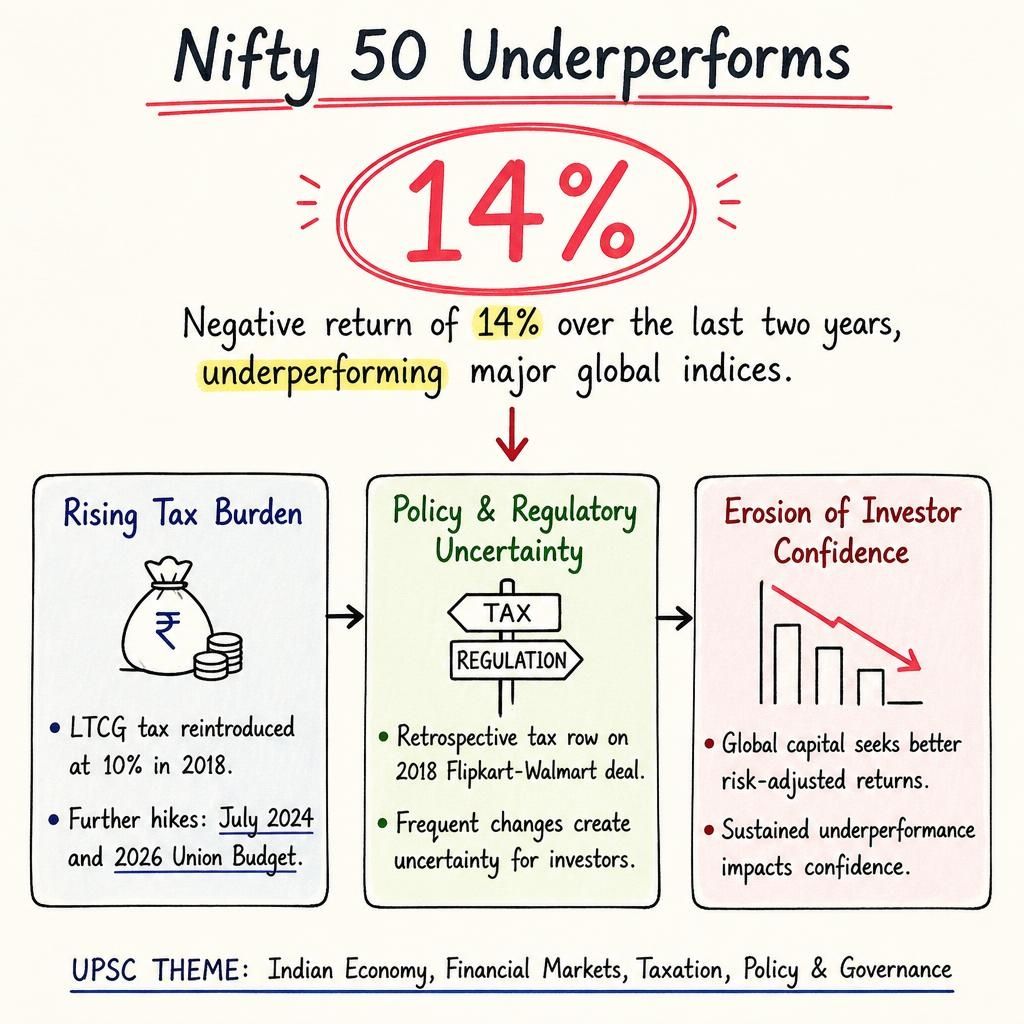
- India's Nifty 50 index showed a negative return of 14% over the last two years, underperforming major global indices.
- This underperformance is attributed to increased taxation, regulatory uncertainty, and inconsistent policy signals for investors.
- The Finance Act of 2004 introduced Securities Transaction Tax (STT) and exempted long-term capital gains (LTCG) on listed equities.
- In 2018, LTCG tax was reintroduced at 10% while STT was retained, increasing the tax burden.
- Further tax hikes occurred in July 2024 (LTCG to 12.5%, STCG to 20%) and the 2026 Union Budget (increased STT on futures and options).
- The retrospective tax controversy related to the 2018 Flipkart-Walmart deal also eroded investor confidence.
Nifty 50.jpg
Detailed Insights:
- The article highlights that predictability and consistency in the investment environment are crucial for attracting global capital.
- The original rationale for STT was to simplify tax collection and incentivize formal equity market participation by exempting LTCG.
- The simultaneous imposition of capital gains tax and STT raises concerns about the cumulative tax burden on equity market participants.
- Frequent changes in tax and regulatory frameworks create uncertainty, making investors hesitant to commit long-term capital.
- India, as a capital-deficit economy, competes globally for investment based on ecosystems, technology, and policy environments, not just its market size.
- Global capital is mobile and seeks markets offering better risk-adjusted returns, stable regulations, and transparent decision-making.
- Sustained market underperformance can eventually impact domestic investor confidence, despite ongoing inflows through Systematic Investment Plans.
Key Concepts Involved:
- Capital Gains Tax: A tax levied on the profit realized from the sale of a non-inventory asset.
- Securities Transaction Tax (STT): A direct tax levied on every transaction of purchase or sale of securities listed on Indian stock exchanges.
- Retrospective Taxation: A tax imposed on income, profits, or transactions that occurred in the past, often before the law was enacted.
- Investor Confidence: The degree of optimism or pessimism that investors feel about the future of the economy and financial markets.

SuperKalam is your personal mentor for UPSC preparation, guiding you at every step of the exam journey.
Download the App


STUDY RESOURCES
CONTACT US
ⓒ Snapstack Technologies Private Limited