GS 2: International RelationsGS 3: EconomyPrelimsGS 2: Bilateral, Regional and Global Groupings and AgreementsGS 2: Effect of Policies and Politics of Developed and Developing Countries on India's Interests
Summits in Asia frame India's stakes, challenges, Pg10
PM Modi attends crucial Asian summits amidst regional flux, navigating China's assertiveness and shifting global alliances for India's strategic interests.
Practice MCQs
739 Students attempted
Key Highlights:
- Prime Minister Narendra Modi is attending the ASEAN-India Summit and East Asia Summit in Manila.
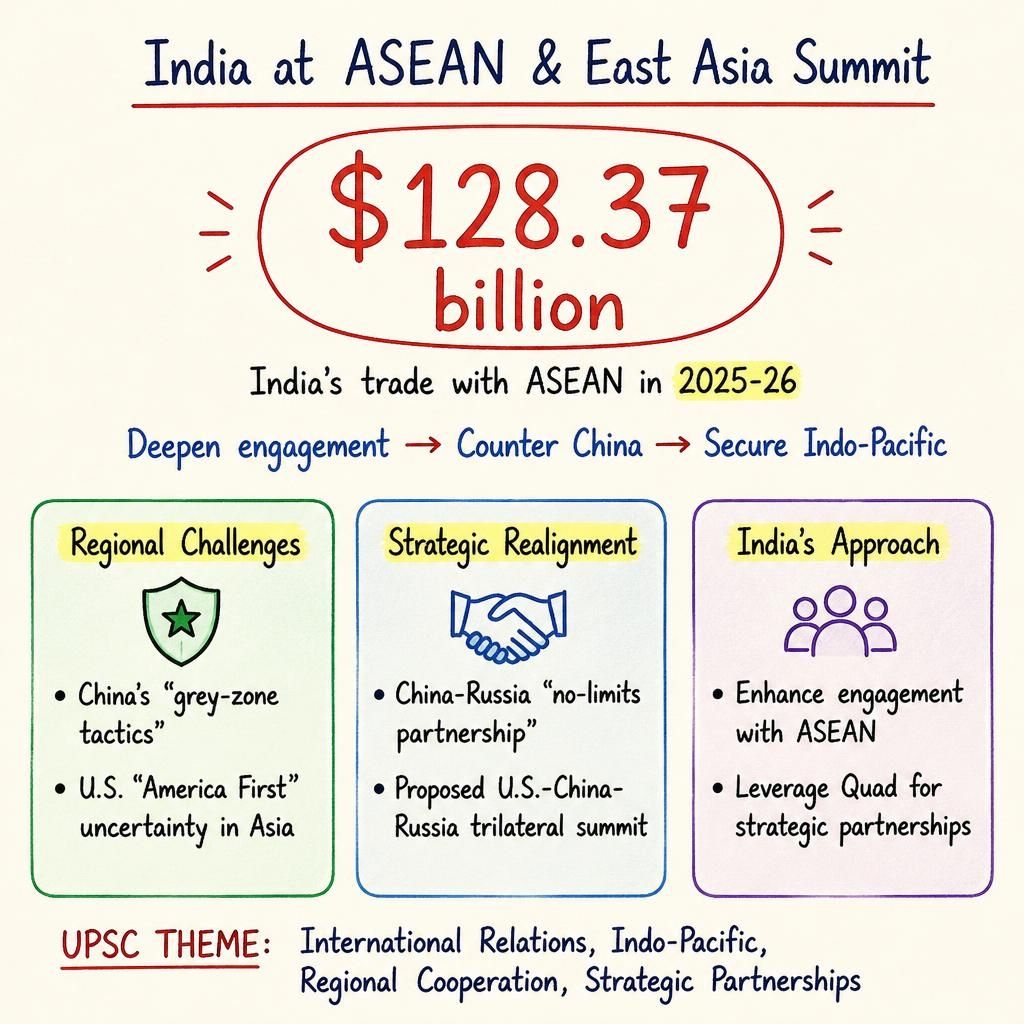
- These summits address regional flux, including China's assertive tactics and shifts in U.S. security guarantees.
- A deepening "no-limits partnership" between China and Russia, alongside a potential U.S.-China-Russia trilateral summit, reshapes geopolitical dynamics.
- India aims for a "peaceful, prosperous and resilient Indo-Pacific" amidst these challenges.
- India seeks to enhance engagement with ASEAN for economic and security benefits, and leverage the Quad for strategic partnerships.
ASEAN Summit.jpg
Detailed Insights:
- The ASEAN-India Summit and East Asia Summit are crucial platforms for India to engage with nations in a rapidly changing Asian landscape.
- China's military and economic coercion, coupled with its "grey-zone tactics," pose significant regional challenges.
- The U.S. "America First" doctrine and its military focus on Eastern Europe and West Asia have led to uncertainty regarding traditional U.S. security commitments in Asia.
- The growing alignment between China and Russia, termed a "no-limits partnership," introduces a new dimension to global power dynamics.
- A proposed trilateral summit involving the U.S., China, and Russia further complicates the geopolitical environment for India.
- India's trade with ASEAN reached $128.37 billion in 2025-26, which is modest compared to ASEAN-China trade exceeding $1 trillion.
- Deeper engagement with ASEAN is vital for India to counter China's influence, bolster maritime security, and diversify global supply chains.
- The Quad grouping, comprising India, the U.S., Japan, and Australia, continues ministerial consultations and cooperation on maritime, technological, climate, and cybersecurity issues.
- The Quad provides India a crucial platform to strengthen ties with the U.S., Japan, and Australia, who share concerns about China's expansionism.
- India's diplomatic objective is to foster a stable regional order and strengthen national capabilities to navigate great-power rivalries.
Key Concepts Involved:
- ASEAN-India Summit: An annual meeting between leaders of India and the Association of Southeast Asian Nations to discuss cooperation.
- East Asia Summit: A forum for leaders from 18 countries in the East Asian region to discuss political, security, and economic issues.
- Quad: An informal strategic dialogue between Australia, India, Japan, and the United States, focused on a free and open Indo-Pacific.
- Indo-Pacific: A geopolitical concept emphasizing the interconnectedness of the Indian and Pacific Oceans, central to global trade and security.

SuperKalam is your personal mentor for UPSC preparation, guiding you at every step of the exam journey.
Download the App


STUDY RESOURCES
CONTACT US
ⓒ Snapstack Technologies Private Limited