GS 2: GovernanceGS 3: EconomyPrelimsGS 3: Indian Economy, Planning, Mobilization of Resources, Growth, Development and EmploymentGS 3: Public Distribution System
Ripples from future, Pg6
Nobel-winning economic research by Hall and Woodford offers crucial insights for Indian policymakers on consumption, pricing, and effective communication, vital for fiscal management and policy clarity.
Practice MCQs
731 Students attempted
Key Highlights:
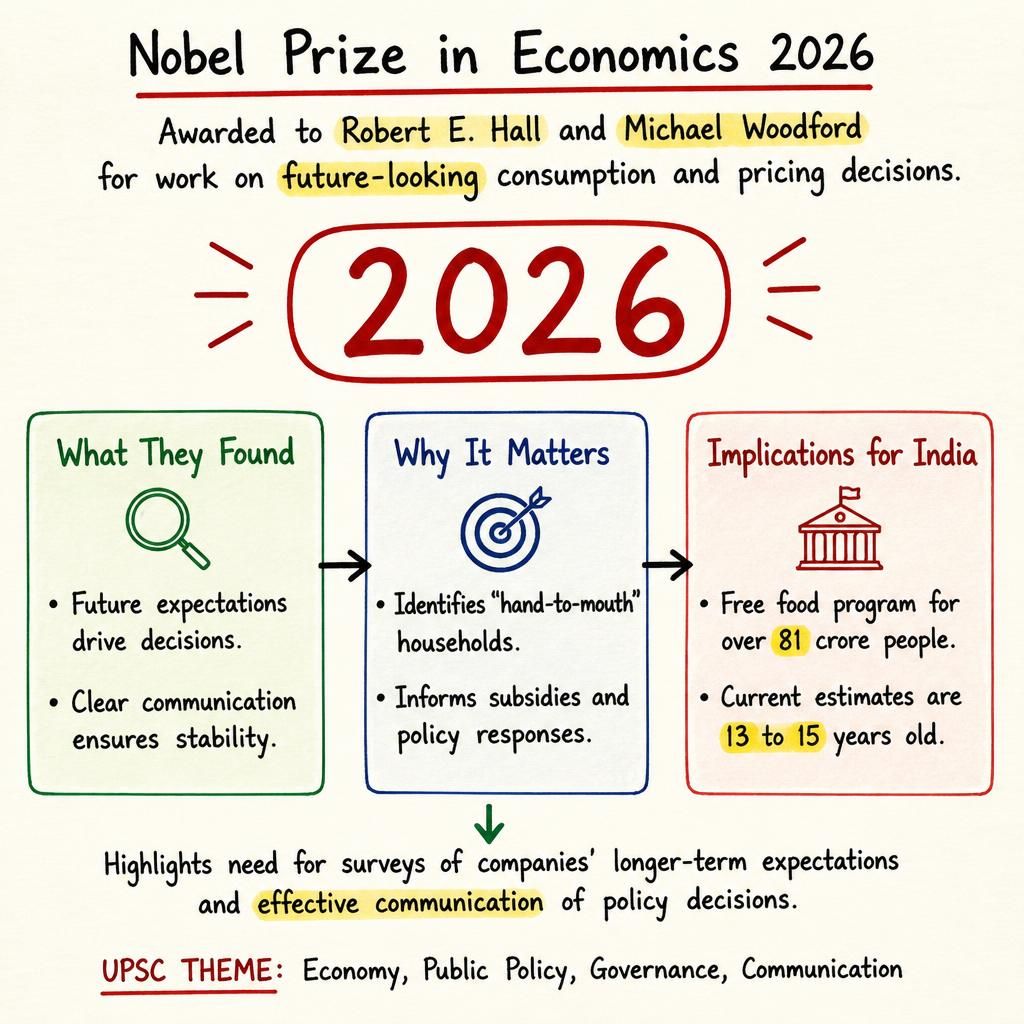
- The Nobel Prize in Economics for 2026 was awarded to Robert E. Hall and Michael Woodford for their work on future-looking consumption and pricing decisions.
- Their research quantifies how households and companies make decisions based on future expectations, providing empirical rigor to economic models.
- Hall's work specifically helps identify the proportion of "hand-to-mouth" households, crucial for targeting subsidies effectively.
- Woodford's research highlights the significance of companies' future expectations in setting current prices.
- The laureates' findings emphasize the importance of clear policy communication for economic stability and effective responses to supply shocks.
Nobel Prize in Economics.jpg
Detailed Insights:
- The research by Hall and Woodford offers a framework for policymakers to identify economically distressed segments of the population, enabling more effective policy implementation during economic disruptions.
- In India, this work is particularly relevant for streamlining subsidy expenditure, as the current free food program for over 81 crore people relies on estimates that are 13 to 15 years old.
- Woodford's insights suggest a need for government surveys to gauge companies' longer-term expectations, complementing existing measures like the Purchasing Managers' Index.
- A critical aspect of their work underscores that effective communication of policy decisions is vital for households and companies to make secure economic choices.
- The article points to past instances in India, such as the Farm Laws, Labour Codes, and Citizenship (Amendment) Act, where a lack of effective government communication led to public uncertainty.
- The laureates' framework also illustrates how global events, like the war in West Asia, can create economic uncertainty that impacts present-day decisions.
Key Concepts Involved:
- Hand-to-mouth households: Households that spend nearly all their income, possessing minimal savings, making them highly vulnerable to economic shocks.
- Fiscal room: The capacity of a government to increase spending or reduce taxes without compromising its financial stability.
- Purchasing Managers' Index (PMI): A monthly economic indicator derived from surveys of private sector companies, reflecting current and future business conditions.
- Stabilisation policy: Government actions, either fiscal or monetary, designed to moderate economic fluctuations such as recessions or inflation.

SuperKalam is your personal mentor for UPSC preparation, guiding you at every step of the exam journey.
Download the App


STUDY RESOURCES
CONTACT US
ⓒ Snapstack Technologies Private Limited