GS 2: International RelationsPrelimsGS 2: Bilateral, Regional and Global Groupings and AgreementsGS 2: India and its Neighbourhood Relations
The 1991 Treaty Violated By Pak Ship That Collided With Indian Vessel, Pg4
India summons Pakistan's Charge d'Affaires after a Pakistani ship collided with an Indian Navy vessel, violating the 1991 bilateral agreement on naval conduct.
Practice MCQs
724 Students attempted
Key Highlights:
- India summoned Pakistan’s Charge d’Affaires following a collision between a Pakistani ship and an Indian Navy vessel in international waters.
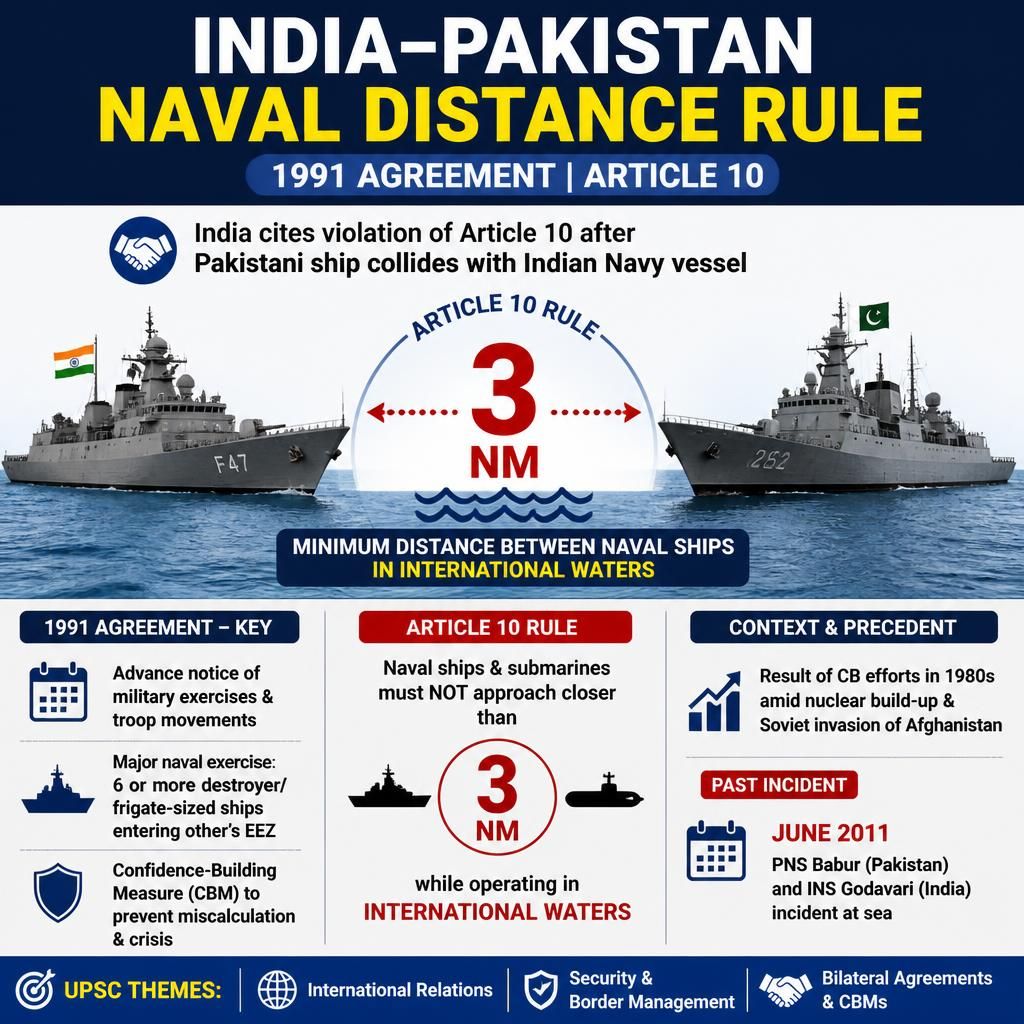
- India stated that the Pakistani vessel's conduct was in direct contravention of Article 10 of the 1991 Agreement between India and Pakistan on Advance Notice on Military Exercises, Manoeuvres and Troops Movements.
- Article 10 of the agreement stipulates that naval ships and submarines of both countries must not approach closer than three Nautical Miles (NMs) to each other while operating in international waters.
- A similar incident occurred in June 2011, involving the Pakistani naval warship PNS Babur and the Indian Navy frigate INS Godavari.
Naval Agreement.jpg
Detailed Insights:
- The 1991 Agreement serves as a Confidence-Building Measure (CBM) designed to prevent crisis situations arising from misinterpretation of military intentions.
- It mandates that both nations provide advance notice regarding major military exercises and troop movements near their borders.
- For naval forces, a major exercise is defined as involving six or more destroyer/frigate-sized ships exercising in company and crossing into the other's Exclusive Economic Zone (EEZ).
- The agreement was a culmination of confidence-building efforts in the 1980s, influenced by the heightened nuclear activity and the Soviet invasion of Afghanistan.
- A significant precursor was the Brass Tacks IV military exercise conducted by India in 1987, which had raised concerns in Pakistan.
- Other related agreements include the 1983 Agreement for the establishment of a joint commission and the 1988 Agreement on the prohibition of attack against nuclear installations and facilities.
- Concurrently, on April 6, 1991, the Agreement between India and Pakistan on prevention of air space violations was also signed.
Key Concepts Involved:
- Charge d’Affaires: A diplomatic representative who heads a diplomatic mission in the absence of an ambassador or when ambassador-level relations are not maintained.
- Exclusive Economic Zone (EEZ): A maritime area extending up to 200 nautical miles from a coastal state's baseline, where it has sovereign rights over natural resources.
- Confidence-Building Measures (CBMs): Actions or agreements between states aimed at reducing mistrust, enhancing transparency, and lowering the risk of armed conflict.
- Nautical Mile (NM): A unit of distance primarily used in marine and air navigation, defined as exactly 1,852 meters.

SuperKalam is your personal mentor for UPSC preparation, guiding you at every step of the exam journey.
Download the App


STUDY RESOURCES
CONTACT US
ⓒ Snapstack Technologies Private Limited