GS 3: Science & TechnologyGS 3: Environment & EcologyGS 3: EconomyPrelimsGS 3: E Technology in Aid of Farmers
Rs 2.5 cr as carbon credits: In a first, farmers reap harvest of good practices, Pg22
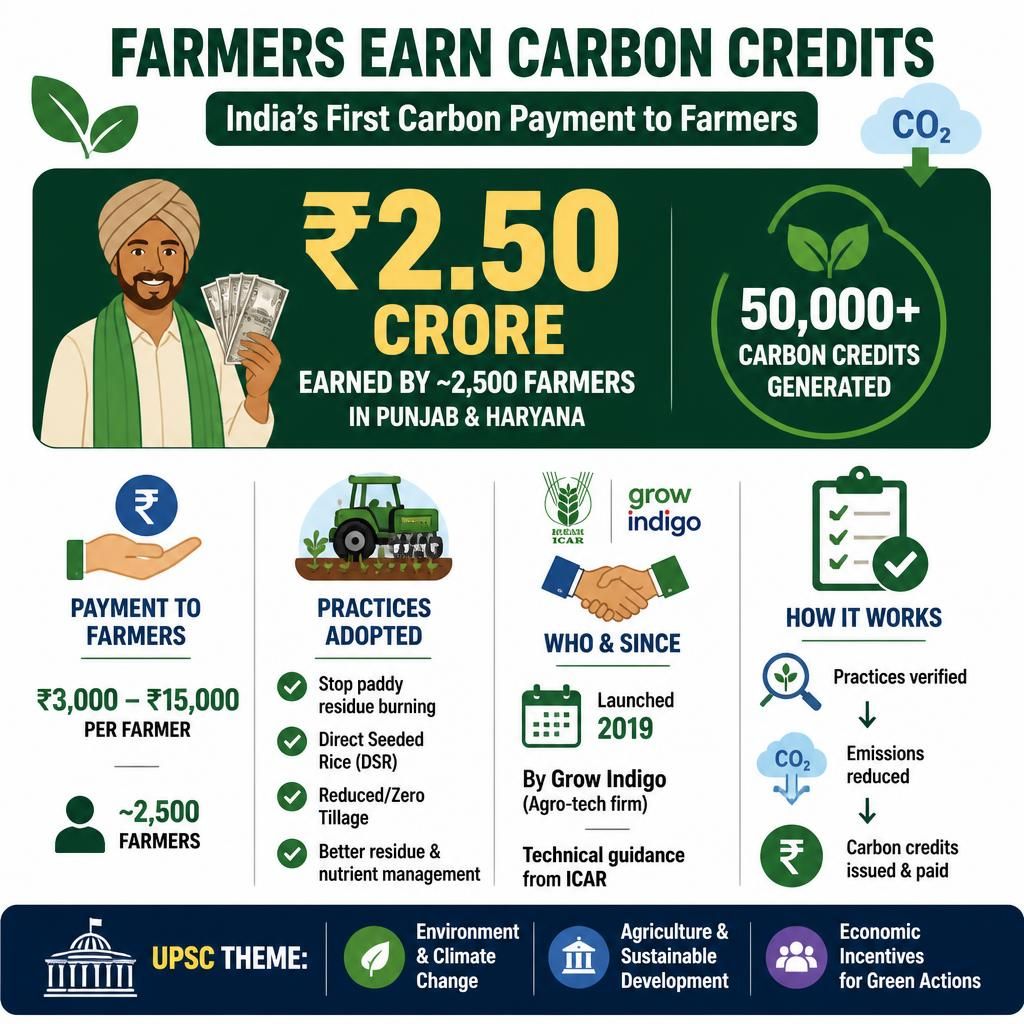
Over 2,500 farmers in Punjab and Haryana earn Rs 2.5 crore in India's first carbon credit payments for adopting sustainable agricultural practices.
Practice MCQs
724 Students attempted
Key Highlights:
- For the first time in India, approximately 2,500 farmers from Punjab and Haryana received carbon credit payments for adopting improved agricultural practices.
- These farmers earned a total of around Rs 2.50 crore, with individual payments ranging from Rs 3,000 to Rs 15,000.
- Over 50,000 carbon credits were generated through practices such as stopping paddy residue burning and using Direct Seeded Rice.
- The initiative was launched by agro-tech firm Grow Indigo in 2019, with technical guidance from the Indian Council of Agricultural Research (ICAR).
Carbon Credits.jpg
Detailed Insights:
- The program aims to provide economic value to farming practices that reduce greenhouse gas emissions and conserve soil and water.
- An MoU exists between ICAR-Agricultural Technology Application Research Institute (ATARI), Ludhiana, and Grow Indigo for technical collaboration and farmer support.
- Payments are based on verified carbon credits attributed to individual farmers for their changed practices, rather than being linked to acreage.
- Adopted practices include reduced or zero tillage, better residue management, and more efficient fertilizer use, particularly relevant in the rice-wheat cropping system.
- Monitoring of these practices involves advanced technologies like satellite and remote-sensing systems, geo-fencing, and soil sampling to assess changes in soil organic carbon.
- The recent BRICS Summit in New Delhi adopted a declaration for establishing a BRICS Network of Centres of Excellence on Agroecology and Regenerative Agriculture and a BRICS Network on Digital Agriculture.
- Punjab also has a pre-existing carbon credit scheme, launched in August 2024, which pays farmers for engaging in agroforestry by raising and maintaining trees on agricultural land.
- This program is designed as a continuing process, encouraging sustained adoption of climate-smart practices rather than offering one-time payments.
Key Concepts Involved:
- Carbon Credits: Tradable permits allowing the holder to emit one tonne of carbon dioxide equivalent, earned by reducing greenhouse gas emissions.
- Direct Seeded Rice (DSR): A method of rice cultivation where seeds are directly sown into the field, reducing water and labor requirements compared to transplanting.
- Zero Tillage: An agricultural practice where crops are grown without disturbing the soil through plowing, helping retain soil moisture and organic matter.
- Agroecology: An approach to farming that applies ecological principles to agricultural systems, focusing on sustainability, biodiversity, and local food systems.

SuperKalam is your personal mentor for UPSC preparation, guiding you at every step of the exam journey.
Download the App


STUDY RESOURCES
CONTACT US
ⓒ Snapstack Technologies Private Limited