GS 2: GovernanceGS 3: Environment & EcologyPrelimsGS 3: Conservation, Pollution and DegradationGS 1: Changes in Critical Geographical Features, Water Bodies, Ice Caps, Flora and Fauna
Hog In The Limelight, Pg6
Pygmy hog conservation efforts highlight the critical decline of India's alluvial floodplains, with captive breeding boosting populations amidst habitat threats.
Practice MCQs
724 Students attempted
Key Highlights:
- The pygmy hog (Porcula salvania), the world's smallest wild suid, serves as an indicator species for the health of India's alluvial floodplains.
- A captive breeding programme in Assam has led to a 32-fold increase in the pygmy hog population over the last three decades.
- The species was once believed extinct by the mid-20th century, primarily due to habitat loss and degradation, but was rediscovered in 1971 near Barnadi Wildlife Sanctuary.
- The Pygmy Hog Conservation Programme (PHCP), a collaborative effort initiated in 1995, is central to current conservation efforts.
- The last known natural population, estimated at around 250 individuals in early 2025, resides in the Panbari grasslands of Manas National Park.
- Assam aims to increase the wild pygmy hog population to 300 by 2040, focusing on restoring fragmented grasslands and buffer zones.
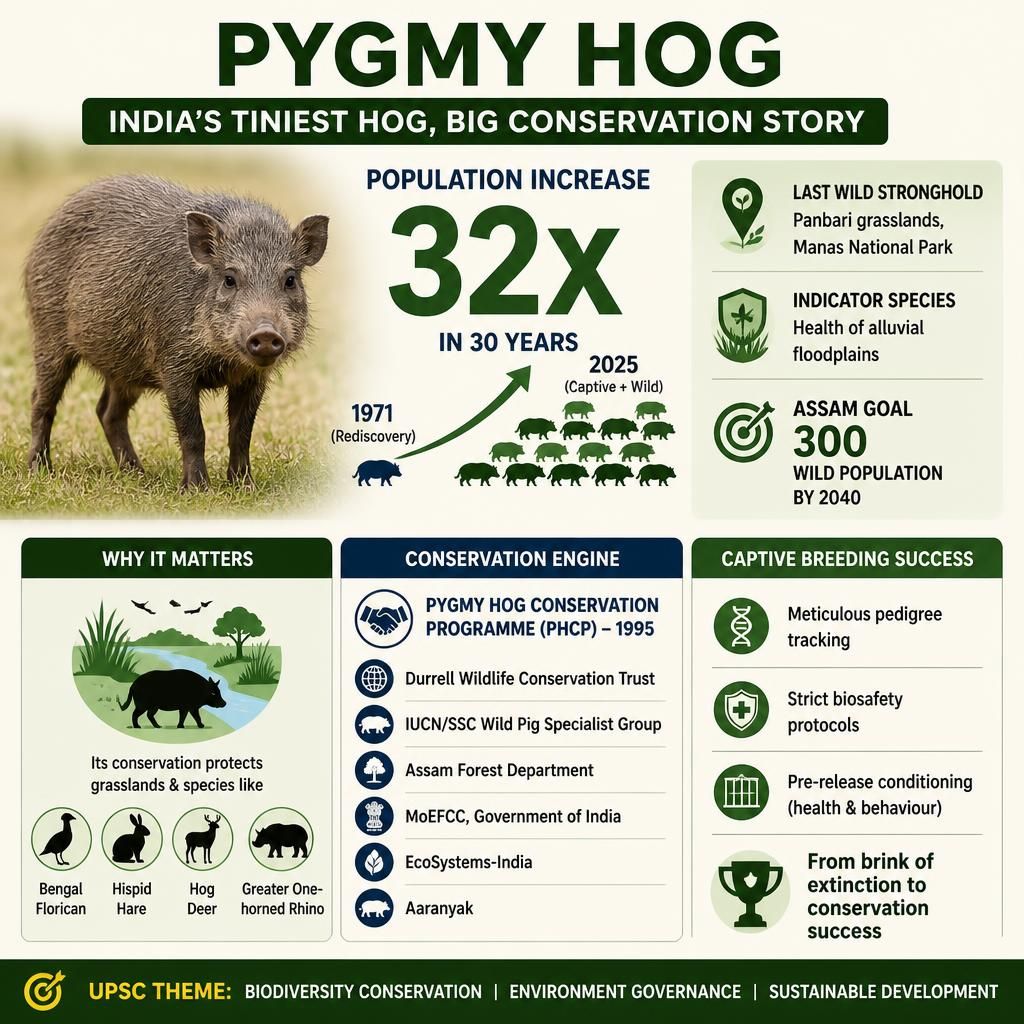
Pygmy Hog.jpg
Detailed Insights:
- The pygmy hog depends significantly on dense grasslands for feeding, concealment, and reproduction, making its decline a direct reflection of floodplain degradation.
- Conservation of the pygmy hog extends protection to other threatened species such as the Bengal florican, hispid hare, hog deer, and greater one-horned rhinoceros.
- The PHCP is a collaborative initiative involving the Durrell Wildlife Conservation Trust, IUCN/SSC Wild Pig Specialist Group, Assam Forest Department, Ministry of Environment, Forest and Climate Change, Government of India, EcoSystems-India, and Aaranyak.
- Captive breeding requires meticulous tracking of pedigree, adherence to biosafety protocols, and conditioning of individuals before release to prevent disease and inbreeding.
- Major threats include land conversion for agriculture and tea plantations, flood control infrastructure, invasive plants, altered flood cycles, and unscientific burning of grasslands.
- The pygmy hog is listed as Endangered on the IUCN Red List and in Schedule I of the Indian Wildlife (Protection) Act, 1972.
- Reintroduction efforts have successfully established a self-sustaining population in Orang National Park, estimated at 200-250 wild-born individuals.
- Restoration efforts are crucial for areas like Rupahi and Kanchanbari, and buffer zones around Manas National Park, Orang National Park, and Sonai Rupai Wildlife Sanctuary.
Key Concepts Involved:
- Indicator Species: A species whose presence, absence, or abundance reflects the health and environmental conditions of an ecosystem.
- Alluvial Floodplains: Flat land areas adjacent to rivers, formed by the deposition of sediment during floods, characterized by rich soil and dynamic ecosystems.
- Captive Breeding Programme: A conservation strategy involving breeding endangered species in controlled environments to increase their numbers for reintroduction into the wild.
- Habitat Fragmentation: The process by which large, continuous habitats are divided into smaller, isolated patches, often leading to reduced biodiversity and genetic isolation.

SuperKalam is your personal mentor for UPSC preparation, guiding you at every step of the exam journey.
Download the App


STUDY RESOURCES
CONTACT US
ⓒ Snapstack Technologies Private Limited