Odisha's coastal erosion: The measures to save lives, livelihoods, Pg4
Union Minister reveals 28% of Odisha's coastline is eroding, displacing hundreds; government implements geotextile tubes and climate resettlement colonies.
Practice MCQs
898 Students attempted
Key Highlights:
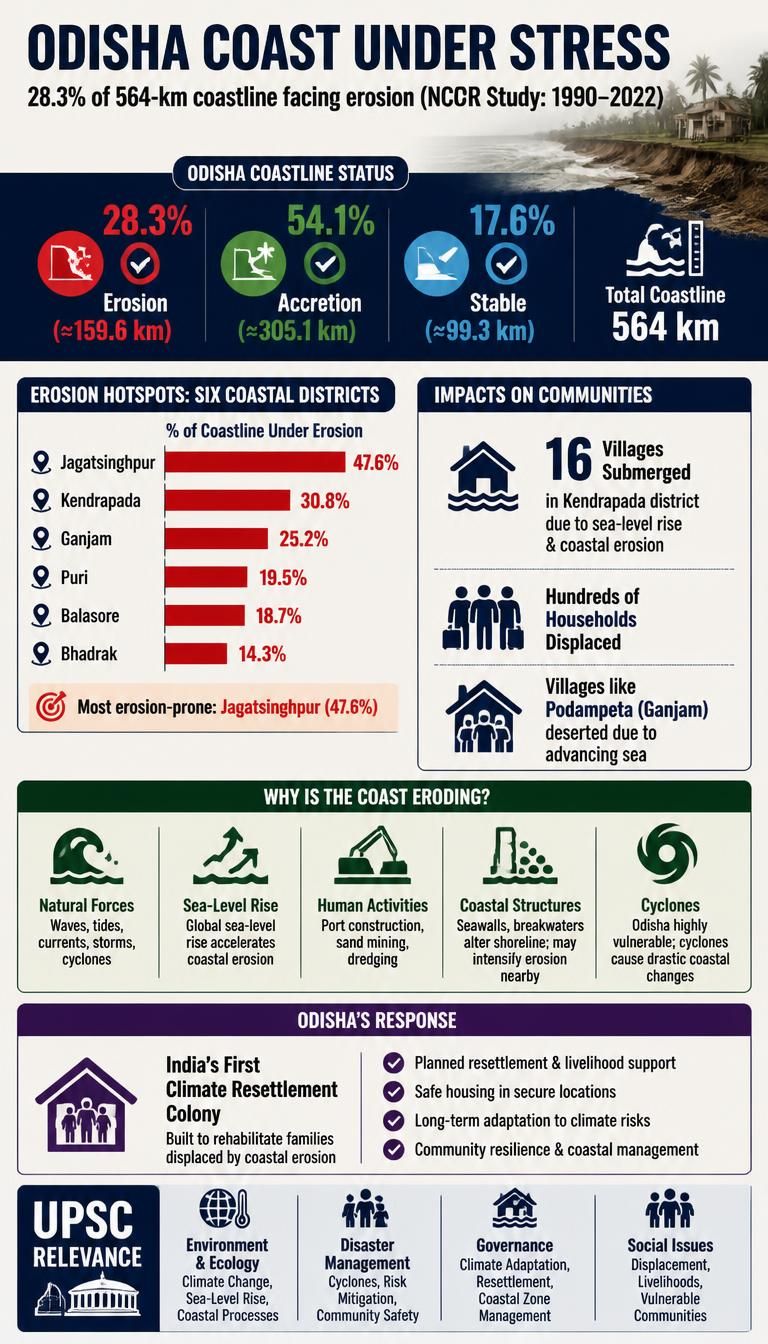
- Approximately 28.3% of Odisha's 564-km coastline is experiencing erosion, as per a study by the National Centre for Coastal Research (NCCR).
- The NCCR assessment, conducted from 1990 to 2022, also found 17.6% of the coastline stable and 54.1% undergoing accretion.
- Six coastal districts in Odisha are affected, with Jagatsinghpur being the most erosion-prone at 47.6% of its coastline.
- Rising sea levels and coastal erosion have submerged 16 villages in Kendrapada district, leading to displacement.
- Odisha has developed India’s first climate resettlement colony to accommodate those displaced by coastal erosion.
Odisha Coast.jpg
Detailed Insights:
- Shoreline changes are driven by natural forces like waves, tides, and storms, alongside human activities such as port construction and sand mining.
- Global sea-level rise significantly contributes to coastal erosion, exacerbating the issue in vulnerable regions.
- Coastal structures like seawalls and breakwaters can alter shoreline morphology, sometimes intensifying erosion in adjacent areas.
- Odisha is particularly susceptible to cyclones, which cause drastic changes to its coastline.
- Ganjam district has seen villages like Podampeta deserted due to the advancing sea, impacting hundreds of households.
- Protective measures include the development of a geotextile tube embankment at Pentha village in Kendrapada.
- Sea wall-cum-serving roads are being constructed in Balasore and Ganjam districts to offer dual protection and access.
Scientific/Technical Concepts Involved:
- National Centre for Coastal Research (NCCR): An attached office of the Ministry of Earth Sciences that monitors long-term shoreline changes and conducts research on coastal processes.
- Geotextile tube embankment: A coastal protection structure made from high-strength, porous synthetic fabrics filled with sand slurry, designed to absorb wave impact and minimize erosion.
- Sea wall-cum-serving roads: Dual-purpose coastal structures where an outer barrier protects against tidal waves and erosion, while an inner layer functions as a roadway.

SuperKalam is your personal mentor for UPSC preparation, guiding you at every step of the exam journey.
Download the App


STUDY RESOURCES
CONTACT US
ⓒ Snapstack Technologies Private Limited