GS 3: EconomyGS 3: Environment & EcologyGS 2: GovernancePrelimsGS2: Government policies and interventions for development in various sectors
India's sweet revolution depends on this: Safeguard the bee, sustainability is key, Pg15
India's booming honey sector, second largest globally, hinges on safeguarding bees, diversifying exports, and boosting domestic consumption for sustainable economic growth.
Practice MCQs
898 Students attempted
Key Highlights:
- Bees are crucial pollinators, responsible for nearly one-third of global crop output and enhancing the nutritional quality of farm produce.
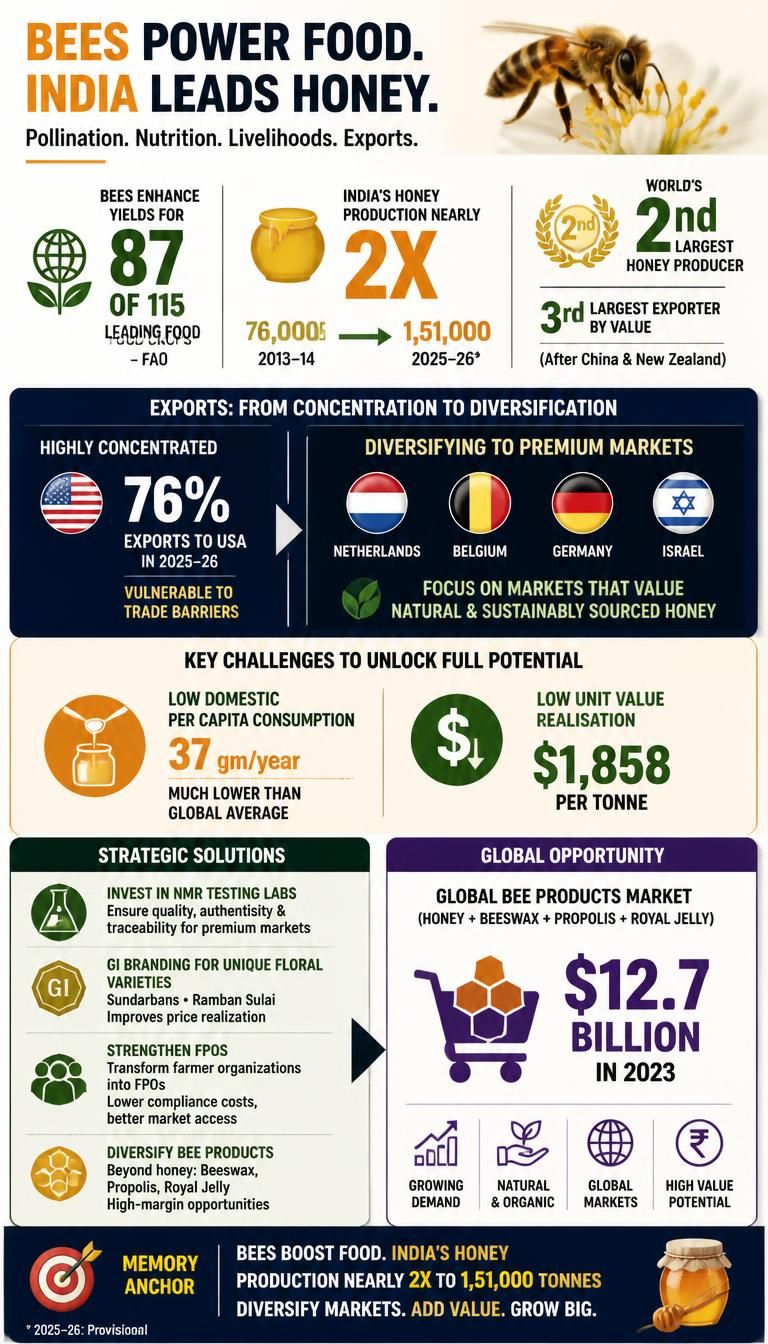
- India is the world's second-largest honey producer and the third-largest exporter by value, after China and New Zealand respectively.
- India's honey production nearly doubled from 76,000 tonnes in 2013-14 to approximately 1,51,000 tonnes in 2025-26.
- Exports, historically concentrated in the US, are diversifying towards European markets like the Netherlands, Belgium, Germany, and Israel.
- Key challenges include low domestic per capita honey consumption (37 gm/year) and a low unit value realization of $1,858 per tonne.
Bee.jpg
Detailed Insights:
- The UN Food and Agriculture Organisation (FAO) highlights that bees enhance yields for 87 of 115 leading food crops.
- India's export basket was highly concentrated, with the US absorbing about 76% of exports in 2025-26, leading to vulnerability to trade barriers.
- Diversification efforts target markets that value natural and sustainably sourced honey, leveraging India's multifloral and organic varieties.
- Investment in Nuclear Magnetic Resonance (NMR) testing labs is crucial for ensuring honey quality and traceability for premium markets.
- Geographical Indication (GI) branding for unique floral varieties like Sundarbans and Ramban Sulai can improve price realization.
- Transforming farmer organizations into Farmer Producer Organizations (FPOs) can lower compliance costs and facilitate market entry.
- The global bee products market, including beeswax, propolis, and royal jelly, was valued at $12.7 billion in 2023, offering high-margin diversification.
- Initiatives under the National Beekeeping and Honey Mission and APEDA support scientific beekeeping, pesticide management, and export promotion.
- Policymakers aim to double honey bee colonies in the country and India's share in the global market by 2030.
Key Concepts Involved:
- Pollination: The transfer of pollen, essential for plant reproduction and enhancing crop yield and quality.
- Apiculture: The practice of beekeeping, involving the rearing and management of honey bees for honey and other products.
- Nuclear Magnetic Resonance (NMR): A sophisticated analytical technique used for detailed quality testing and authentication of honey.
- Geographical Indication (GI): A sign used on products that have a specific geographical origin and possess qualities or a reputation due to that origin.

SuperKalam is your personal mentor for UPSC preparation, guiding you at every step of the exam journey.
Download the App


STUDY RESOURCES
CONTACT US
ⓒ Snapstack Technologies Private Limited