GS 2: GovernanceGS 2: PolityGS 2: Social JusticePrelims
Panel flags autonomy risks under VBSA Bill, Pg17
Joint panel warns Viksit Bharat Shiksha Adhishthan Bill 2025 threatens higher education autonomy, concentrating vast regulatory powers in single central body.
Practice MCQs
891 Students attempted
Key Highlights:
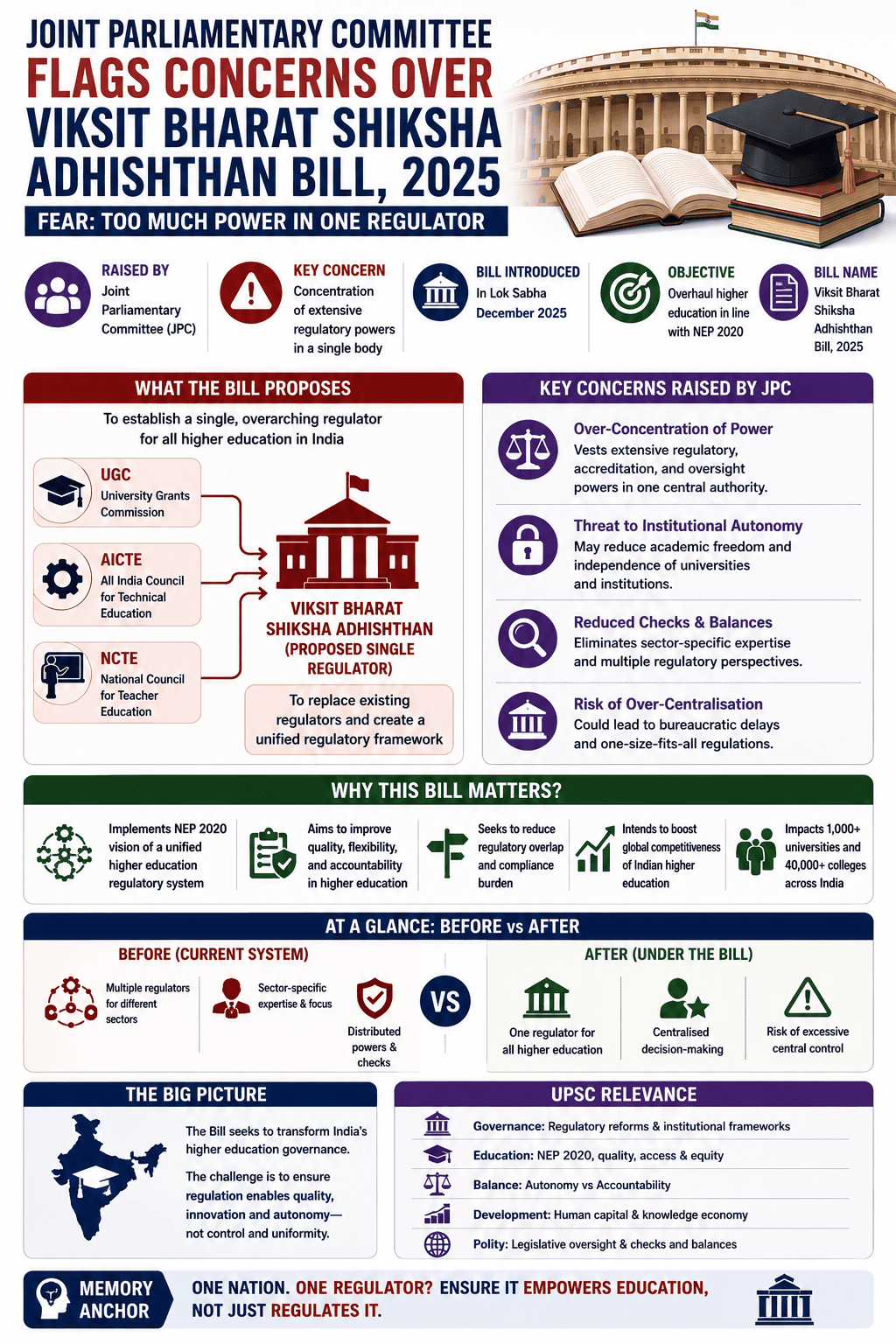
- A joint parliamentary committee has raised concerns regarding the Viksit Bharat Shiksha Adhishthan Bill, 2025.
- The committee flagged that the Bill could lead to a concentration of extensive regulatory powers in a single central regulator.
- This concentration of power is feared to negatively impact the institutional autonomy of higher education bodies.
- The Viksit Bharat Shiksha Adhishthan Bill, 2025 was introduced in the Lok Sabha in December 2025.
- It proposes to replace existing regulators such as the University Grants Commission (UGC), All India Council for Technical Education (AICTE), and National Council for Teacher Education (NCTE).
VBSA.png
Detailed Insights:
- The Bill aims to significantly overhaul India's higher education sector, aligning with the recommendations of the National Education Policy (NEP) 2020 for a unified regulatory framework.
- The parliamentary committee expressed apprehension that such concentrated powers could result in bureaucratic or ideological overreach.
- Concerns were also raised that the proposed graded penalty architecture in the Bill should not be imposed arbitrarily.
- Institutional autonomy is considered crucial for higher education institutions to make independent decisions on academic standards and management.
- The Bill explicitly exempts medical, legal, and veterinary education from its regulatory scope.
Key Concepts Involved:
- Viksit Bharat Shiksha Adhishthan Bill, 2025: Proposed Indian legislation to establish a single apex regulatory body for higher education, replacing multiple existing regulators.
- University Grants Commission (UGC): A statutory body in India responsible for the coordination, determination, and maintenance of standards in higher education.
- National Education Policy (NEP) 2020: A comprehensive framework for India's education system that recommended an overarching regulatory body for higher education.
- Institutional Autonomy: The degree of self-governance allowing higher education institutions to make independent decisions regarding academic work, management, and related activities.

SuperKalam is your personal mentor for UPSC preparation, guiding you at every step of the exam journey.
Download the App


STUDY RESOURCES
CONTACT US
ⓒ Snapstack Technologies Private Limited