GS 2: GovernanceGS 3: Science & TechnologyGS 2: Social JusticeGS 3: EconomyPrelims
More education entrepreneurs needed, Pg12
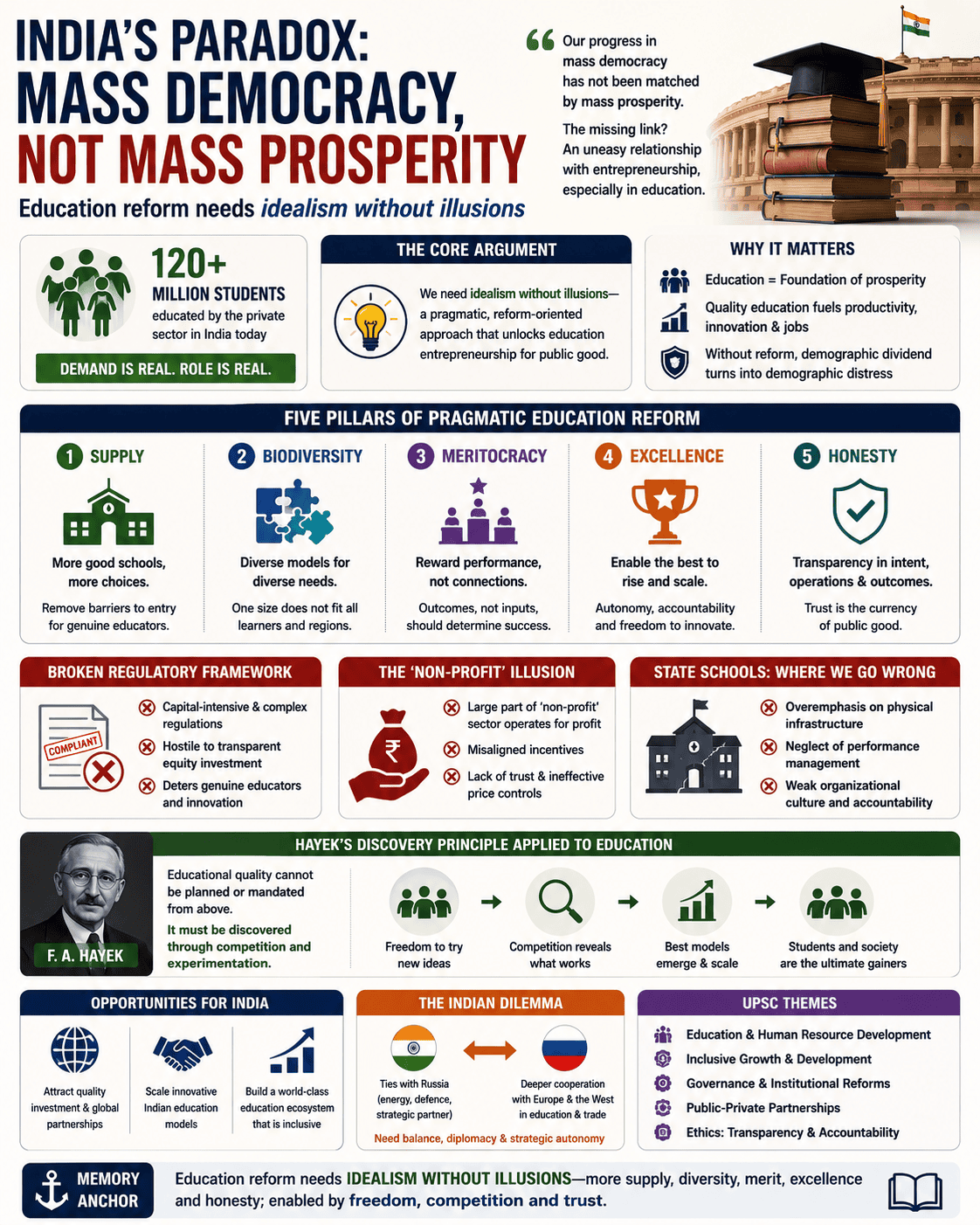
India needs more education entrepreneurs to unlock mass prosperity, challenging regulations and fostering innovation for quality learning across 120 million students.
Practice MCQs
891 Students attempted
Key Highlights:
- India's progress in mass democracy has not been matched by mass prosperity, partly due to an uneasy relationship with entrepreneurship, especially in education.
- The article advocates for "idealism without illusions," a pragmatic approach to education reform, focusing on five key areas: Supply, Biodiversity, Meritocracy, Excellence, and Honesty.
- The private sector currently educates over 120 million students in India, indicating a significant demand and role despite ideological debates.
- Current education regulations are criticized for being capital-intensive and hostile to transparent equity investment, deterring genuine educators.
- A substantial portion of the "non-profit" education sector is legally non-profit but operates for profit, leading to a lack of trust and ineffective price controls.
Education.png
Detailed Insights:
- The state's failure to improve government schools is attributed to an overemphasis on physical infrastructure rather than performance management and organizational culture.
- Hayek's discovery principle is invoked to suggest that educational quality must be discovered through competition and experimentation, not mandated.
- Regulations that make school setup capital-intensive lead to adverse selection, attracting entrepreneurs primarily focused on capital rather than educational quality.
- The article highlights the need for gifted-student programs, which are often better suited for private institutions due to their risk appetite and longer-term objectives.
- The lack of honesty in legal structures discourages financial investors who could bring superior governance, technology, and management to the education sector.
- Financial investors are seen as crucial for reducing education inflation and ensuring accountability for labor laws and child safety compliance.
- The author emphasizes the importance of bridging the gap between "thinkers" and "doers" in education to foster innovation and effective solutions.
Key Concepts Involved:
- Idealism without Illusions: A pragmatic approach that combines aspirational goals with realistic and practical solutions.
- Hayek's Discovery Principle: The idea that complex societal problems are best solved through decentralized experimentation and competition rather than central planning.
- Goodhart's Law: States that when a measure becomes a target, it ceases to be a good measure, applied to the focus on school buildings over educational quality.
- Adverse Selection: A market phenomenon where one party in a transaction has more or better information than the other, leading to undesirable outcomes.

SuperKalam is your personal mentor for UPSC preparation, guiding you at every step of the exam journey.
Download the App


STUDY RESOURCES
CONTACT US
ⓒ Snapstack Technologies Private Limited