GS 1: Physical GeographyGS 2: International RelationsGS 3: EconomyPrelims
Be ready to 'shut' Red Sea gateway if US hits power network: Iran to Houthis, Pg2
Iran directs Houthis to prepare Red Sea oil route closure, threatening global energy supplies amid potential US strikes on power infrastructure.
Practice MCQs
891 Students attempted
Key Highlights:
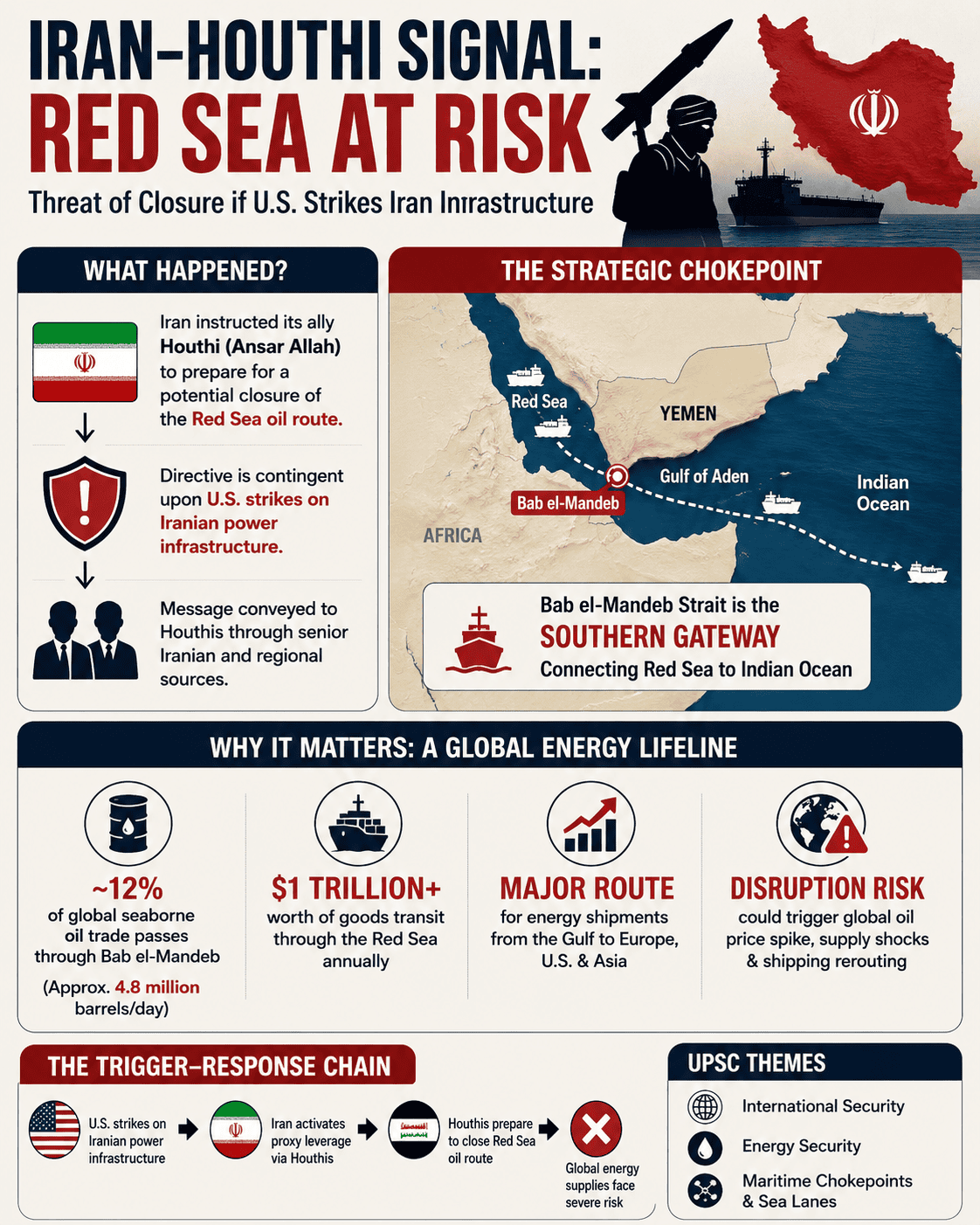
- Iran instructed its Yemeni ally, the Houthi movement, to prepare for a potential closure of the Red Sea oil route.
- This directive was contingent upon the United States launching strikes against Iranian power infrastructure.
- The move was discussed within Iran's leadership and conveyed to the Houthis, also known as Ansar Allah, through senior Iranian and regional sources.
- The potential closure of the Red Sea gateway poses a significant threat to global energy supplies.
Red sea.png
Detailed Insights:
- The instruction to the Houthis came amid heightened tensions between the U.S. and Iran, following threats by then-U.S. President Donald Trump to target Iranian infrastructure.
- The Red Sea is a crucial maritime corridor, with the Bab el-Mandeb Strait serving as its southern chokepoint, connecting it to the Gulf of Aden and the Indian Ocean.
- Disruption of shipping through the Bab el-Mandeb Strait would force vessels to reroute around the Cape of Good Hope, significantly increasing transit times and costs for global trade.
- Approximately 12% of global trade and a substantial portion of the world's seaborne oil and natural gas transit through the Red Sea and the Suez Canal.
- The Houthis, a Zaydi Shia Islamist political and military organization, control significant parts of northern Yemen and are considered a proxy force for Iran in the region.
- Iran's strategy aimed to leverage its regional influence to pressure the U.S. by threatening vital global economic arteries.
Key Concepts Involved:
- Red Sea: A seawater inlet of the Indian Ocean, lying between Africa and Asia, crucial for global maritime trade.
- Bab el-Mandeb Strait: A narrow chokepoint connecting the Red Sea to the Gulf of Aden and the Arabian Sea, vital for oil and gas transit.
- Houthis (Ansar Allah): A Yemeni Shia Islamist political and military organization backed by Iran, a key non-state actor in the region.
- Chokepoint: A narrow channel or passage, such as a strait, where traffic can be restricted or blocked, making it strategically important.

SuperKalam is your personal mentor for UPSC preparation, guiding you at every step of the exam journey.
Download the App


STUDY RESOURCES
CONTACT US
ⓒ Snapstack Technologies Private Limited