GS 2: GovernanceGS 1: Indian SocietyGS 3: EconomyPrelimsGS 3: Indian Economy, Planning, Mobilization of Resources, Growth, Development and Employment
To understand why women don't work, govt goes looking for data, Pg13
Government seeks detailed data on women's unpaid care work to boost female Labour Force Participation Rate, crucial for India's 2047 developed nation goal.
Practice MCQs
731 Students attempted
Key Highlights:
- India's goal to become a developed nation by 2047 faces a significant hurdle due to the low female Labour Force Participation Rate (LFPR).
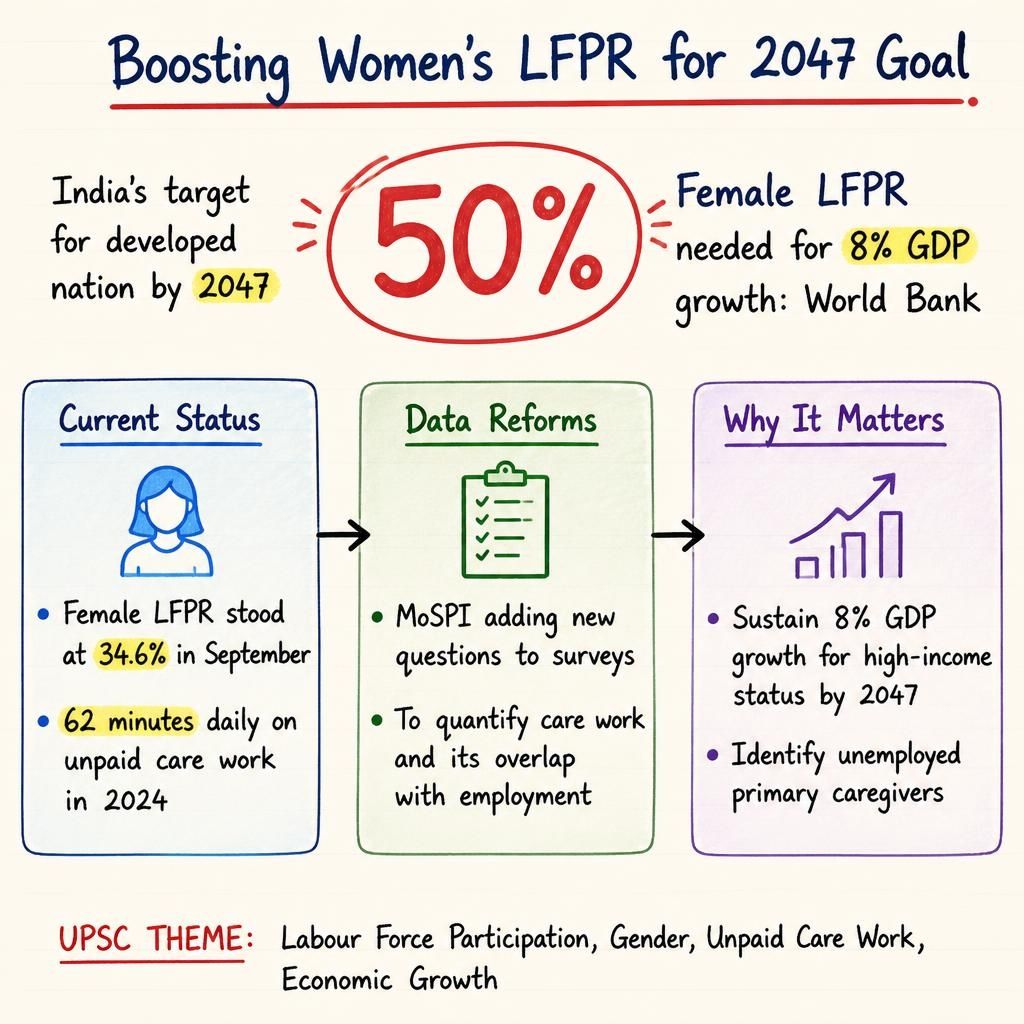
- The World Bank suggests increasing the female LFPR to 50% to help India achieve an 8% GDP growth rate, necessary for high-income status.
- The female LFPR stood at 34.6% in September.
- The Ministry of Statistics and Programme Implementation (MoSPI) is seeking more detailed data on unpaid care work performed by women.
- New questions will be added to surveys, including the Periodic Labour Force Survey (PLFS), to better understand the link between care duties and women's employment.
Women in Labor Force.jpg
Detailed Insights:
- Achieving a high-income country status by 2047 requires India to sustain an 8% GDP growth rate.
- Academics and ministries such as Micro, Small & Medium Enterprises (MSME) and Skill Development and Entrepreneurship requested improved data on care work.
- Current survey questions regarding reasons for women not working, such as "child care or personal commitments," are considered too generic.
- The new questions aim to quantify the extent of care work and its potential overlap with formal employment.
- They will also identify the number of unemployed individuals who are primary caregivers or are unable to work due to care responsibilities.
- The MoSPI's Time Use Survey data shows working-age women spent 62 minutes daily on unpaid care work in 2024, a decrease from 74 minutes in 2019.
- Conversely, men's time spent on unpaid care work increased from 26 minutes in 2019 to 36 minutes in 2024.
Key Concepts Involved:
- Labour Force Participation Rate (LFPR): The percentage of the working-age population that is either employed or actively seeking employment.
- Unpaid Care Work: Domestic and caregiving tasks performed without monetary compensation, primarily by women.
- Periodic Labour Force Survey (PLFS): A large-scale household survey conducted by MoSPI to estimate employment and unemployment indicators.
- Time Use Survey: A survey that measures how individuals spend their time on various activities, including paid and unpaid work.

SuperKalam is your personal mentor for UPSC preparation, guiding you at every step of the exam journey.
Download the App


STUDY RESOURCES
CONTACT US
ⓒ Snapstack Technologies Private Limited