GS 2: International RelationsGS 3: EconomyPrelimsGS 2: Bilateral, Regional and Global Groupings and AgreementsGS 2: Effect of Policies and Politics of Developed and Developing Countries on India's Interests
PM in Manila: Giving new momentum to Act East Policy, Pg8
PM Modi's Manila visit boosts India's Act East Policy, strengthening ASEAN ties through maritime, economic, and digital cooperation for a stable Indo-Pacific.
Practice MCQs
731 Students attempted
Key Highlights:
- Prime Minister Narendra Modi participated in the ASEAN-India Summit and East Asia Summit in Manila on November 16-17.
- The visit aimed to reaffirm ASEAN Centrality, consolidate the 2026 ASEAN-India Year of Maritime Cooperation, and boost India’s Act East Policy.
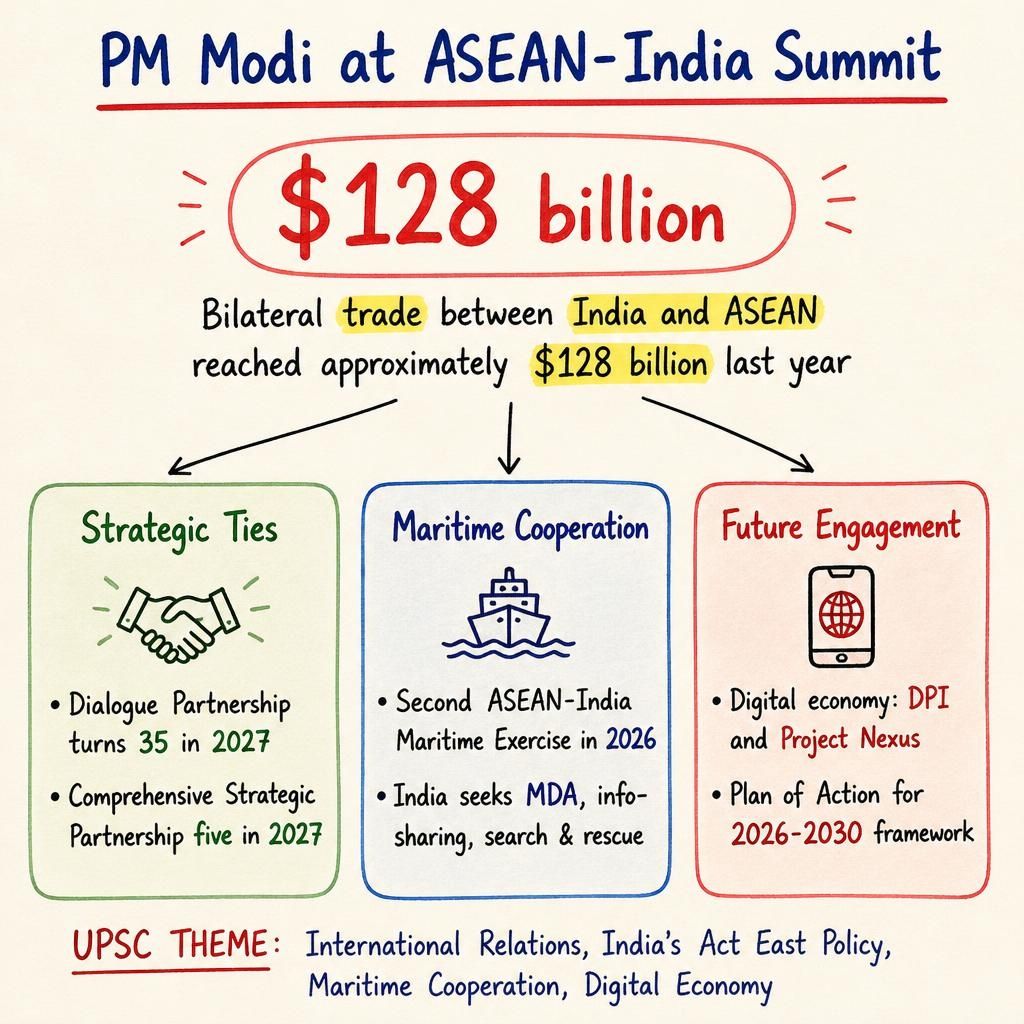
- Bilateral trade between India and ASEAN reached approximately $128 billion last year, with Indian exports to ASEAN rising by 56%.
- The review of the ASEAN-India Trade in Goods Agreement (AITIGA) remains incomplete, requiring political direction for conclusion.
- Cooperation in the digital economy, including India’s digital public infrastructure and Project Nexus, holds significant promise for future engagement.
India-ASEAN Summit.jpg
Detailed Insights:
- The ASEAN-India Dialogue Partnership will turn 35 and their Comprehensive Strategic Partnership five in 2027, reflecting evolving ties.
- Maritime cooperation was central in 2026, highlighted by the second ASEAN-India Maritime Exercise and events like MILAN 2026 and the Indian Ocean Naval Symposium.
- India seeks to enhance engagement in maritime domain awareness, information-sharing, search and rescue, and protection of submarine cables.
- The Information Fusion Centre-Indian Ocean Region plays a crucial role, with six ASEAN countries associated with it.
- The ASEAN-India Scale Hub in Bali, launched in July 2026, demonstrated growing collaboration potential among start-ups and technology enterprises.
- PM Modi’s participation in the East Asia Summit emphasized the need for inclusive regional dialogue amidst tensions in the South China Sea and other global conflicts.
- India maintains a distinct strategic position, engaging with the Quad, Russia, China, Japan, Australia, Europe, and the United States to advocate for a rules-based Indo-Pacific.
- The possibility of a Quad summit in Manila further underscores India's regional perspective.
- BRICS has emerged as another platform for increased exchanges with ASEAN members, with Indonesia as a member and Malaysia, Thailand, and Vietnam as partners.
- The ASEAN-India Plan of Action for 2026-2030 provides a framework for future cooperation, focusing on maritime cooperation, trade facilitation, and digital connectivity.
Key Concepts Involved:
- Act East Policy: India's foreign policy initiative to strengthen economic, strategic, and cultural relations with the Asia-Pacific region.
- ASEAN Centrality: The principle that ASEAN should be at the core of regional cooperation and security architecture in Southeast Asia.
- Indo-Pacific: A geopolitical concept emphasizing the interconnectedness of the Indian and Pacific Oceans, crucial for trade and security.
- Digital Public Infrastructure (DPI): Open, interoperable digital systems like Aadhaar or UPI that enable public and private service delivery.

SuperKalam is your personal mentor for UPSC preparation, guiding you at every step of the exam journey.
Download the App


STUDY RESOURCES
CONTACT US
ⓒ Snapstack Technologies Private Limited