GS 2: GovernanceGS 3: Science & TechnologyGS 3: Environment & EcologyPrelimsGS 3: Infrastructure: Energy, Ports, Roads, Airports, Railways etc.
Keralam’s Orchids Endure From Highway Trees to Salt-Sprayed Shores, Pg II
Kerala project successfully rescues over 27,000 native orchids from highway destruction, demonstrating resilience in diverse habitats including salt-sprayed beaches, highlighting policy gaps.
Practice MCQs
731 Students attempted
Key Highlights:
- Keralam accounts for over a third of India's 307 endemic orchid species, with a density comparable to South American countries like Costa Rica.
- Habitat loss and fragmentation, particularly from road-widening projects like NH66 and SH59, threaten the State's orchid diversity.
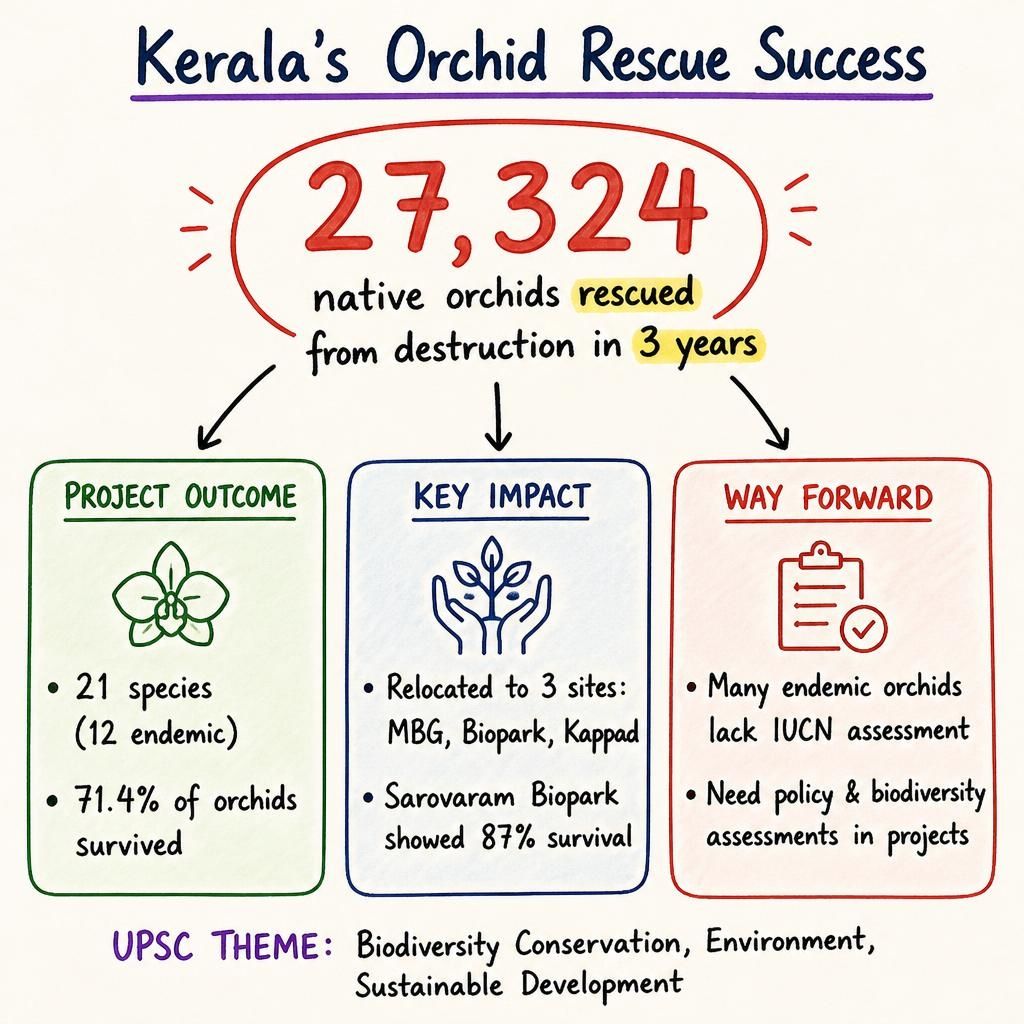
- A project led by Dr. Viswambharan Sarasan and N.S. Pradeep rescued 27,324 native orchids from destruction over three years.
- The rescued orchids, representing 21 species (12 endemic), were relocated to the Malabar Botanical Garden, Sarovaram Biopark, and Kappad Beach.
- The project demonstrated high survival rates, with 71.4% of relocated orchids surviving, and proved cost-effective, spending ₹2.5-3 lakh for a conservation effort estimated at ₹25-50 lakh.
- Many endemic orchid species lack IUCN Red List assessments, hindering conservation efforts and highlighting a knowledge gap due to funding and resource shortages.
Kerala's Orchids.jpg
Detailed Insights:
- The project was initiated with funding from the Royal Society International Exchanges programme and focused on northern districts like Wayanad and Kozhikode due to higher diversity.
- Orchids, some inhabiting trees for 25-50 years, were left unattended for months after trees were felled for infrastructure projects.
- Relocation sites included the Calicut Corporation area and coffee plantations, where trees were regularly cleared.
- The Sarovaram Biopark, an urban wetland under the District Tourism Promotion Council (DTPC), Calicut, showed the strongest establishment rates for the relocated orchids at 87%.
- The successful survival of orchids at Kappad Beach, exposed to significant winds and salt spray, demonstrated the resilience of these plants.
- The project highlighted the need for a coherent policy, suggesting the State Biodiversity Board should collaborate with stakeholders for biodiversity assessments in all infrastructure development projects.
- This initiative serves as a valuable and replicable model for biodiversity conservation, promoting public engagement and awareness.
Key Concepts Involved:
- Endemic Species: A species native to a particular geographic region and found only there.
- Habitat Fragmentation: The process by which habitat loss results in the division of large, continuous habitats into smaller, isolated patches.
- IUCN Red List: The world's most comprehensive inventory of the global conservation status of biological species.
- Biodiversity Assessment: The process of evaluating the variety of life in a particular ecosystem or region.
Previous13/13

SuperKalam is your personal mentor for UPSC preparation, guiding you at every step of the exam journey.
Download the App


STUDY RESOURCES
CONTACT US
ⓒ Snapstack Technologies Private Limited