GS 2: GovernanceGS 2: PolityPrelimsGS 2: Government policies and interventions for development in various sectorsGS 2: Important Aspects of Governance, Transparency and Accountability
The debate over immunity to CEC, ECs, Pg10
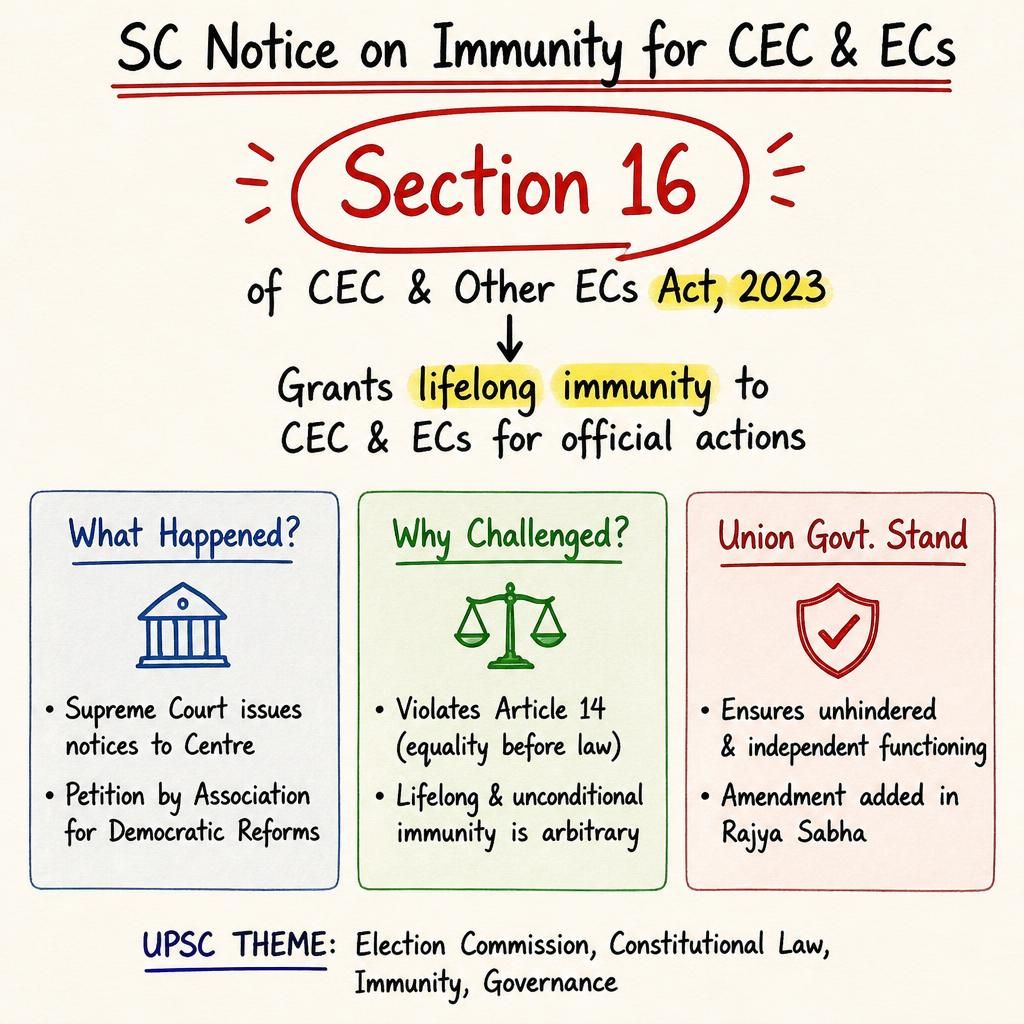
Supreme Court issues notice on plea challenging lifelong immunity for CEC and ECs under the new 2023 Act, raising concerns over constitutional equality.
Practice MCQs
724 Students attempted
Key Highlights:
- The Supreme Court has issued notices to the Centre regarding a petition challenging lifelong immunity for the Chief Election Commissioner (CEC) and Election Commissioners (ECs).
- The petition, filed by the Association for Democratic Reforms (ADR), targets Section 16 of the Chief Election Commissioner and Other Election Commissioners (Appointment, Conditions of Service and Terms of Office) Act, 2023.
- Section 16 grants immunity from civil or criminal proceedings to current and former CECs and ECs for actions taken in their official capacity.
- This provision was added as an amendment during the Bill's passage in Rajya Sabha, without prior rationale in the Statement of Objects and Reasons.
- The Union Law Minister stated the amendment aims to ensure unhindered and independent functioning of the CEC and ECs.
Immunity to CEC and EC.jpg
Detailed Insights:
- The CEC & EC Act, 2023, enacted in December 2023, replaced the Election Commission (Conditions of Service of Election Commissioners and Transaction of Business) Act, 1991, which did not contain such immunity.
- The challenge argues that this lifelong and unconditional immunity is an arbitrary classification, violating Article 14 (equality before the law).
- Unlike the President and Governors, whose immunity under Article 361 is limited to their term of office, the immunity for CEC/ECs is perpetual.
- Parliamentary privileges under Articles 105 and 194 are largely confined to actions within legislative houses and during sessions.
- Diplomatic immunity, governed by the Vienna Convention, is based on functional necessity and reciprocity, differing from the blanket immunity for CEC/ECs.
- Other independent constitutional and statutory authorities like judges, CAG, UPSC members, and Lokpal do not enjoy such extensive immunity for official actions.
- The lack of a stated rationale for Section 16's inclusion in the original Bill raises concerns about its legislative intent and justification.
Key Concepts Involved:
- Equality Before the Law (Article 14): A fundamental right ensuring no person is above the law and all are subject to the same laws, forming part of the Constitution's basic structure.
- Rule of Law: A principle where all individuals and institutions are accountable to laws that are publicly promulgated, equally enforced, and independently adjudicated.
- Constitutional Immunities: Specific protections granted by the Constitution to certain high offices (e.g., President, Governors, MPs) to ensure their dignity and unhindered functioning.
- Chief Election Commissioner and Other Election Commissioners (Appointment, Conditions of Service and Terms of Office) Act, 2023: A recent law governing the appointment, service conditions, and tenure of election commissioners, which includes the controversial Section 16.

SuperKalam is your personal mentor for UPSC preparation, guiding you at every step of the exam journey.
Download the App


STUDY RESOURCES
CONTACT US
ⓒ Snapstack Technologies Private Limited