GS 2: GovernanceGS 2: International RelationsPrelimsGS 2: Bilateral, Regional and Global Groupings and AgreementsGS 2: Effect of Policies and Politics of Developed and Developing Countries on India's Interests
A contested UNSC seat poses a test for India, Pg8
India faces a challenging diplomatic contest for a non-permanent UNSC seat against Tajikistan, testing its global influence and UN reform aspirations.
Practice MCQs
724 Students attempted
Key Highlights:
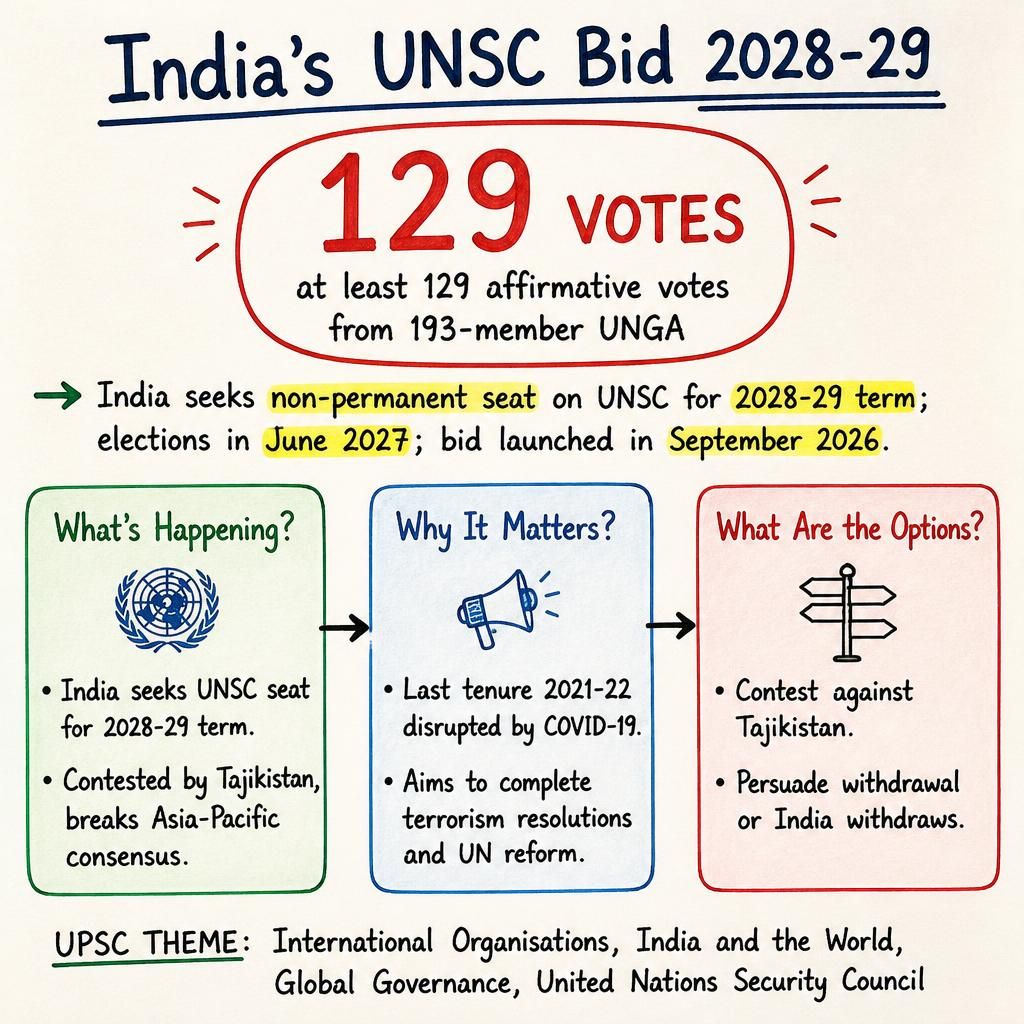
- India is seeking a non-permanent seat on the United Nations Security Council (UNSC) for the 2028-29 term, with elections scheduled for June 2027.
- External Affairs Minister S. Jaishankar launched India's bid during the 81st session of the United Nations General Assembly (UNGA) in September 2026.
- India needs at least 129 affirmative votes from the 193-member UNGA to secure the seat.
- The bid is contested by Tajikistan, breaking the usual consensus within the Asia-Pacific Grouping.
- This marks a departure from India's previous eight successful bids, where it was often the consensus choice.
UNSC Bid.jpg
Detailed Insights:
- India's last tenure on the UNSC was in 2021-22, which the government felt was disrupted by the COVID-19 pandemic.
- The current bid aims to complete objectives like resolutions on terrorism and United Nations reform before the Modi government's term ends in 2029.
- Historically, India lost UNSC elections when facing a contest, specifically against Pakistan in 1975 and Japan in 1996.
- The three options for India are to contest against Tajikistan, persuade Tajikistan to withdraw, or for India to withdraw its own candidature.
- Tajikistan's bid appeals to smaller nations and the Global South, emphasizing responsibility to the UN Charter over status.
- Voting patterns in recent UNGA resolutions and UNSC elections show a sentiment against major powers, which could influence the outcome.
- India has previously negotiated with Kazakhstan (2010) and Afghanistan (2013) to step aside for its UNSC bids.
- A potential withdrawal by India could be seen as a strategic move, acknowledging Tajikistan's historical ties and returning later with full regional backing.
Key Concepts Involved:
- United Nations Security Council (UNSC): One of the six principal organs of the United Nations, responsible for maintaining international peace and security.
- United Nations General Assembly (UNGA): The main deliberative, policymaking, and representative organ of the United United Nations.
- Non-permanent seat: A temporary two-year term position on the UNSC, elected by the UNGA.
- Asia-Pacific Grouping: One of the five regional groups within the United Nations that coordinate candidacies for various UN bodies.
- Global South: A term referring to countries in Africa, Latin America, and developing Asia, often characterized by shared experiences of colonialism and economic challenges.

SuperKalam is your personal mentor for UPSC preparation, guiding you at every step of the exam journey.
Download the App


STUDY RESOURCES
CONTACT US
ⓒ Snapstack Technologies Private Limited