GS 1: Indian GeographyGS 1: Physical GeographyGS 3: Disaster ManagementGS 3: Environment & EcologyPrelims
Peak Water: A Flow U-Turn, Pg II
Himalayan glaciers melt faster, pushing region towards 'peak water' by mid-century, threatening India's water security and 20% GDP.
Practice MCQs
898 Students attempted
Key Highlights:
- Himalayan glaciers are melting at an accelerated rate, leading to the region approaching "peak water" by mid-century.
- A recent glacier collapse in late August on the Nepal-Tibet border caused over 1,300 confirmed deaths and 5,300 missing.
- The study highlights the formation of unstable glacial lakes, posing a significant threat to downstream populations.
- Peak water refers to the point when river flows, fed by glaciers, stop rising and begin to decline.
- The Hindu Kush-Himalaya (HKH) region is critical, underpinning more than 20% of India’s GDP.
- The study was a collaborative effort by Systemiq, Integrated Mountain Initiative, International Centre for Integrated Mountain Development (ICIMOD), and G.B. Pant National Institute of Himalayan Environment.
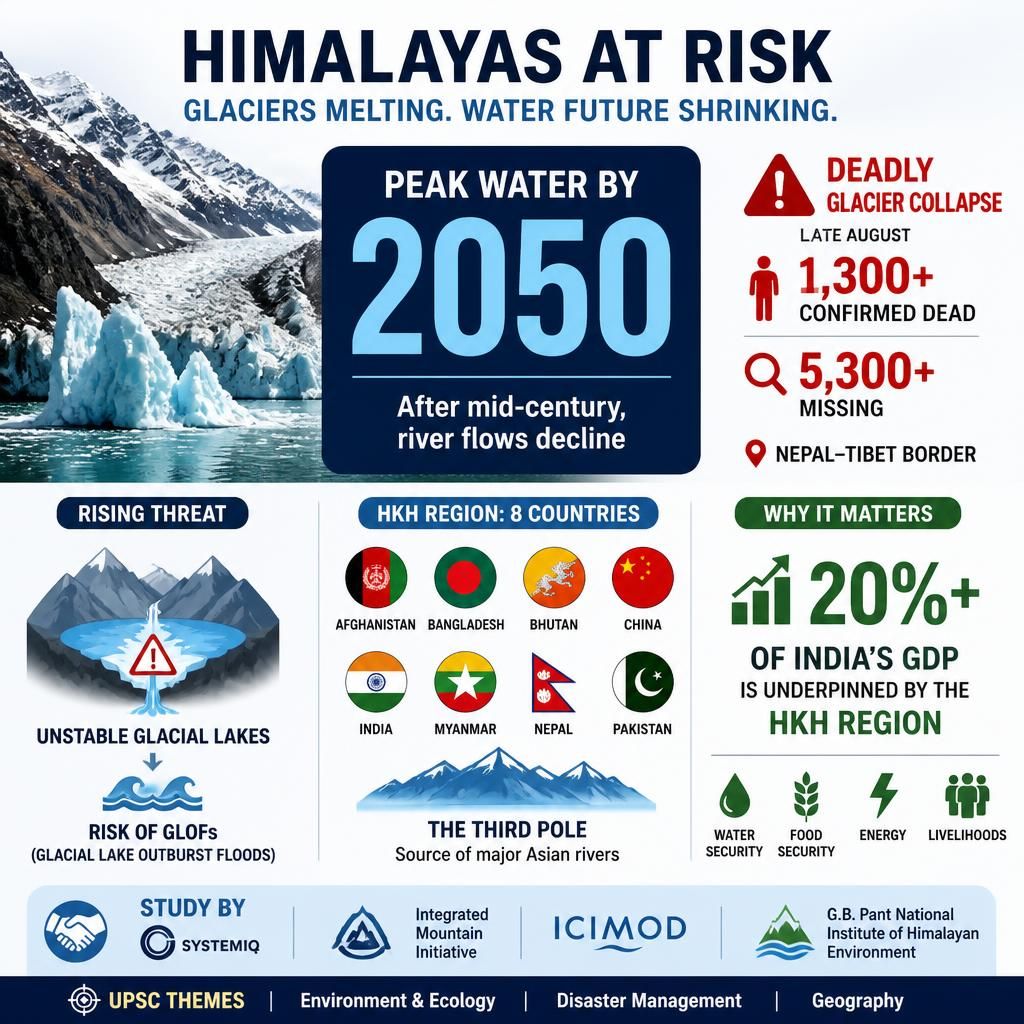
Himalayas at Risk.jpg
Detailed Insights:
- The accelerated glacier melt in the Himalayas is projected to cause peak water by mid-century, impacting water security.
- The August glacier collapse led to cascading landslides and flash floods in valleys across Nepal and China's Tibet region.
- Retreating glaciers leave behind unstable glacial lakes, increasing the risk of Glacial Lake Outburst Floods (GLOFs).
- The Hindu Kush-Himalaya (HKH) region is a vast mountain system spanning eight countries: Afghanistan, Bangladesh, Bhutan, China, India, Myanmar, Nepal, and Pakistan.
- Out of an estimated 40,000 glaciers in the HKH region, only 21 are currently monitored on the ground.
- Despite comprising about 18% of India's land area, the Himalayan region accounts for approximately 35% of the country's natural disasters.
- ICIMOD is an intergovernmental learning and knowledge-sharing center working for sustainable mountain development in the HKH region.
- G.B. Pant National Institute of Himalayan Environment is an autonomous research institute under India's Ministry of Environment, Forest and Climate Change.
Key Concepts Involved:
- Peak water: The point in time when river flows, primarily fed by glacial melt, reach their maximum and subsequently begin to decrease.
- Glacial Lake Outburst Flood (GLOF): A sudden and rapid release of a large volume of water from a glacial lake, often caused by the failure of a natural dam.
- Hindu Kush-Himalaya (HKH) region: A vast mountain range system in Asia, often referred to as the "Third Pole" due to its extensive ice and snow reserves.

SuperKalam is your personal mentor for UPSC preparation, guiding you at every step of the exam journey.
Download the App


STUDY RESOURCES
CONTACT US
ⓒ Snapstack Technologies Private Limited