GS 3: EconomyPrelimsGS 3: Indian Economy, Planning, Mobilization of Resources, Growth, Development and EmploymentGS 2: Important Aspects of Governance, Transparency and Accountability
Decoding India’s GDP base revision, Pg9
India's nominal GDP estimates revised downwards by 2.7-3.8% for 2022-25, reflecting improved data and methods for the unincorporated sector.
Practice MCQs
898 Students attempted
Key Highlights:
- India revised its GDP base year to 2022-23, replacing the 2011-12 series.
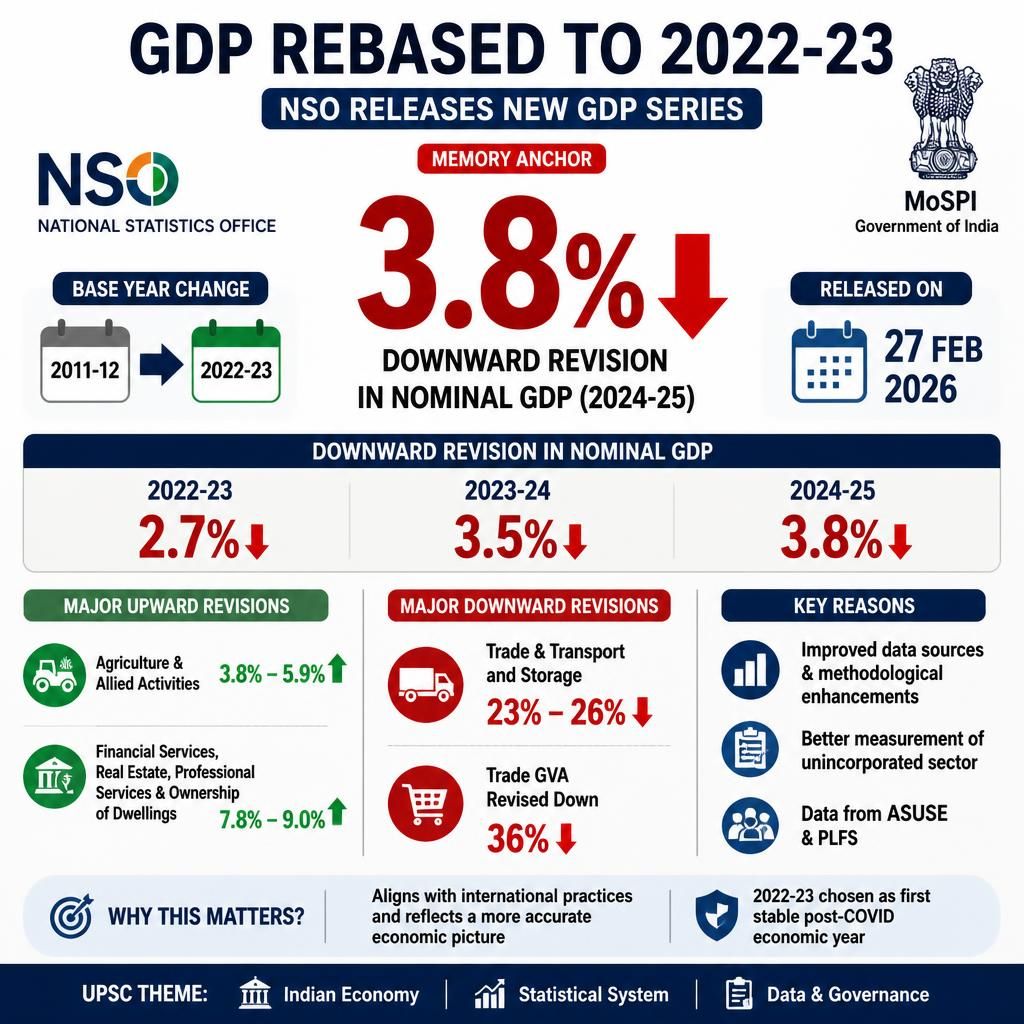
- This revision led to a downward adjustment of India’s nominal GDP by approximately 2.7% in 2022-23, 3.5% in 2023-24, and 3.8% in 2024-25.
- The changes are attributed to improved data sources and methodological enhancements, particularly in measuring the unincorporated services sector.
- The National Statistics Office (NSO) under the Ministry of Statistics and Programme Implementation (MoSPI) released the new GDP estimate framework on February 27, 2026.
GDP Base.jpg
Detailed Insights:
- The revision aligns with international statistical practices, where rebasing exercises in various countries have also led to changes in nominal GDP estimates.
- India's previous shift from the 2004-05 to the 2011-12 base year also altered the estimated size of the economy.
- The 2022-23 base year was chosen as it represents the first stable post-COVID economic year, avoiding distortions from pandemic-era volatility.
- Upward revisions were noted in agriculture and allied activities (3.8%–5.9%) and financial services, real estate, professional services, and ownership of dwellings (7.8%–9.0%).
- Significant downward revisions occurred in trade and transport and storage (23%–26%), with trade Gross Value Added (GVA) revised down by 36%.
- The improved measurement of the unincorporated sector, using data from Annual Survey of Unincorporated Sector Enterprises (ASUSE) and Periodic Labour Force Survey (PLFS), was a major driver of the nominal GDP revision.
- The previous 2011-12 series relied on proxy indicators for the informal sector, assuming its growth mirrored the formal sector, which proved inaccurate during economic disruptions.
- The World Bank's April 2026 India Development Update also highlighted the reassessment of the informal economy as a primary reason for the nominal GDP revision.
- The new series indicates less volatile and more broad-based quarterly growth from FY 2023-24 to FY 2025-26.
- The International Monetary Fund (IMF) had previously given India's national accounts data a 'C' grade, partly due to the outdated base year and informal sector coverage.
- The United Nations System of National Accounts (SNA 1993) recommends base-year updates every five years, and India is now committing to a more regular cycle.
Key Concepts Involved:
- GDP Base Year: A reference year whose prices are used to calculate real GDP, reflecting changes in the volume of goods and services.
- Nominal GDP: The total value of goods and services produced in an economy, measured at current market prices.
- Gross Value Added (GVA): A measure of the value of goods and services produced in an area, industry, or sector of an economy.
- Unincorporated Sector: Businesses that are not legally separate from their owners, often part of the informal economy.

SuperKalam is your personal mentor for UPSC preparation, guiding you at every step of the exam journey.
Download the App


STUDY RESOURCES
CONTACT US
ⓒ Snapstack Technologies Private Limited