GS 2: GovernanceGS 3: Science & TechnologyGS 2: International RelationsGS 3: EconomyPrelims
China’s open AI advantage may not last forever, Pg8
China's strategic open-weight AI models, offering cost advantages, may see restrictions by 2028, prompting India to leverage and prepare.
Practice MCQs
898 Students attempted
Key Highlights:
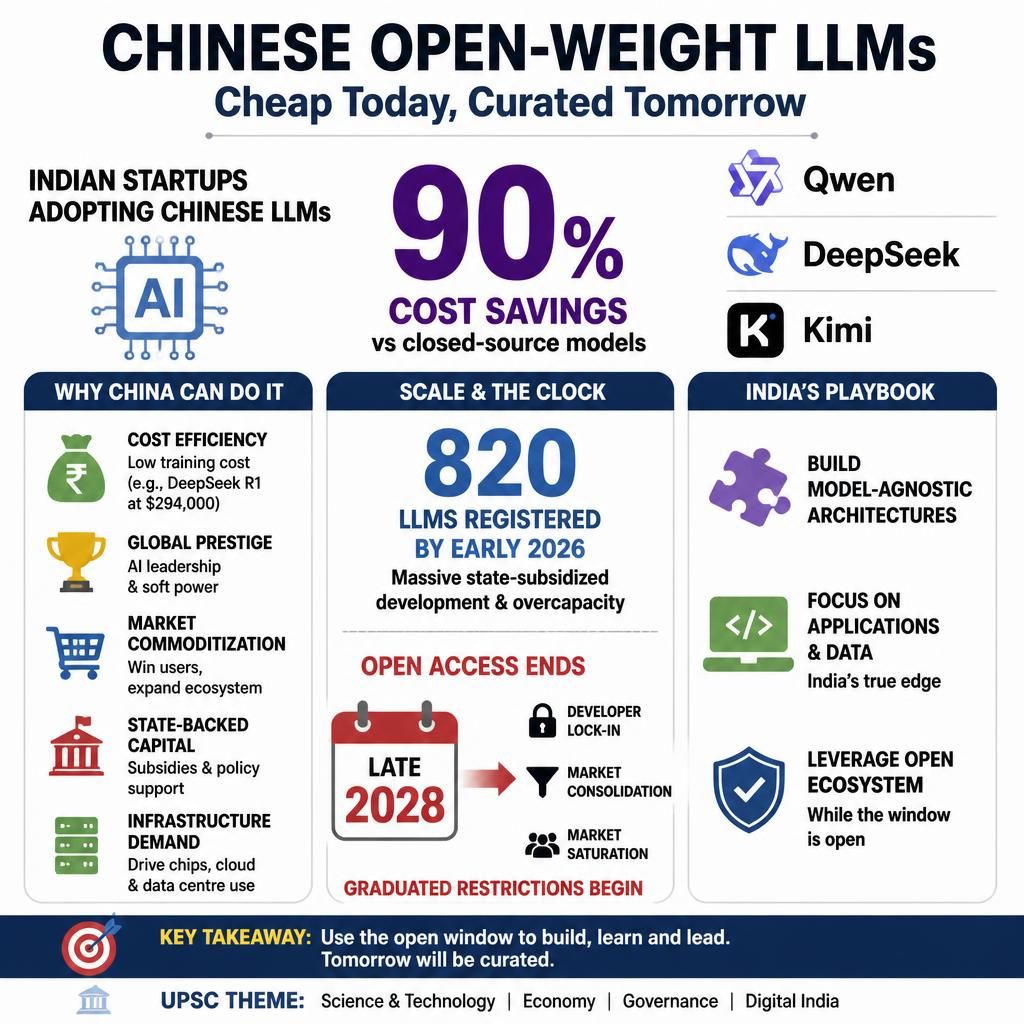
- Indian startups are increasingly adopting Chinese open-weight Large Language Models (LLMs) like Qwen, DeepSeek, and Kimi for significant cost savings.
- China's strategy of offering these models is driven by cost efficiency, global prestige, market commoditization, state-backed capital, and infrastructure demand.
- This open access is projected to begin facing graduated restrictions around late 2028, as China aims for consolidation, developer lock-in, and market saturation.
- By early 2026, China had 820 LLMs registered, indicating massive state-subsidized development and overcapacity.
- India is advised to leverage this open ecosystem by building model-agnostic architectures and focusing on specific strengths like applications and data.
Chinese LLMs.jpg
Detailed Insights:
- Chinese LLMs are reported to perform nearly as well as American frontier models, with a lag of about six months, offering substantial cost reductions for users.
- China's low training costs, exemplified by DeepSeek's R1 model at $294,000, are due to distillation from American models and architectural efficiencies.
- The open-weight strategy enhances China's global influence, as seen with President Xi Jinping's engagement and the World Artificial Intelligence Cooperation Organization (WAICO) bloc.
- By offering free models, China aims to commoditize AI, undermining the pricing power of proprietary American AI labs like OpenAI and Anthropic.
- State-backed capital, similar to solar and EV sectors, has fueled the proliferation of numerous LLMs in China, creating overcapacity.
- Free models boost AI adoption, driving demand for complementary Chinese-dominated products like cloud services and energy, benefiting companies like Alibaba Cloud.
- Chinese regulators are consulting on limiting data transfer and model weight downloads, signaling potential future restrictions.
- Restrictions are likely when China achieves consolidation among its AI firms, global developer lock-in to its cloud stack, and market saturation of American models.
- India should implement model-agnostic architectures and consider public sector platforms like OpenRouter to mitigate future switching costs.
- India's focus should be on atmashakti in AI applications, industrial data, edge inference silicon design, and domain-specific fine-tuning, rather than full self-sufficiency.
- Diplomatically, India should actively shape open-weight norms in multilateral forums while China still seeks legitimacy for its open AI strategy.
Key Concepts Involved:
- Open-weight models: AI models where the underlying parameters (weights) are publicly accessible, allowing others to inspect, modify, and use them.
- Large Language Models (LLMs): Advanced AI models trained on vast text datasets to understand, generate, and respond to human language.
- Financial repression: Government policies that channel household savings into state-controlled banks, which then lend cheaply to strategic sectors.
- Model-agnostic architectures: Software designs that allow applications to switch between different AI models or providers without significant re-engineering.

SuperKalam is your personal mentor for UPSC preparation, guiding you at every step of the exam journey.
Download the App


STUDY RESOURCES
CONTACT US
ⓒ Snapstack Technologies Private Limited