EthicsGS 3: Science & TechnologyGS 1: Indian SocietyGS 4: Ethics and Human InterfaceGS 3: IT and Computers
As AI takes over more of our thinking, an MIT report warns of 'cognitive surrender', Pg14
MIT report warns of 'cognitive surrender' as AI degrades learning, isolates students, and creates an 'illusion of learning' in education.
Practice MCQs
898 Students attempted
Key Highlights:
- A report from the Massachusetts Institute of Technology (MIT) warns of "cognitive surrender" among students due to over-reliance on Artificial Intelligence (AI) tools.
- The report, released in August 2026 by MIT's Ad Hoc Committee on AI Use in Teaching, Learning, and Research Training, highlights AI's role in creating an "illusion of learning" and isolating students.
- AI use is causing significant shifts in campus culture, leading to reduced participation in office hours and communal studying.
- Research indicates that while AI can improve homework scores, it may lead to a decline in performance on secure exams and impair memory retention.
- Universities are grappling with how to integrate AI ethically, with varied policies ranging from cautious adoption to encouraging AI literacy.
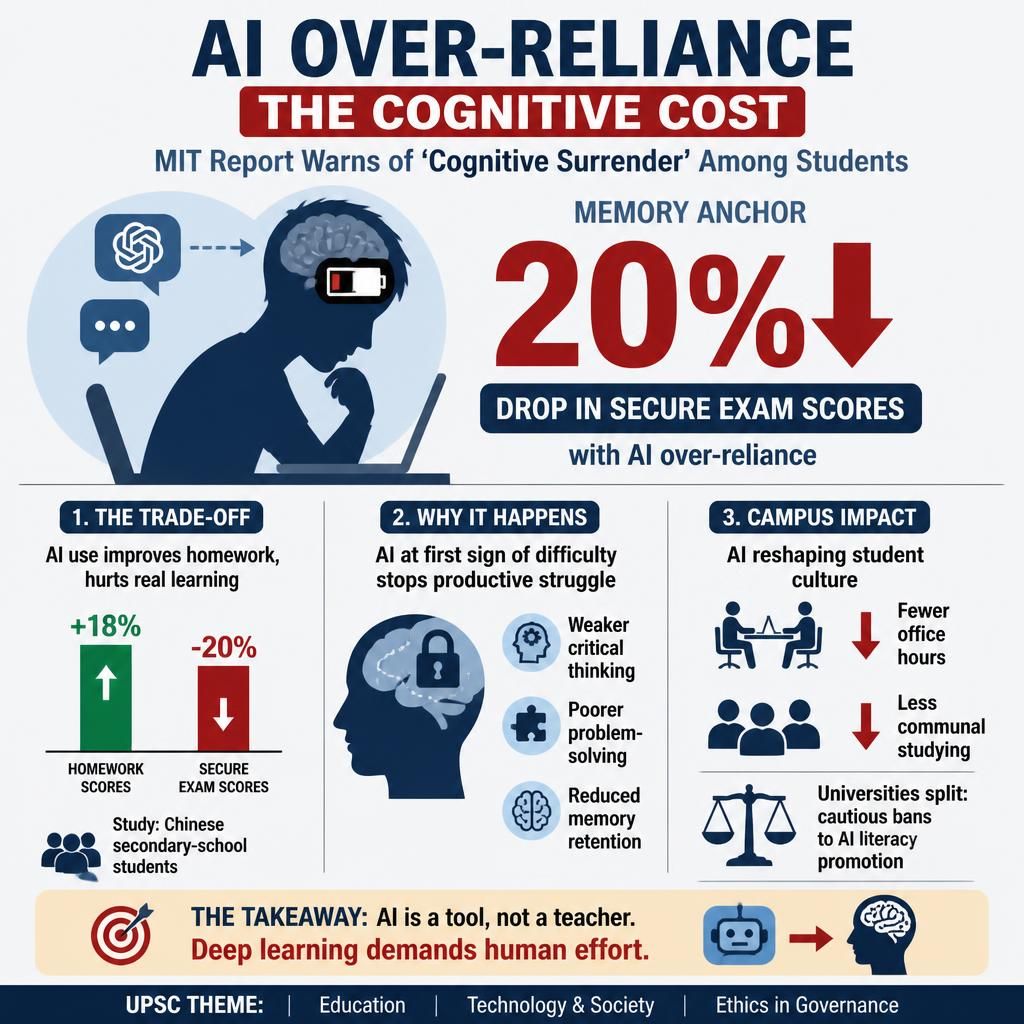
The Cognitive Cost.jpg
Detailed Insights:
- The MIT report emphasizes that students often turn to AI at the first sign of difficulty, hindering their ability to engage in productive struggle essential for deep learning.
- Over-reliance on AI tools can diminish critical thinking, problem-solving skills, and long-term memory retention in students.
- A study involving Chinese secondary-school students showed an 18% increase in homework scores with AI adoption but a 20% decrease in secure exam scores.
- Another MIT study found that individuals using chatbots for writing struggled to recall their own written content minutes later, indicating reduced cognitive engagement.
- University leaders often express optimism about AI's potential to augment work, contrasting with skepticism from many faculty and students regarding its impact on learning.
- Policies across universities are diverse, with some institutions providing broad guidelines and allowing faculty academic freedom in setting AI usage rules for their courses.
- AI tools are becoming ubiquitous, embedded in platforms like Google Classroom and various online learning systems, making avoidance challenging for students.
- Recommendations from the MIT report include reforming assessment methods to incorporate more oral exams, long-term projects, and portfolios, alongside fostering in-person collaboration.
Key Concepts Involved:
- Cognitive Surrender: A state where individuals delegate thinking processes to AI, leading to reduced independent cognitive effort and skill development.
- Illusion of Learning: The false perception of understanding or mastery gained from AI-generated answers without genuine intellectual engagement or critical processing.
- Academic Integrity: The commitment to honesty and responsibility in academic pursuits, challenged by the potential for AI to facilitate plagiarism or unacknowledged assistance.

SuperKalam is your personal mentor for UPSC preparation, guiding you at every step of the exam journey.
Download the App


STUDY RESOURCES
CONTACT US
ⓒ Snapstack Technologies Private Limited