Why India Needs More Power For AI, Chips And Data Centres, Pg11
India targets 100 GWe nuclear power by 2047, deploying SMRs and private investment to meet surging energy demands from AI and data centers.
Practice MCQs
891 Students attempted
Key Highlights:
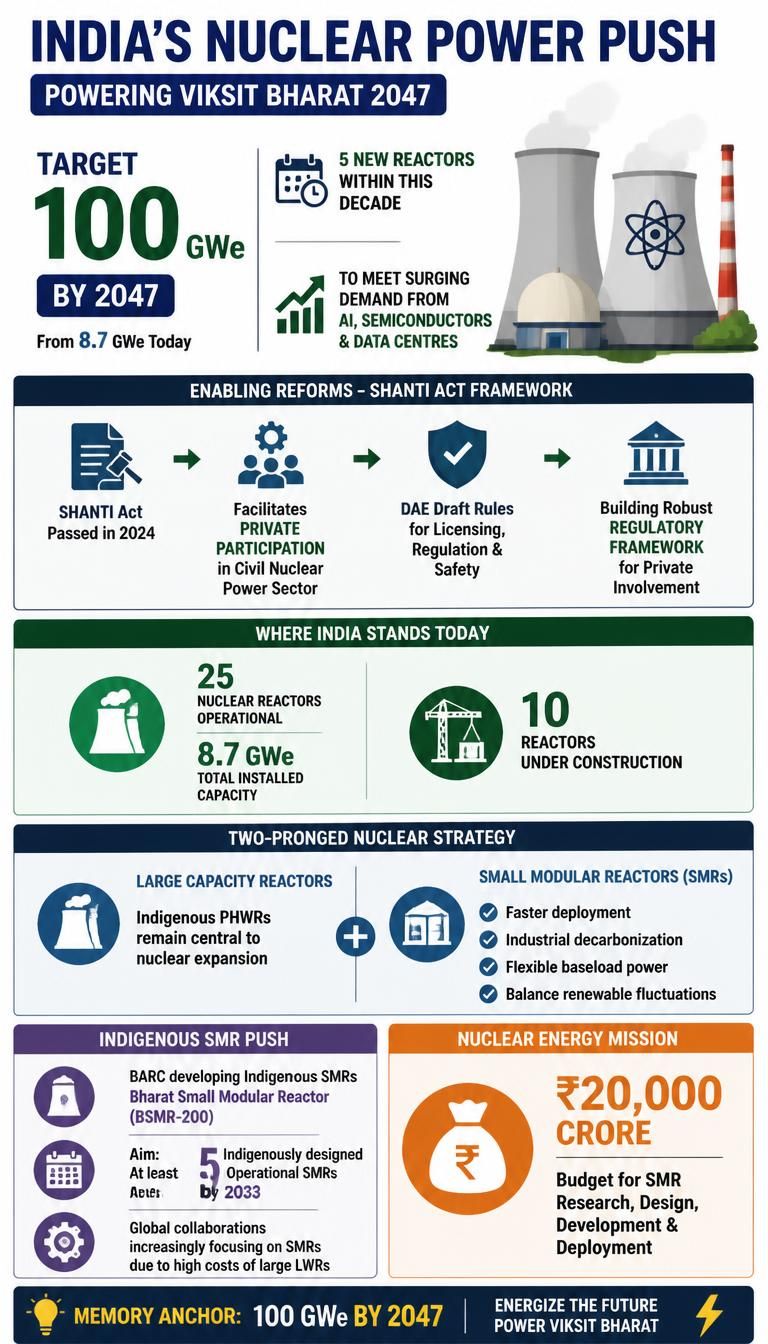
- India aims to expand its nuclear power capacity to 100 gigawatt-electric (GWe) by 2047 to meet rising electricity demand from sectors like AI, semiconductors, and data centers.
- Prime Minister Narendra Modi has set a target of commissioning five new nuclear reactors within the current decade.
- The SHANTI Act, passed last year, facilitates wider private participation in India's civil nuclear power sector.
- The Department of Atomic Energy (DAE) released draft rules under the SHANTI Act to establish a regulatory framework for private involvement, licensing, and safety.
- India currently operates 25 nuclear reactors with a total capacity of 8.7 GWe, with 10 more reactors under construction.
Nuclear Power Push.jpg
Detailed Insights:
- The increased energy demand from emerging technologies necessitates a significant boost in baseload power generation.
- India is pursuing a two-pronged strategy involving both large-capacity reactors and Small Modular Reactors (SMRs) for faster deployment.
- SMRs are considered crucial for industrial decarbonization and providing flexible baseload power to balance renewable energy fluctuations.
- India's indigenous Pressurised Heavy Water Reactors (PHWRs) remain central to the country's nuclear expansion plans.
- International collaborations are increasingly focused on SMRs due to the high project costs associated with large light water reactors.
- The Bhabha Atomic Research Centre (BARC) is developing indigenous SMRs, including the Bharat Small Modular Reactor (BSMR-200).
- India aims to have at least five indigenously designed and operational SMRs by 2033.
- The Nuclear Energy Mission has been announced with a budget of ₹20,000 crore for SMR research, design, development, and deployment.
- Studies are underway to repurpose old thermal power plant sites for nuclear projects, potentially favoring SMRs due to their smaller footprint.
Key Concepts Involved:
- SHANTI Act: Legislation aimed at enabling broader private sector participation and investment in India's civil nuclear energy program.
- Small Modular Reactors (SMRs): Advanced nuclear reactors with a power output typically less than 300 MWe, designed for factory fabrication and modular construction.
- Pressurised Heavy Water Reactors (PHWRs): A type of nuclear reactor that uses heavy water as both a coolant and moderator, forming the backbone of India's indigenous nuclear program.
- Baseload Power: The minimum amount of electric power delivered or required over a given period, typically supplied by power plants that operate continuously.
- Three-Stage Nuclear Power Programme: India's long-term strategy to achieve energy independence using its vast thorium reserves, involving PHWRs, fast breeder reactors, and thorium-based reactors.
Previous6/6

SuperKalam is your personal mentor for UPSC preparation, guiding you at every step of the exam journey.
Download the App


STUDY RESOURCES
CONTACT US
ⓒ Snapstack Technologies Private Limited