GS 3: Science & TechnologyPrelimsGS2: Health SectorGS3: Science and Technology in Everyday LifeGS3: Biotechnology
TB Vaccine Offers Clue To Shape Immunity Against Alzheimer’s, Pg11
Research indicates BCG vaccine, traditionally for TB, could retrain immune cells to combat brain inflammation, offering a potential preventive strategy for Alzheimer's.
Practice MCQs
891 Students attempted
Key Highlights:
- A study suggests the Bacillus Calmette-Guérin (BCG) vaccine, traditionally used for tuberculosis, may offer clues to shaping immunity against Alzheimer’s disease.
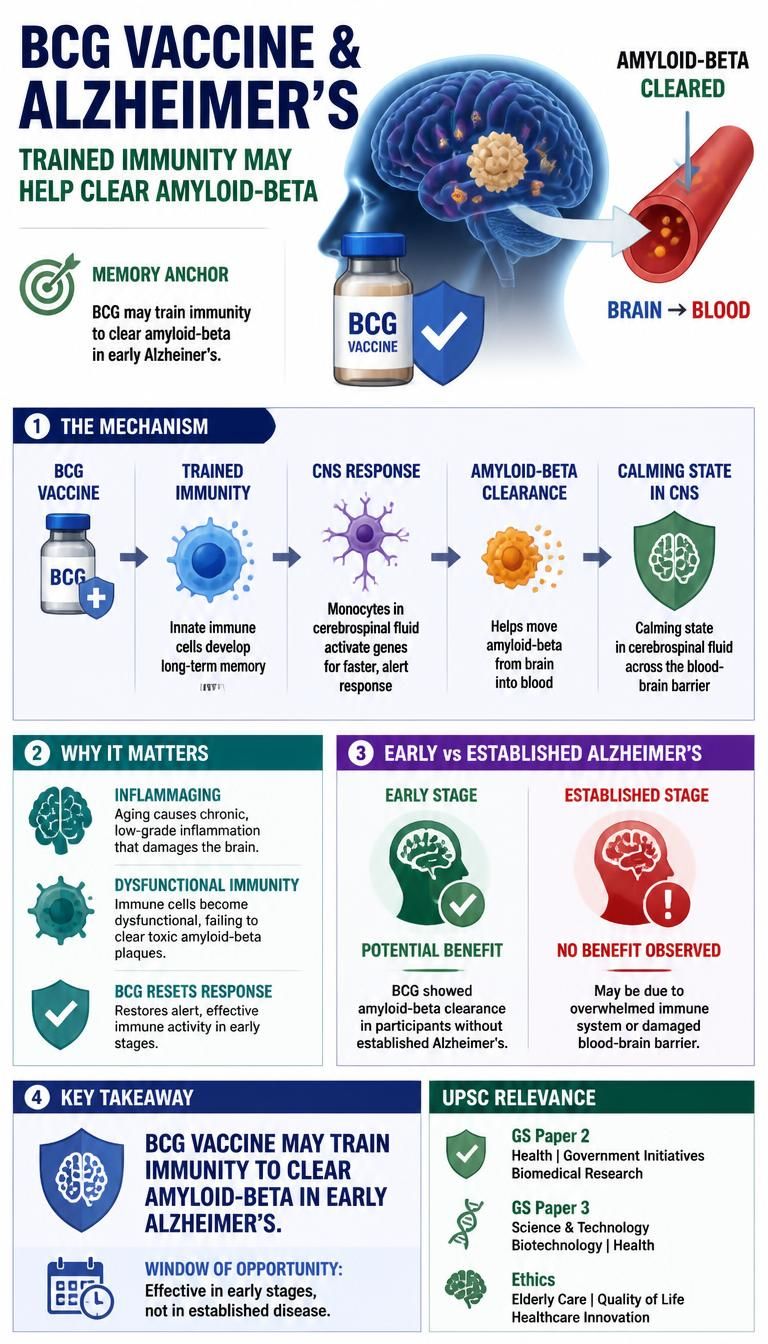
- Researchers at Massachusetts General Hospital found that BCG induced trained immunity-like responses within the central nervous system of older adults.
- The vaccine appeared to help clear amyloid-beta from the brain into the blood in participants without established Alzheimer’s.
- BCG led to a calming state in the cerebrospinal fluid across the blood-brain barrier, despite triggering inflammatory signals in blood plasma.
BCG Vaccine.jpg
Detailed Insights:
- The aging immune system often enters a state of chronic, low-grade inflammation known as inflammaging, which is particularly damaging to the brain.
- Inflammaging causes immune cells to become dysfunctional, hindering their ability to clear toxic amyloid-beta plaques associated with Alzheimer’s disease.
- Trained immunity is a phenomenon where certain vaccines provide innate immune cells with a long-lasting memory, enhancing their response to unrelated threats.
- The study observed that monocytes in the cerebrospinal fluid activated genes linked to a faster, more alert immune response after BCG vaccination.
- While the vaccine showed potential for amyloid-beta clearance in early stages, it did not materialize in participants with established Alzheimer’s, possibly due to an overwhelmed immune system or a damaged blood-brain barrier.
- The study, involving 23 participants, was primarily designed to understand the biological effects of BCG and highlighted its plausible utility as a preventive measure rather than a treatment for advanced Alzheimer's.
- BCG is a cost-effective vaccine with extensive safety data, offering a potential alternative to expensive modern anti-amyloid drugs.
Scientific/Technical Concepts Involved:
- Inflammaging: Chronic, low-grade inflammation associated with aging, contributing to various age-related diseases.
- Amyloid-beta: A protein fragment that can accumulate in the brain, forming plaques characteristic of Alzheimer's disease.
- Trained immunity: The ability of innate immune cells to develop a long-term memory after exposure to certain stimuli, leading to enhanced responses to subsequent infections.
- Blood-brain barrier: A highly selective semipermeable border that separates the circulating blood from the brain and extracellular fluid in the central nervous system.

SuperKalam is your personal mentor for UPSC preparation, guiding you at every step of the exam journey.
Download the App


STUDY RESOURCES
CONTACT US
ⓒ Snapstack Technologies Private Limited