GS 2: GovernanceGS 2: PolityPrelimsGS 2: Government policies and interventions for development in various sectorsGS 2: Devolution of Powers and Finances up to Local Levels
Ladakh's 7 councils & the decentralisation debate, Pg12
Ladakh's move to establish seven new Autonomous Hill Development Councils sparks fierce debate, as civil society groups fear dilution of Article 371 demands for stronger representative governance.
Practice MCQs
883 Students attempted
Key Highlights:
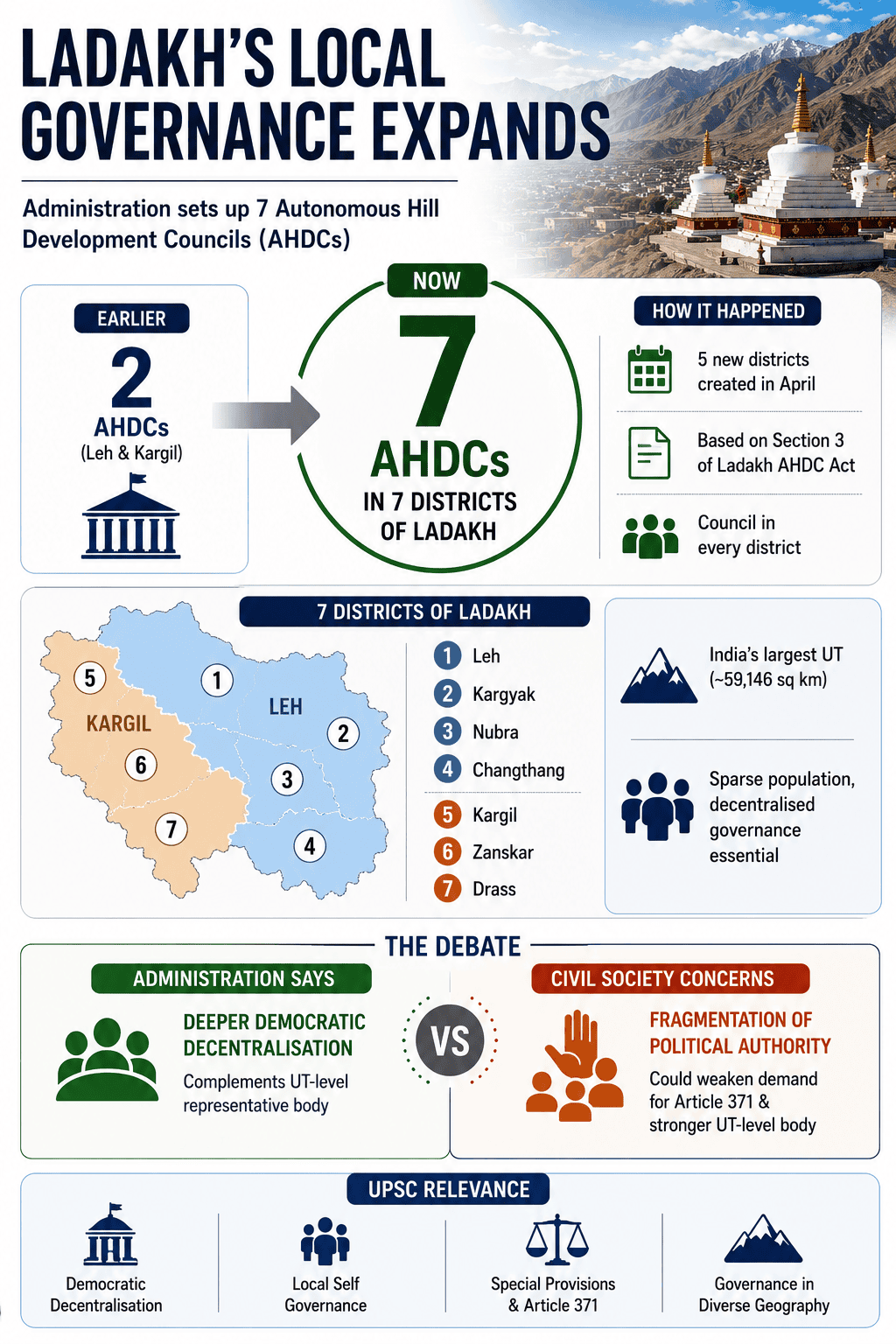
- The Ladakh administration announced the constitution of Autonomous Hill Development Councils (AHDCs) in each of the Union Territory's seven districts.
- This expands the existing two councils in Leh and Kargil, following the creation of five new districts in April.
- Civil society groups, the Apex Body, Leh (ABL) and the Kargil Democratic Alliance (KDA), oppose the move, viewing it as a fragmentation of political authority.
- They argue it could weaken the proposed representative political structure they demand under Article 371 for Ladakh.
- The administration states the move aims to deepen democratic decentralisation and is complementary to a Union Territory-level representative body.
Ladakh.png
Detailed Insights:
- The decision to establish seven AHDCs is based on Section 3 of the Ladakh Autonomous Hill Development Council Act, which provides for a council in every district.
- Ladakh's unique geography, being India's largest Union Territory by area with a sparse population, is cited by the administration as a reason for decentralised governance.
- The ABL and KDA fear that empowering multiple district councils will dilute the authority of a future representative government under Article 371.
- Civil society leaders also express concern over blurred lines of political accountability with the coexistence of multiple administrative bodies.
- There is a significant trust deficit between Ladakh's leadership and the Centre, stemming from the lack of a legislature post-2019 Union Territory status.
- Despite their statutory powers for planning, development, and budget, existing AHDCs are perceived by local leaders as having lost relevance since Ladakh became a Union Territory.
Key Concepts Involved:
- Autonomous Hill Development Councils (AHDCs): Statutory bodies in certain regions of India designed for local self-governance and development.
- Union Territory: An administrative division in India directly governed by the Central Government.
- Article 371: A part of the Indian Constitution that grants special provisions to certain states, allowing for unique administrative arrangements.
- Sixth Schedule: A constitutional provision that allows for the formation of autonomous administrative divisions within certain states, providing greater political autonomy to tribal areas.
- Ladakh Autonomous Hill Development Council Act: The specific legislation governing the establishment and functioning of AHDCs in Ladakh.

SuperKalam is your personal mentor for UPSC preparation, guiding you at every step of the exam journey.
Download the App


STUDY RESOURCES
CONTACT US
ⓒ Snapstack Technologies Private Limited