GS 2: GovernanceGS 3: Environment & EcologyPrelimsGS 3: Conservation, Pollution and DegradationGS 2: Government policies and interventions for development in various sectors
Dust and Waste Burning to Farm Fires and Crackers: Pollution Load Shifts in Weeks, Pg4
Local sources like open waste burning and road dust contributed one-third of Delhi's PM2.5 pollution in October, preceding stubble burning and Diwali emissions.
Practice MCQs
724 Students attempted
Key Highlights:
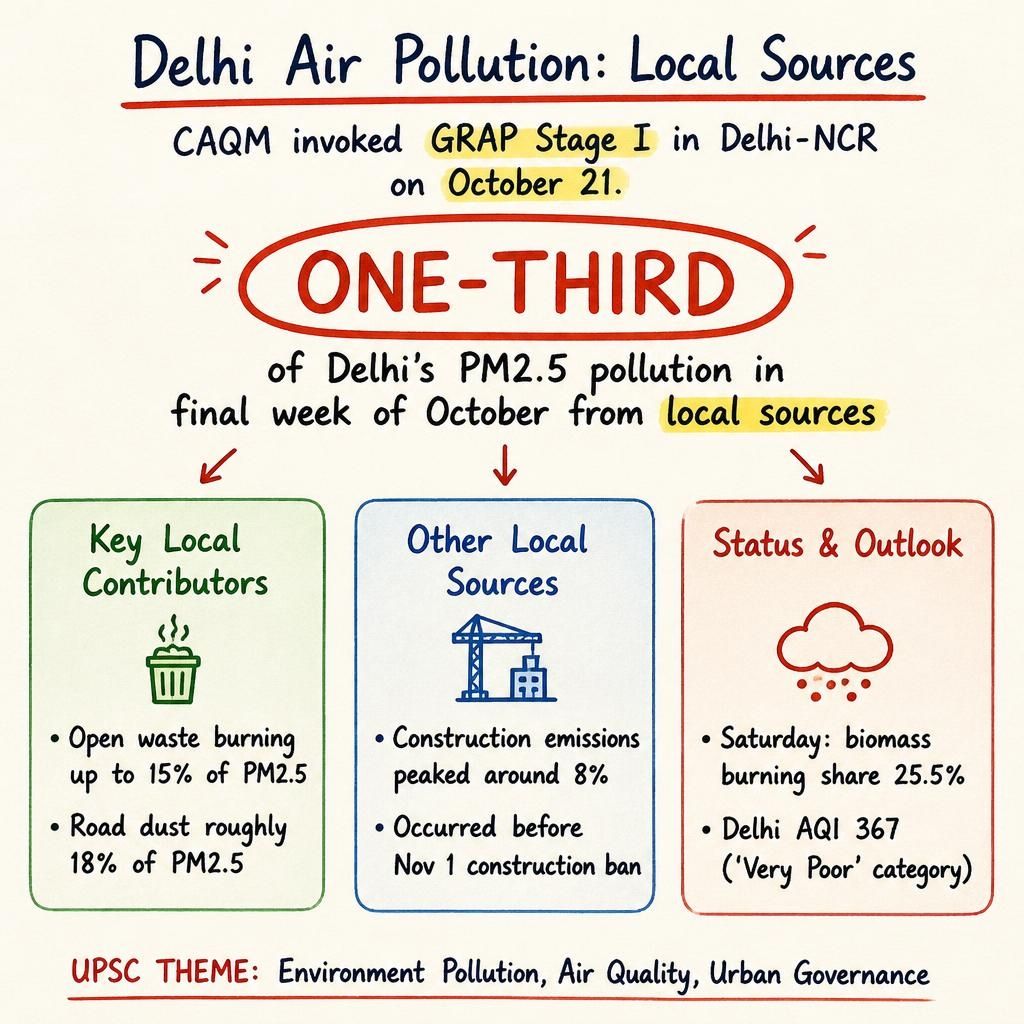
- The Commission for Air Quality Management (CAQM) invoked Stage I of the Graded Response Action Plan (GRAP) in Delhi-NCR on October 21.
- Local sources contributed approximately one-third of Delhi’s PM2.5 pollution in the final week of October.
- Open waste burning, road dust, and construction activity were identified as key local contributors to air pollution.
- Open waste burning accounted for up to 15% and road dust for roughly 18% of Delhi's daily PM2.5 load between October 26 and October 31.
- This significant contribution from local sources occurred before stubble burning and Diwali emissions became dominant in early November.
Air Pollution Sources.jpg
Detailed Insights:
- The analysis was based on source-apportionment data from the Indian Institute of Tropical Meteorology (IITM) for a 30-day period starting October 13.
- The increase in local pollution sources occurred despite GRAP Stage I mandating stricter enforcement against open waste burning and promoting mechanised road sweeping.
- Construction emissions peaked at around 8% of the PM2.5 burden in the first week of October, prior to the Delhi government's construction ban on November 1.
- On a specific Saturday, biomass burning, including stubble burning and domestic solid fuels, accounted for the largest share of PM2.5 pollution at 25.5%.
- Delhi’s daily average Air Quality Index (AQI) was recorded at 367, falling into the 'Very Poor' category, according to data from the Central Pollution Control Board (CPCB).
- A brief improvement in air quality was anticipated due to potential light rain, but pollution levels were expected to rise again shortly thereafter.
Key Concepts Involved:
- PM2.5: Fine particulate matter with a diameter of 2.5 micrometers or less, capable of penetrating deep into the lungs and bloodstream.
- Air Quality Index (AQI): A tool used to communicate air quality status to the public, indicating how clean or polluted the air is and its associated health implications.
- Graded Response Action Plan (GRAP): A set of emergency measures implemented in Delhi-NCR to combat air pollution, with actions escalating based on pollution severity.
- Commission for Air Quality Management (CAQM): A statutory body responsible for coordinating efforts and implementing measures for air quality management in the National Capital Region and adjoining areas.

SuperKalam is your personal mentor for UPSC preparation, guiding you at every step of the exam journey.
Download the App


STUDY RESOURCES
CONTACT US
ⓒ Snapstack Technologies Private Limited