GS 1: Indian SocietyGS 1: Art & CulturePrelimsGS 1: Art FormsGS 1: Indian Society and Diversity of India
1,000 Drums Power Meghalaya Harvest Festival, Pg9
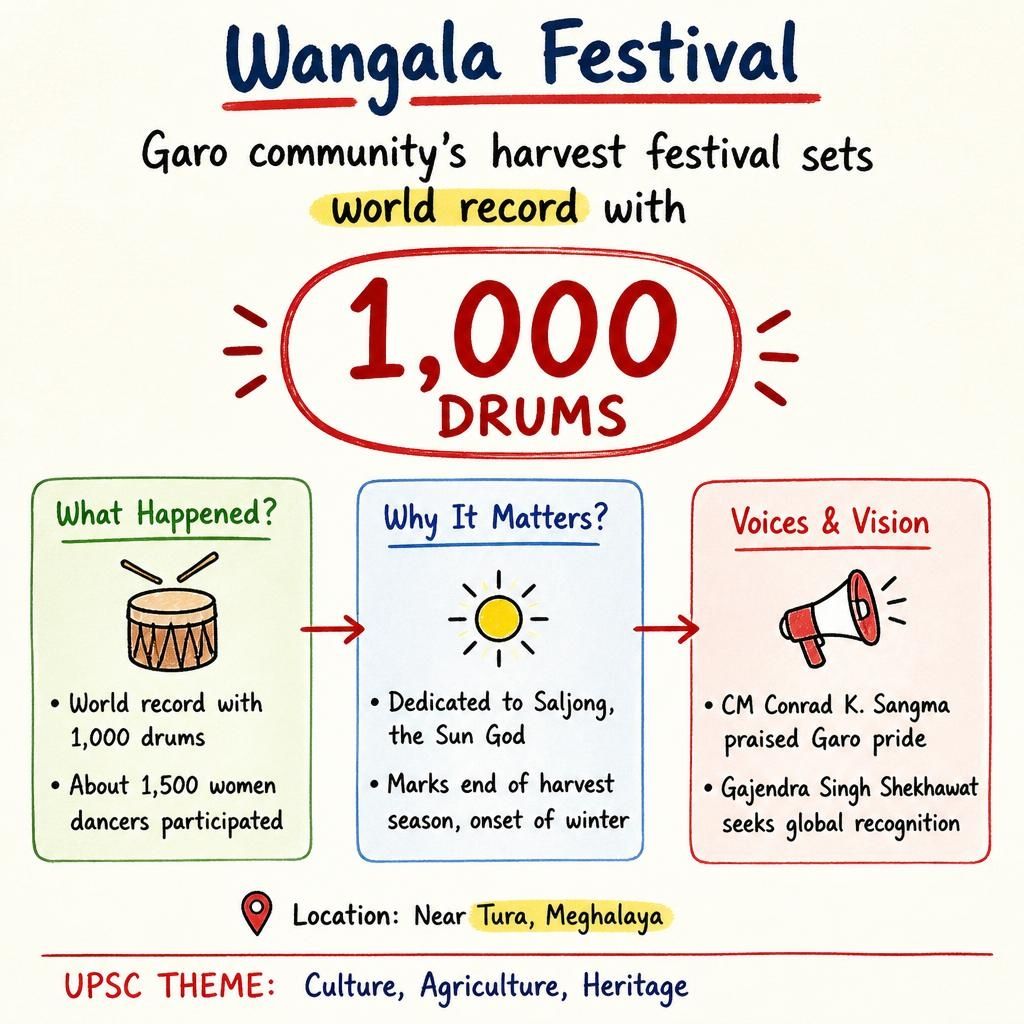
Meghalaya's Garo community sets a Guinness World Record with 1,000 drums at the golden jubilee Wangala harvest festival, celebrating tribal heritage.
Practice MCQs
724 Students attempted
Key Highlights:
- The Wangala festival, the harvest festival of Meghalaya’s Garo community, achieved a world record with 1,000 drums during its Golden Jubilee celebration.
- The event took place near Tura, Meghalaya, with participants from across the five Garo Hills districts.
- The festival is dedicated to Saljong, the Sun God, marking the end of the harvest season and the onset of winter.
- Meghalaya Chief Minister Conrad K. Sangma highlighted the pride of the Garo people in this achievement.
- Union Minister Gajendra Singh Shekhawat expressed aspirations for the festival to gain international recognition, similar to Nagaland's Hornbill festival.
Wangala Festival.jpg
Detailed Insights:
- The Wangala festival, also historically known as the '100 drums festival', is a significant cultural and agricultural celebration for the Garo community.
- Farmers offer sacrifices to Saljong, the Sun God, as a gesture of gratitude for a bountiful harvest.
- The traditional drum central to the festival is called dama, typically measuring about 4 feet in length.
- The festival was formally structured in 1976, and then Chief Minister Captain Williamson A. Sangma expanded it to include 100 drummers.
- The recent record-breaking performance featured approximately 1,500 women dancers and 1,000 drummers at Wangala A’dam.
- The Union Minister emphasized the central government's commitment to preserving and promoting India's diverse cultural heritage.
Key Concepts Involved:
- Wangala Festival: A harvest festival of the Garo community in Meghalaya, dedicated to the Sun God Saljong.
- Garo Community: A major tribal group predominantly residing in the Garo Hills region of Meghalaya, India.
- Saljong: The Sun God, revered by the Garo community and offered sacrifices during the Wangala festival.
- Dama: The traditional, long drum used by the Garo community during their Wangala festival celebrations.

SuperKalam is your personal mentor for UPSC preparation, guiding you at every step of the exam journey.
Download the App


STUDY RESOURCES
CONTACT US
ⓒ Snapstack Technologies Private Limited