GS 3: Science & TechnologyPrelimsGS 3: Indigenization of Technology and New Technology DevelopmentGS 3: IT and Computers
Old Doubts Linger, Yet New Microsoft Quantum Chip Raises the Stakes, Pg2
Microsoft's Majorana 2 quantum chip, claiming topological qubits, faces renewed scientific skepticism regarding its unproven commercial viability.
Source: The Hindu (Pg. 2)
Practice MCQs
898 Students attempted
Key Highlights:
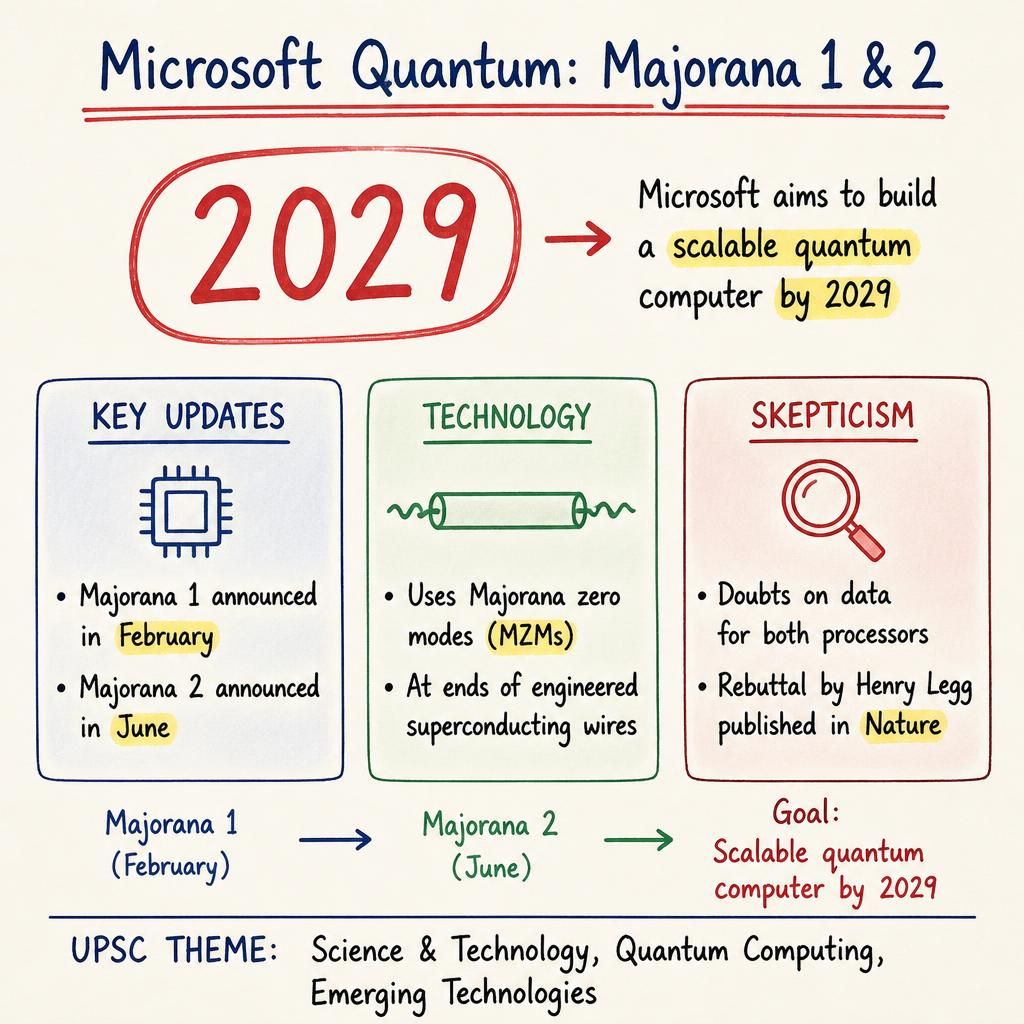
- In February, Microsoft Quantum announced Majorana 1, a processor claimed to contain the world’s first topological qubits using a new material called a ‘topoconductor’.
- The company followed up in June with Majorana 2, an upgraded processor with improved robustness and performance metrics.
- Both announcements faced significant skepticism from the scientific community regarding the conclusive proof of Majorana zero modes (MZMs) and working topological qubits.
- Microsoft aims to build a scalable quantum computer by 2029, a significantly accelerated timeline based on these reported advances.
Quantum Chips.jpg
Detailed Insights:
- The initial announcement of Majorana 1 in February was accompanied by a Nature paper, which was more cautious than Microsoft's press release.
- Topological quantum computing is a promising approach to overcome the fragility of conventional qubits by encoding information in Majorana zero modes.
- Majorana zero modes (MZMs) are emergent quasiparticles, theoretically predicted to exist at the ends of specially engineered superconducting wires.
- A key challenge is to definitively detect MZMs and distinguish them from "impostor states" through indirect measurements and airtight inference.
- Majorana 2 replaced aluminium with lead and redesigned the semiconductor stack, reportedly increasing the topological gap and parity switching time.
- Scientists, including those from the University of Pittsburgh and Cornell University, expressed doubts about the strength and scope of the data presented for both processors.
- A rebuttal published in Nature by Henry Legg questioned the device's suitability for hosting MZMs and the reliability of Microsoft's data analysis protocol.
Scientific/Technical Concepts Involved:
- Topological Qubits: Quantum bits that store information using topological properties, making them inherently more stable against environmental disturbances.
- Majorana Zero Modes (MZMs): Exotic quasiparticles that are their own antiparticles, predicted to exist in certain superconducting materials and used to encode quantum information.
- Quantum Error Correction: Techniques designed to protect fragile quantum information from errors caused by noise and decoherence in quantum systems.
- Topological Gap: The energy difference between the ground state and the first excited state in a topological system, indicating the robustness of the topological protection.

SuperKalam is your personal mentor for UPSC preparation, guiding you at every step of the exam journey.
Download the App


STUDY RESOURCES
CONTACT US
ⓒ Snapstack Technologies Private Limited