GS 1: Indian SocietyGS 2: Social JusticeGS 3: EconomyPrelimsGS 3: Inclusive Growth
IMF Growth Numbers For India Don't Tell The Whole Story, Pg16
IMF projects 7% GDP growth for India, but experts warn against ignoring rising inequality, informality, and unemployment, urging a shift to prosperity-driven growth.
Practice MCQs
898 Students attempted
Key Highlights:
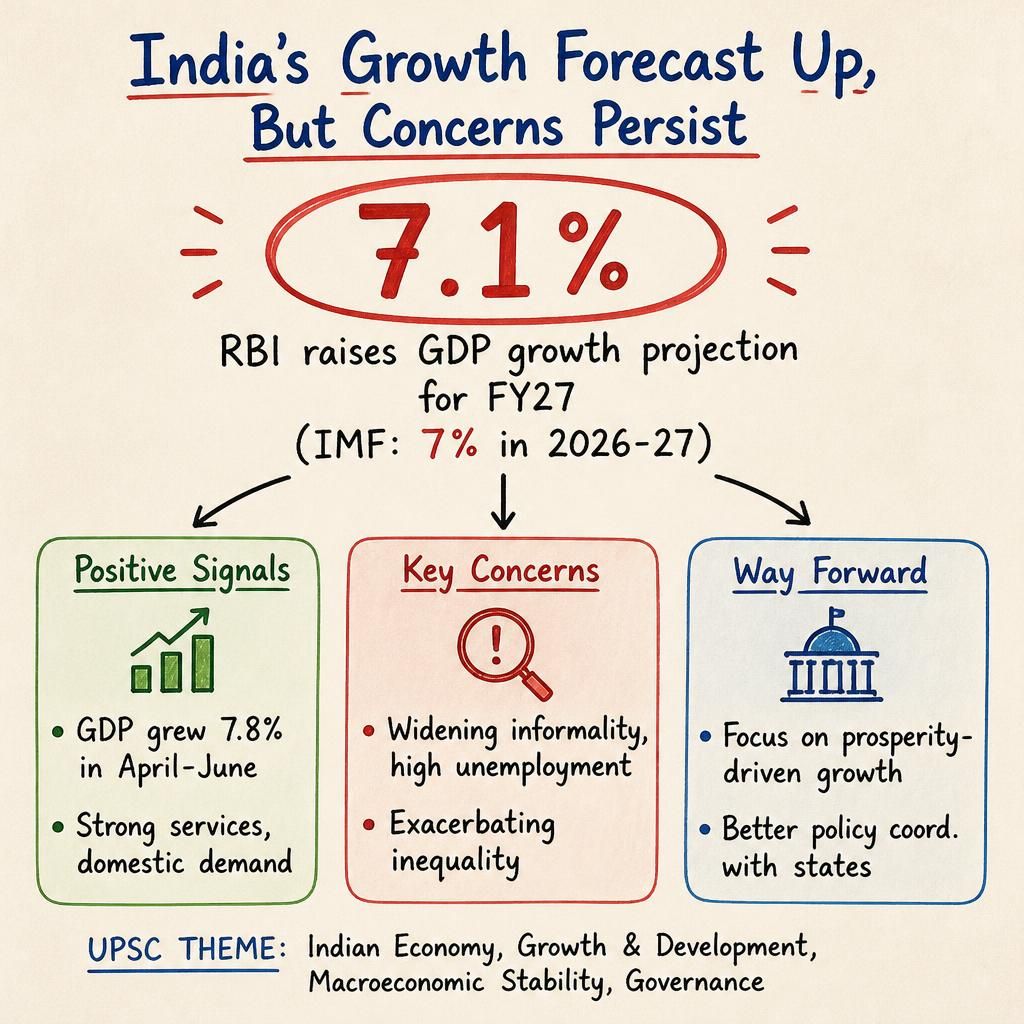
- The International Monetary Fund (IMF) recently raised India's GDP growth forecast to 7% for 2026-27, up from 6.4% in July, citing strong momentum and resilient domestic demand.
- The Reserve Bank of India (RBI) also increased its GDP growth projection for the current fiscal year (FY27) to 7.1%.
- India's economy grew by 7.8% in the April-to-June quarter.
- Despite these positive headline numbers, the article highlights underlying concerns such as widening informality, high unemployment, and exacerbating inequality.
- Geopolitical crises, rising global debt, and volatile financial markets pose external risks to India's stable macro-position.
Growth Forecast.jpg
Detailed Insights:
- The upward revisions by IMF and RBI are attributed to robust services activity and strong domestic demand, positioning India as a fast-growing major economy.
- India's macroeconomic fundamentals have largely withstood global shocks, including the West Asian crisis, which has introduced supply-side concerns and inflationary risks.
- The article suggests that a focus solely on GDP growth rates overlooks critical aspects of economic well-being, such as equitable distribution of prosperity.
- A significant concern is the increasing informality across sectors, where many workers, especially rural-to-urban migrants, struggle to find quality jobs in the organized sector.
- This informality often leads to poor wages, high living costs, and difficult working conditions, contributing to social resentment.
- The article advocates for an "intersectional approach" to growth validation, questioning who truly benefits from economic expansion.
- Key macro challenges for India include managing inflation, addressing structural unemployment, reducing inequality, and ensuring affordable capital flow for productive growth.
- The government is urged to shift its focus from mere GDP numbers to a prosperity-driven growth process.
- There is a need for better, more decentralized policy coordination with states and deeper state-market interaction to prevent monopolistic control in various sectors.
Key Concepts Involved:
- GDP (Gross Domestic Product): The total monetary or market value of all finished goods and services produced within a country's borders in a specific time period.
- Emerging Market Economy (EME): A country that has some characteristics of a developed market but does not meet all the standards to be a developed market.
- Informality in Economy: Economic activities and employment relationships that operate outside formal legal, regulatory, and social security frameworks.
- Intersectionality (Economic Context): A framework analyzing how overlapping social identities and systemic factors create unique experiences of economic advantage or disadvantage.

SuperKalam is your personal mentor for UPSC preparation, guiding you at every step of the exam journey.
Download the App


STUDY RESOURCES
CONTACT US
ⓒ Snapstack Technologies Private Limited