GS 2: International RelationsGS 3: Environment & EcologyGS 3: EconomyPrelimsGS 3: Changes in Industrial Policy and Effects on Industrial Growth
How to turn overseas green regulation into export advantage, Pg17
India must strategically leverage overseas green regulations, like EU's CBAM, to finance its green industrialization, boost exports, and gain a competitive global advantage.
Practice MCQs
898 Students attempted
Key Highlights:
- India initially resisted overseas green trade regulations like the EU's Carbon Border Adjustment Mechanism (CBAM), viewing them as protectionist.
- A new approach suggests leveraging these regulations to finance India's green industrialization and gain export advantage.
- India aims for net-zero by 2070 and can use global green rules to establish lower-carbon industries from the outset.
- Opportunities exist in exporting green ammonia, Sustainable Aviation Fuel (SAF), cleaner steel, aluminum, and electrical equipment.
- India can build Digital Public Infrastructure (DPI) for carbon accounting and traceability to lower compliance costs.
- Redesigning India's carbon market with higher prices and sector-level targets is crucial for incentivizing decarbonization.
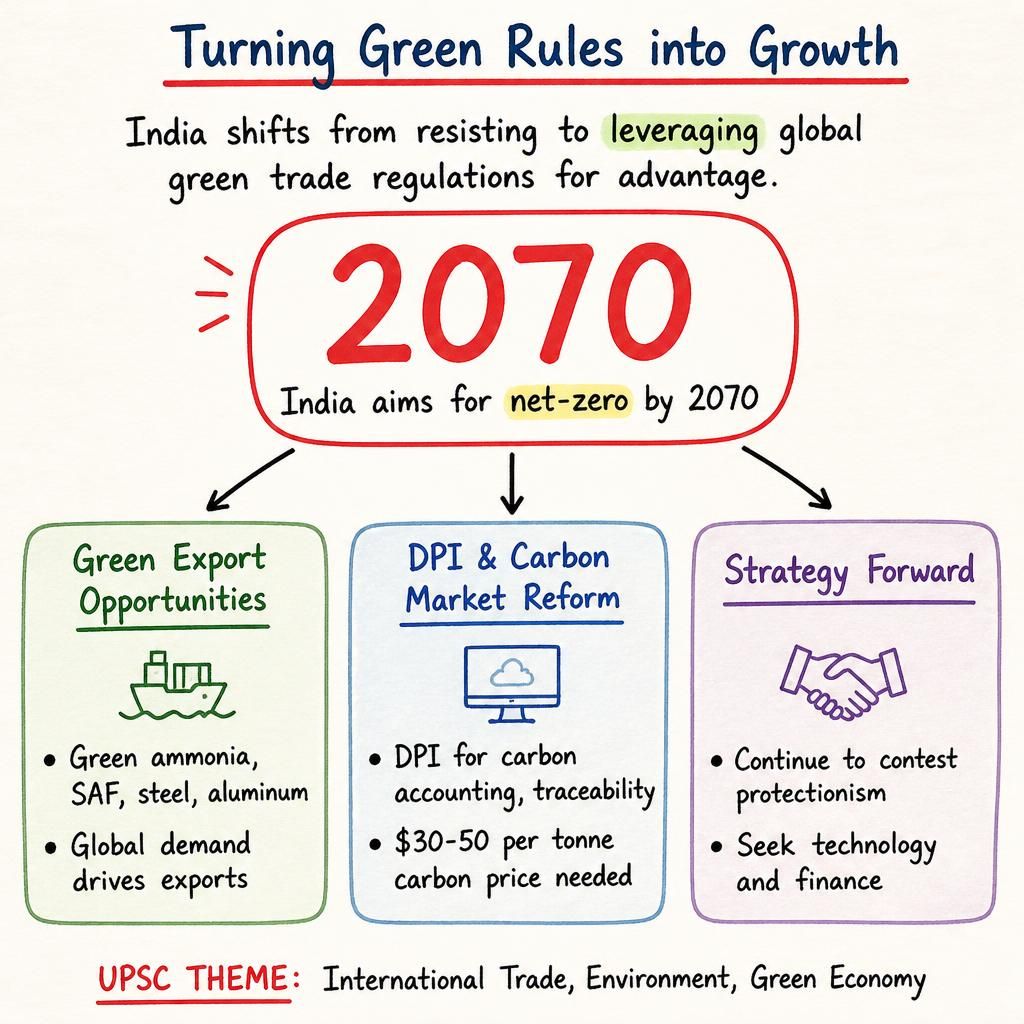
Green Rules.jpg
Detailed Insights:
- The EU's Carbon Border Adjustment Mechanism (CBAM) is set to widen in scope, making green trade regulation a permanent feature.
- Cleaner technologies are capital-intensive, and regulated foreign markets can help finance their early costs for India.
- India has discovered some of the world's lowest prices for green ammonia, offering export potential to Europe, Japan, and Korea.
- Long-term export contracts for green ammonia can help finance early plants and build domestic industry.
- ReFuelEU Aviation regulation mandates a 2% Sustainable Aviation Fuel (SAF) blending requirement by 2025, creating export demand.
- Diverting ethanol from domestic petrol blending to produce higher-value SAF for export is a viable strategy.
- Rising carbon costs in Europe for primary steel create a price umbrella for India to finance cleaner production methods.
- Investments in recycled aluminum and smelters using clean power can provide an export advantage as indirect emissions are counted.
- The global market for electrical equipment is approximately $500 billion, where India currently holds less than 2% of exports.
- India's Digital Public Infrastructure (DPI) model can be adapted to create low-cost, interoperable systems for product-level carbon accounting.
- A carbon price of $30-50 per tonne is needed in India's carbon market to effectively change investment decisions in key sectors.
- Sector-level targets, rather than plant-specific ones, are recommended for India's carbon market to incentivize overall decarbonization.
- India should continue to contest protectionism and seek technology and finance from rich countries.
Key Concepts Involved:
- Carbon Border Adjustment Mechanism (CBAM): An EU policy imposing a carbon price on imported goods to prevent carbon leakage.
- Net-zero emissions: Achieving an overall balance between greenhouse gas emissions produced and greenhouse gas emissions removed from the atmosphere.
- Green industrialization: The process of developing and expanding industries that produce goods and services with minimal environmental impact.
- Sustainable Aviation Fuel (SAF): Biofuel used to power aircraft that has a smaller carbon footprint than traditional jet fuel.
- Digital Public Infrastructure (DPI): Open, interoperable digital systems that enable essential public and private services at scale.

SuperKalam is your personal mentor for UPSC preparation, guiding you at every step of the exam journey.
Download the App


STUDY RESOURCES
CONTACT US
ⓒ Snapstack Technologies Private Limited