GS 3: Science & TechnologyPrelimsGS 3: Achievements of Indians in Science and TechnologyGS 3: Space Technology
Chandrayaan-1 may have just detected oldest impact basin on Moon: Researchers, Pg9
Chandrayaan-1 data reveals Australe Basin, potentially Moon's oldest impact crater, offering new insights into lunar geology and future missions.
Practice MCQs
891 Students attempted
Key Highlights:
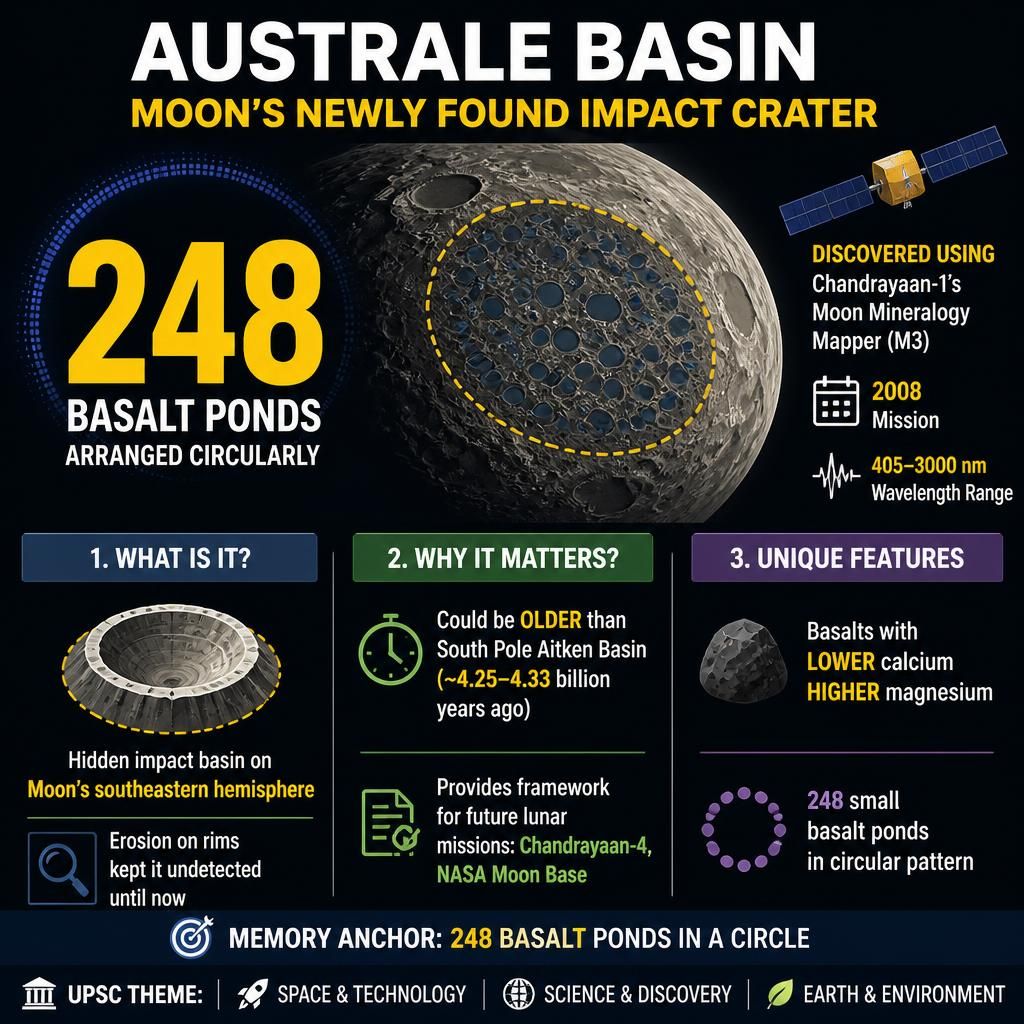
- Planetary scientists from the Physical Research Laboratory (PRL), Ahmedabad, have confirmed the existence of a previously hidden impact crater, the Australe Basin, on the Moon's southeastern hemisphere.
- This discovery was made using mineralogical data collected by NASA's Moon Mineralogy Mapper (M3) instrument aboard India's Chandrayaan-1 mission.
- The Australe Basin exhibits a unique mineralogical composition, featuring basalts that are relatively lower in calcium and higher in magnesium, and is characterized by 248 small basalt ponds arranged circularly.
- Researchers suggest that this newly identified basin could be older than the South Pole Aitken Basin, which is currently recognized as the Moon's largest and oldest known impact basin, formed approximately 4.25 to 4.33 billion years ago.
- The study provides a framework for interpreting data from future lunar missions, including India's Chandrayaan-4 and NASA's proposed Moon Base mission.
Chandrayaan 1.jpg
Detailed Insights:
- The Australe Basin had remained undetected until now because erosion along its rims made it difficult to identify even with modern imaging techniques.
- Chandrayaan-1, India's first lunar mission launched in 2008, aimed to conduct high-resolution remote sensing for topographical and mineralogical mapping of the lunar surface.
- The Moon Mineralogy Mapper (M3) is an imaging spectrometer that provided the first high-resolution mineralogical map of the entire lunar surface, operating in the 405 to 3000 nanometer wavelength range.
- The South Pole Aitken Basin, located on the lunar far side, is a significant feature whose age has been refined by recent studies using samples from missions like Chang'e-6.
- The unique magnesium-rich rock compositions found in the Australe Basin are noteworthy, as similar higher concentrations of magnesium were also observed at the Chandrayaan-3 landing site, known as Shiv Shakti point.
- Understanding the evolution of lunar regolith in regions like the South Polar area is crucial for planning and executing future exploration missions.
Scientific/Technical Concepts Involved:
- Impact Basin: A large, circular depression on a planetary surface formed by the high-velocity collision of an asteroid or comet.
- Mineralogy: The scientific study of minerals, including their chemical composition, crystal structure, and physical properties.
- Imaging Spectrometer: An instrument that captures images while simultaneously collecting spectral data for each pixel, enabling the identification of material composition.
- Regolith: The layer of loose, unconsolidated rock, dust, and soil that covers solid bedrock on planetary bodies like the Moon.

SuperKalam is your personal mentor for UPSC preparation, guiding you at every step of the exam journey.
Download the App


STUDY RESOURCES
CONTACT US
ⓒ Snapstack Technologies Private Limited