GS 3: EconomyGS 2: GovernancePrelimsGS2: Government policies and interventions for development in various sectorsGS2: Effect of Policies and Politics of Developed and Developing Countries on India's Interests
India Locks In 1.7 Million Tonnes Of Urea Imports At Sharply Lower Price, Pg25
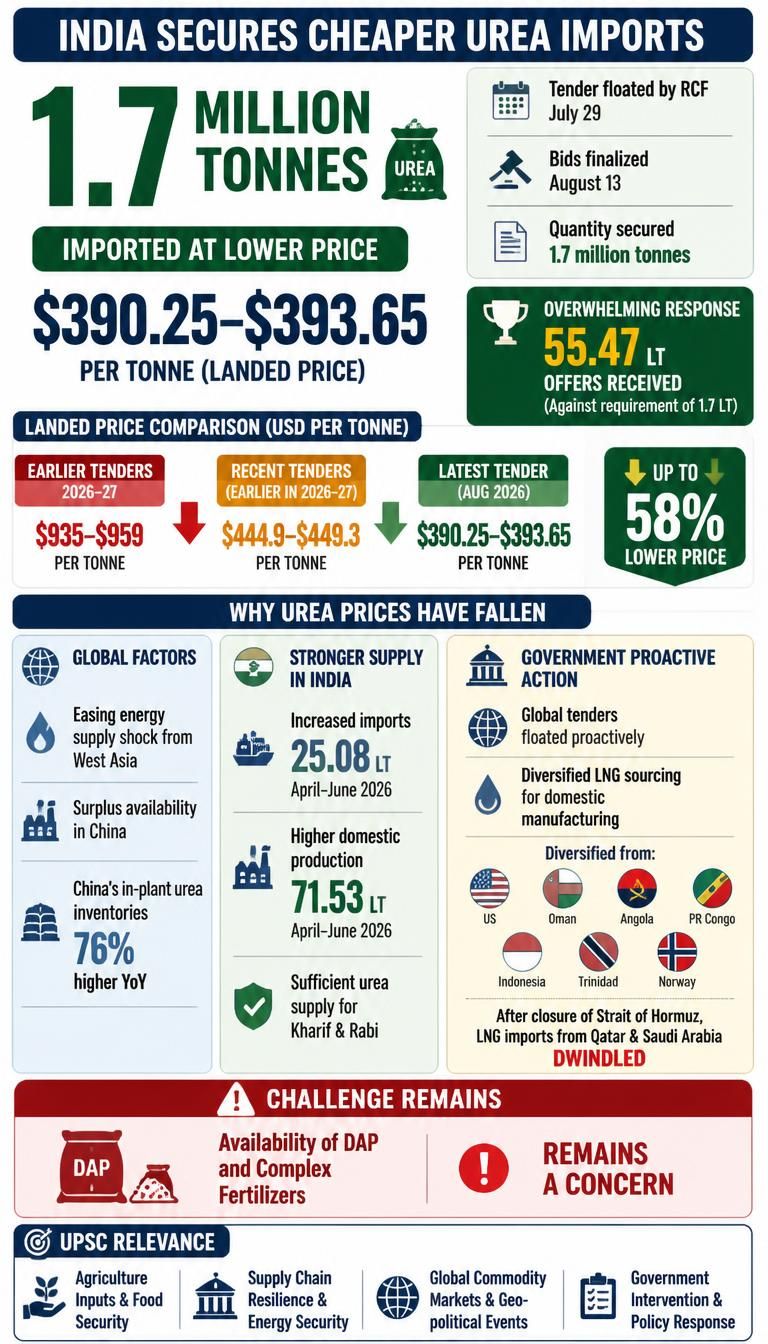
India secures 1.7 million tonnes of urea imports at sharply reduced prices of $390-$393 per tonne, ensuring critical supply for the upcoming rabi crop.
Practice MCQs
883 Students attempted
Key Highlights:
- India has secured imports of 1.7 million tonnes (lt) of urea at a significantly lower landed price of $390.25-$393.65 per tonne.
- The import tender was floated by Rashtriya Chemicals and Fertilizers (RCF) on July 29, with bids finalized on August 13.
- This price is substantially lower than previous contracted rates of $444.9-449.3 and $935-959 per tonne in earlier tenders during the 2026-27 fiscal year.
- The tender attracted offers for 55.47 lt of urea, far exceeding the required quantity.
Urea.jpg
Detailed Insights:
- The reduction in urea prices is attributed to an easing of the energy supply shock from West Asia and surplus availability in China.
- China's in-plant urea inventories were estimated to be 76% higher than the previous year, contributing to global supply.
- India's urea availability improved significantly due to increased imports (25.08 lt in April-June 2026) and domestic production (71.53 lt in April-June 2026).
- The government proactively managed supplies by floating global tenders and diversifying Liquefied Natural Gas (LNG) sourcing for domestic manufacturing.
- LNG imports were diversified from countries like the US, Oman, Angola, People's Republic of Congo, Indonesia, Trinidad, and Norway.
- This diversification was crucial after LNG imports from Qatar and Saudi Arabia dwindled following the closure of the Strait of Hormuz.
- While urea supply is secure for the Kharif and Rabi seasons, the availability of Di-ammonium phosphate (DAP) and complex fertilizers remains a concern.
- The success in diversifying urea and LNG sources has not been replicated for other fertilizers or their raw materials like sulphur, phosphoric acid, and ammonia.
Key Concepts Involved:
- Urea: A nitrogen-rich chemical fertilizer essential for agricultural productivity.
- Rabi season: The winter-spring cropping season in India, typically from October to March.
- Kharif season: The monsoon cropping season in India, typically from June to November.
- Landed price: The total cost of an imported good, including purchase price, freight, insurance, and other charges up to the destination port.
- Liquefied Natural Gas (LNG): Natural gas converted to liquid form for easier storage and transport, a key raw material for urea production.
- Strait of Hormuz: A narrow, strategically important waterway connecting the Persian Gulf to the Arabian Sea, crucial for global oil and gas shipments.

SuperKalam is your personal mentor for UPSC preparation, guiding you at every step of the exam journey.
Download the App


STUDY RESOURCES
CONTACT US
ⓒ Snapstack Technologies Private Limited