GS 2: GovernanceGS 2: PolityGS 2: Social JusticePrelimsGS 2: E Governance
SC weighs SOP for urgent cases affecting life, liberty, Pg1
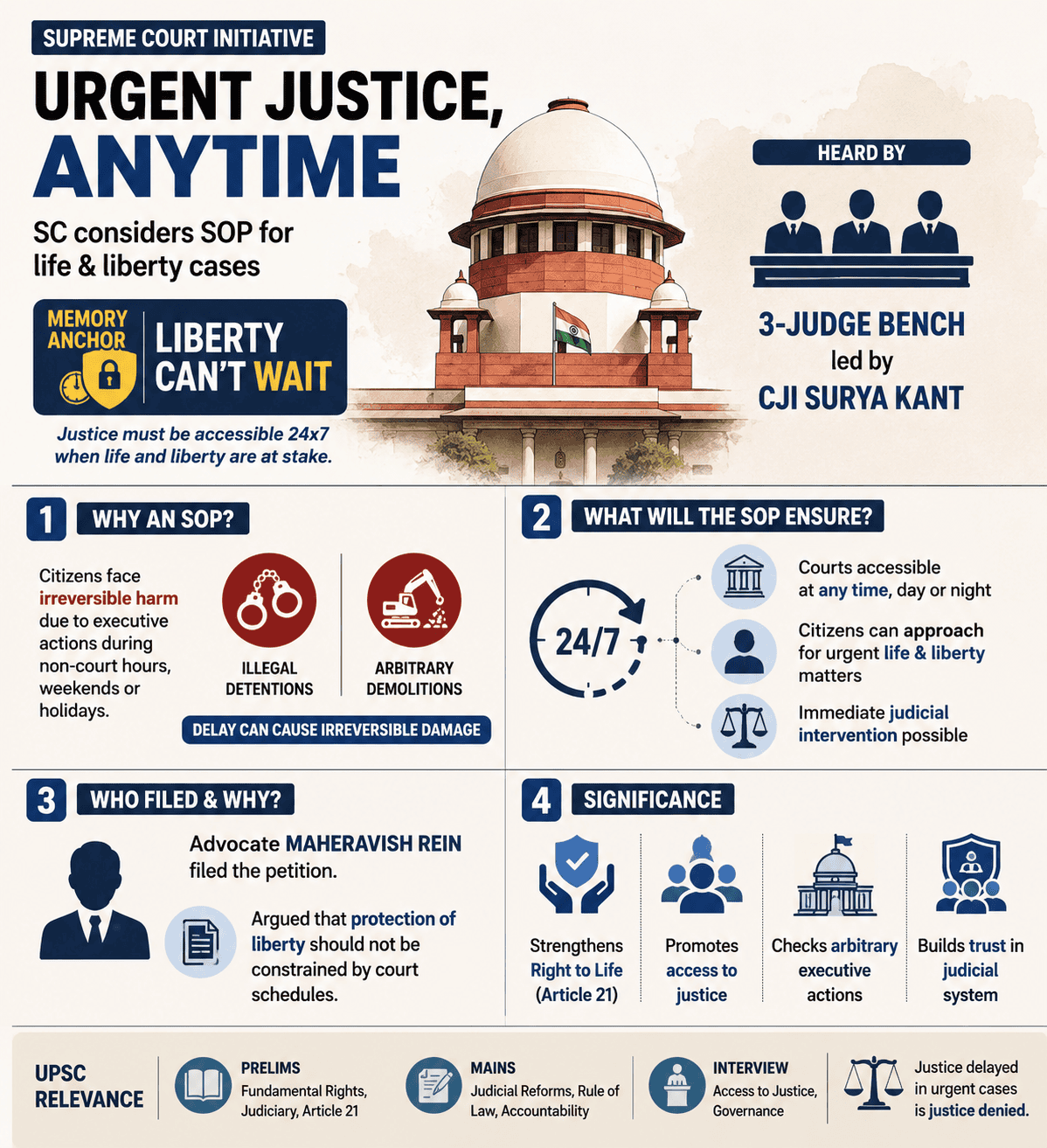
Supreme Court considers framing 24/7 SOP for urgent cases, ensuring continuous judicial access for life and liberty issues like illegal detentions and demolitions.
Practice MCQs
876 Students attempted
Key Highlights:
- The Supreme Court is considering framing a Standard Operating Procedure (SOP) for urgent cases affecting life and liberty.
- This SOP aims to ensure citizens can approach courts at any time, day or night, for matters like illegal detentions or demolitions.
- A three-judge Bench led by Chief Justice of India Surya Kant is hearing a petition on this matter.
- The proposed mechanism seeks to address issues arising from executive actions during non-court hours, weekends, or holidays.
SC urgent hearing.png
Detailed Insights:
- Advocate Maheravish Rein filed the petition, arguing that the protection of liberty should not be constrained by court schedules.
- The petition highlighted that the absence of continuous judicial accessibility can lead to irreversible consequences.
- The Bench suggested that the court's response time to urgent requests under the SOP could be as short as an hour.
- Solicitor-General Tushar Mehta proposed framing the SOP on the administrative side, but the Chief Justice indicated it might require a judicial order due to the federal structure involving High Courts.
- Justice Joymalya Bagchi noted that digital access to justice, including e-filing, means courts are never truly "closed."
- While technological advancements exist, they are not yet uniformly integrated into an institutional framework for emergency judicial access outside regular hours.
Key Concepts Involved:
- Standard Operating Procedure (SOP): A set of step-by-step instructions to ensure consistency and efficiency in routine operations.
- Life and Liberty: Fundamental rights guaranteed under Article 21 of the Indian Constitution, protecting personal freedom and dignity.
- Judicial Accessibility: The principle ensuring that individuals have practical and timely access to courts for legal remedies.
- Constitutional Courts: The Supreme Court and High Courts in India, vested with powers to interpret the Constitution and protect fundamental rights.

SuperKalam is your personal mentor for UPSC preparation, guiding you at every step of the exam journey.
Download the App


STUDY RESOURCES
CONTACT US
ⓒ Snapstack Technologies Private Limited