GS 2: GovernanceGS 1: Indian SocietyGS 3: EconomyPrelimsGS 2: Government policies and interventions for development in various sectors
India's biggest parking problem is that it's free, Pg13
India's free parking culture fuels urban conflicts and congestion, demanding urgent policy reforms for sustainable city planning and revenue generation.
Practice MCQs
876 Students attempted
Key Highlights:
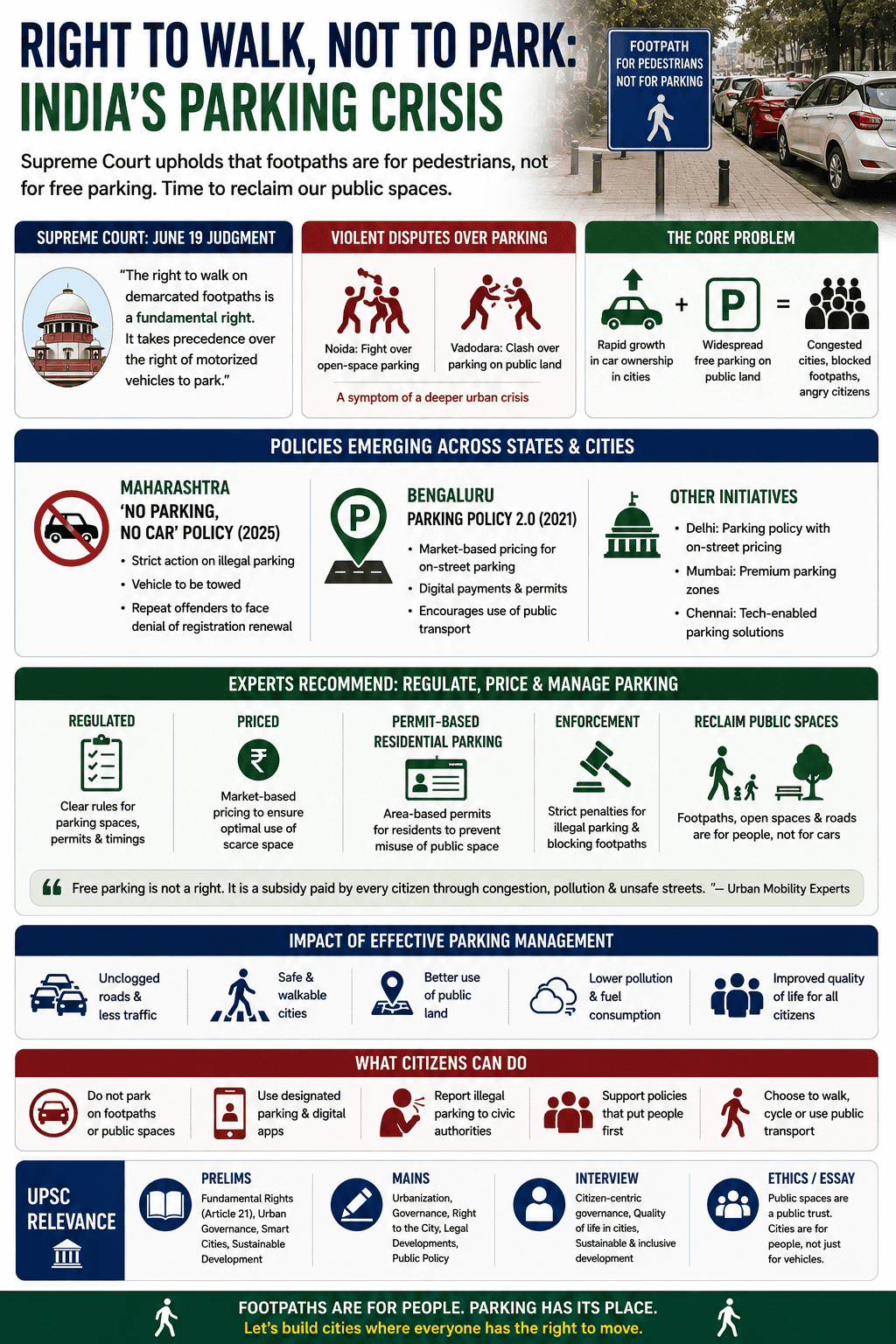
- The Supreme Court's June 19 judgment on the fundamental right to walk highlighted the violation of footpaths by free parking.
- Incidents of violent disputes over open-space parking in Noida and Vadodara underscore the severity of the problem.
- The core issue is the rapid growth in car ownership in Indian cities coupled with the widespread practice of free parking on public land.
- Several states and cities are implementing policies like Maharashtra's 'No Parking, No Car' policy (2025) and Bengaluru's Parking Policy 2.0 (2021) to regulate parking.
- Experts advocate for regulated, priced, and permit-based residential parking to address congestion and reclaim public spaces.
Right to walk.png
Detailed Insights:
- The Supreme Court ruling emphasizes that the right to walk on demarcated footpaths takes precedence over motorized vehicles.
- The increase in car ownership, particularly in metropolitan areas, has led to a shrinking of available free parking spaces.
- A strong sense of entitlement among car owners contributes to the misuse of public spaces for parking.
- The Comprehensive Policy on Traffic, Road Safety, Encroachment and Cattle Menace for Ahmedabad City (2026) requires pre-building use parking compliance for development permissions.
- The Odisha Comprehensive State Parking Policy (2026) includes provisions for residential parking permits.
- Delhi Maintenance and Management of Parking Rules, 2017, proposed paid on-street parking in residential areas, though full enforcement is pending.
- The Motor Vehicles Act, 1988 and Central Motor Vehicles Rules, 1989, currently do not mandate proof of parking space for new vehicle registration.
- Urban planning experts like Donald Shoup argue that free parking exacerbates car use, congestion, and housing costs.
- Implementing paid parking systems can help reduce congestion, improve emergency access, and discourage multiple car ownership.
- Parking fees can generate revenue for Urban Local Bodies to invest in public transport and pedestrian infrastructure.
Key Concepts Involved:
- Right to Walk: A fundamental right recognized by the Supreme Court, ensuring access to safe and demarcated footpaths.
- Right to the City: A concept advocating for collective power to shape urban processes and ensure equitable access to urban resources.
- Motor Vehicles Act, 1988: A central law regulating all aspects related to motor vehicles in India, including registration and traffic rules.
- Urban Local Bodies (ULBs): Local self-governing institutions responsible for urban planning, infrastructure, and public services.

SuperKalam is your personal mentor for UPSC preparation, guiding you at every step of the exam journey.
Download the App


STUDY RESOURCES
CONTACT US
ⓒ Snapstack Technologies Private Limited