GS 3: Science & TechnologyPrelimsGS 3: Indigenization of Technology and New Technology DevelopmentGS 3: Space Technology
How the Gaganyaan crew module is built to survive, Pg10
Gaganyaan's crew module design ensures astronaut safety during re-entry, balancing aerodynamics, stability, and thermal loads with its sphere-cone configuration.
Practice MCQs
876 Students attempted
Key Highlights:
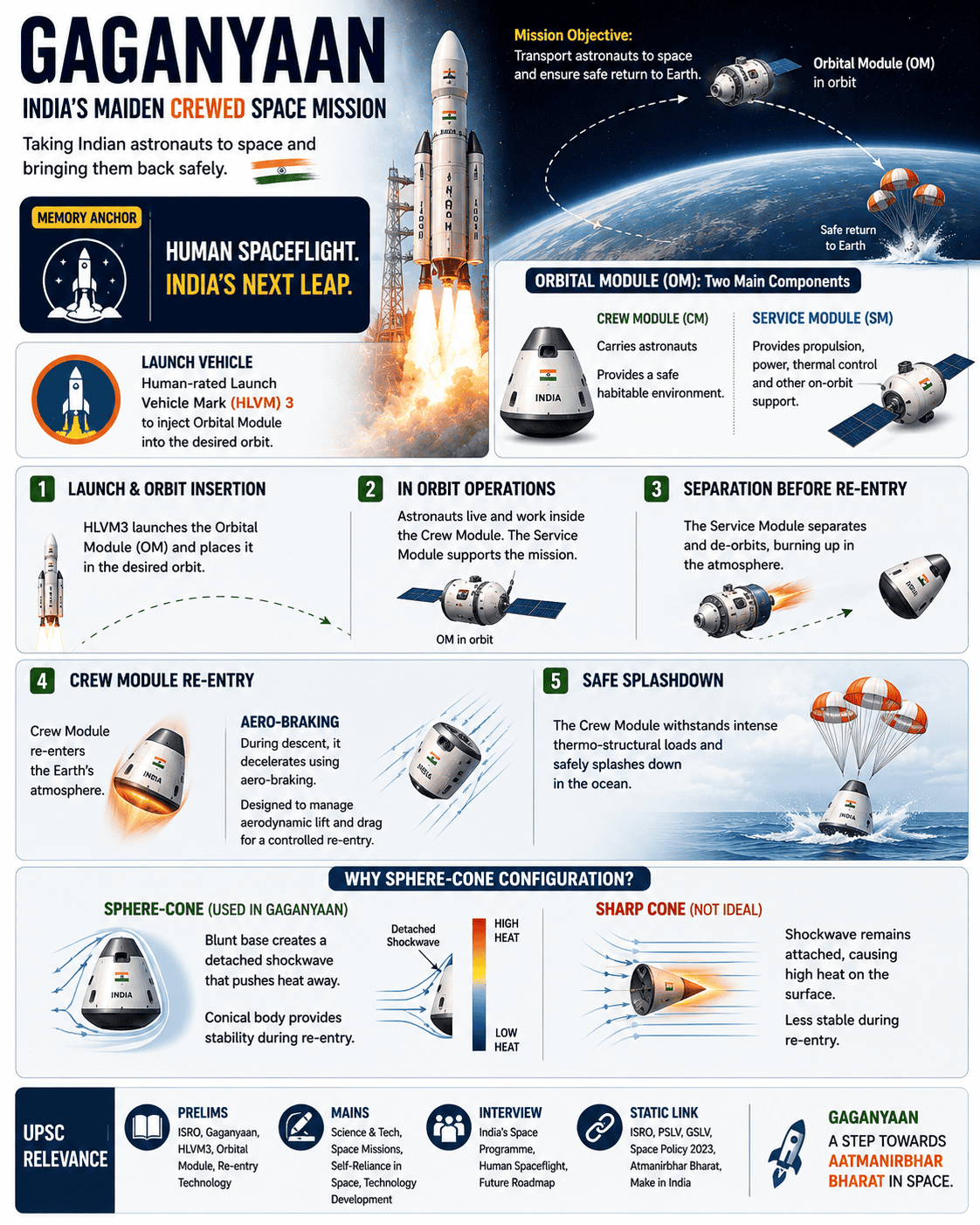
- Gaganyaan is India's maiden crewed space mission, designed to transport Indian astronauts to space and ensure their safe return to Earth.
- The mission will use the Human-rated Launch Vehicle Mark (HLVM) 3 to inject the Orbital Module (OM) into the desired orbit.
- The Orbital Module (OM) comprises a Crew Module for astronauts and a Service Module for on-orbit support.
- The Crew Module is designed with a sphere-cone configuration to withstand intense thermo-structural loads during re-entry and ensure a safe splashdown.
Gaganyaan.png
Detailed Insights:
- The Service Module provides propulsion and separates from the Crew Module before re-entry, burning up in the atmosphere.
- The Crew Module decelerates through aero-braking during descent, designed to manage aerodynamic lift and drag for a controlled re-entry.
- A sphere-cone configuration is preferred for re-entry bodies as its blunt base generates a detached shockwave, pushing heat away, while the conical body provides stability.
- The Gaganyaan Crew Module has two distinct stable aerodynamic and hydrodynamic positions, managed by control thrusters and an up-righting system post-splashdown.
- Dynamic instability, characterized by uncontrolled oscillations during atmospheric deceleration, is a critical challenge addressed by the module's design and control mechanisms.
- Other crewed spacecraft, like Russia's Soyuz and China's Shenzhou, often use a three-module configuration, with an additional module for extra living space and docking.
Scientific/Technical Concepts Involved:
- Orbital Module (OM): The combined spacecraft unit housing the crew and providing necessary support for the mission in orbit.
- Crew Module: The habitable section of the spacecraft designed to carry astronauts and safely return them to Earth.
- Service Module: The uncrewed section of the spacecraft providing propulsion, power, and life support systems for the Orbital Module.
- Aero-braking: A technique using atmospheric drag to slow down a spacecraft, reducing the need for propulsive braking.
- Mono-stability: The characteristic of a re-entering body to maintain a single, stable orientation during atmospheric flight or after splashdown.
- Dynamic Instability: A condition where a re-entry module experiences rapidly growing and uncontrolled oscillations during atmospheric deceleration.

SuperKalam is your personal mentor for UPSC preparation, guiding you at every step of the exam journey.
Download the App


STUDY RESOURCES
CONTACT US
ⓒ Snapstack Technologies Private Limited