GS 2: International RelationsGS 3: EconomyPrelimsGS 2: Bilateral, Regional and Global Groupings and AgreementsGS 2: Effect of Policies and Politics of Developed and Developing Countries on India's Interests
U.S. assures India of tariff edge over its competitors, Pg1
U.S. assures India of tariff advantage over competitors in crucial interim trade deal, aiming for completion by financial year-end.
Practice MCQs
898 Students attempted
Key Highlights:
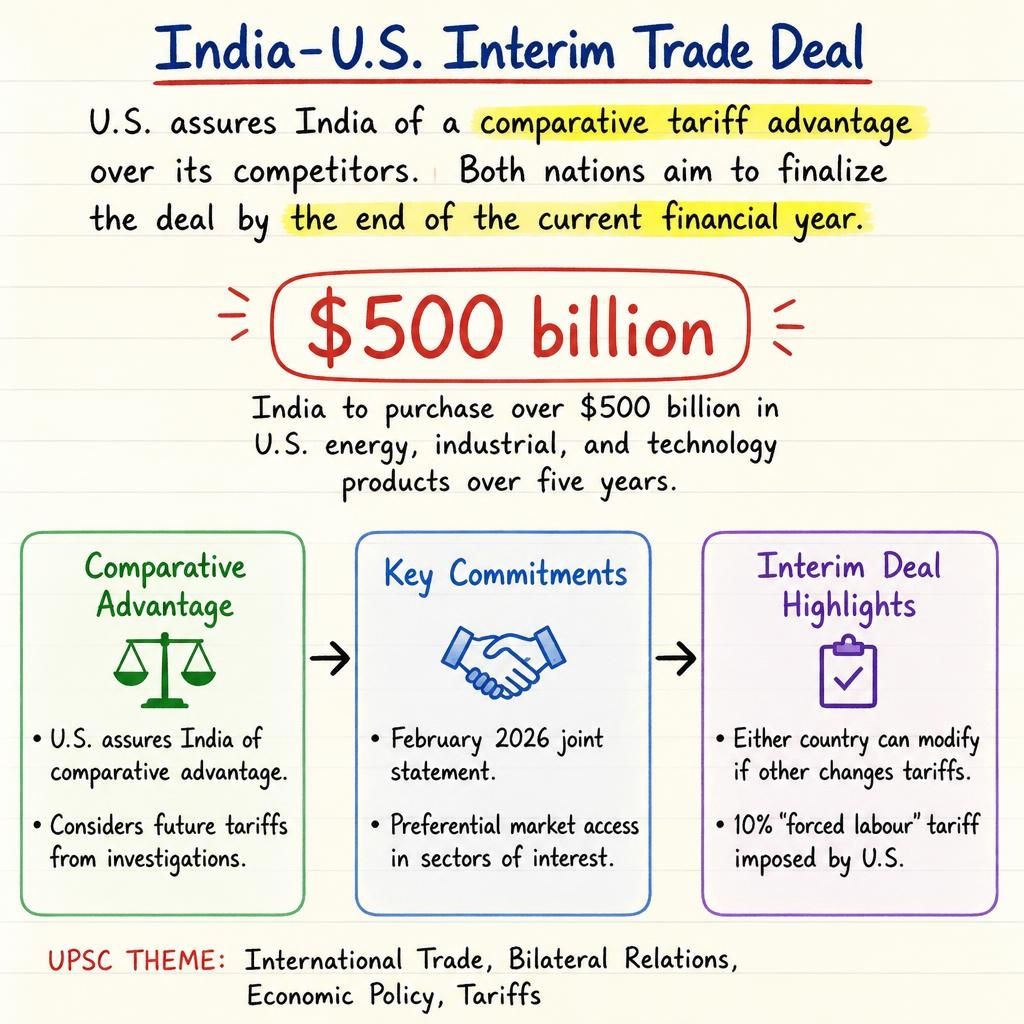
- The U.S. has assured India of a comparative tariff advantage over its competitors as part of the ongoing interim trade deal.
- Both nations aim to finalize the deal by the end of the current financial year.
- This assurance aligns with the February 2026 joint statement between Prime Minister Narendra Modi and U.S. President Donald Trump.
- The deal includes a unique clause allowing either country to modify its commitments if the other changes its tariffs.
- The U.S. recently imposed an additional 10% 'forced labour' tariff on India, similar to those on other competitors.
India-US Trade Deal.jpg
Detailed Insights:
- The interim trade deal is a significant step towards a broader Bilateral Trade Agreement (BTA) between India and the U.S.
- The February 2026 joint statement committed both countries to providing each other preferential market access in sectors of mutual interest on a sustained basis.
- India's insistence on a comparative advantage is crucial, especially given the U.S. imposition of 'forced labour' tariffs and ongoing investigations into excess capacity.
- The U.S. assurance reportedly considers potential future tariffs that might arise from these investigations.
- A two-man team from the U.S. visited India in early November, making substantial progress on customs and trade facilitation.
- India has also committed to purchasing over $500 billion in U.S. energy, industrial, and technology products over five years as part of the framework.
Key Concepts Involved:
- Interim Trade Deal: A preliminary agreement aimed at facilitating trade and building trust, often preceding a comprehensive free trade agreement.
- Comparative Advantage: The ability of a country to produce a good or service at a lower opportunity cost than another country.
- Preferential Market Access: Granting favorable terms, such as lower tariffs or quotas, to specific trading partners for certain goods.
- Tariffs: Taxes imposed on imported goods and services, increasing their price and making them less competitive.

SuperKalam is your personal mentor for UPSC preparation, guiding you at every step of the exam journey.
Download the App


STUDY RESOURCES
CONTACT US
ⓒ Snapstack Technologies Private Limited