GS 2: International RelationsPrelimsGS 2: Bilateral, Regional and Global Groupings and AgreementsGS 2: Effect of Policies and Politics of Developed and Developing Countries on India's InterestsGS 2: Important International Institutions, Agencies and Fora
The Challenge Of Holding The Quad Together, Pg6
Quad leaders to convene in Manila, marking Trump's first summit, amidst Indo-Pacific strategic turbulence and China's growing regional assertiveness.
Practice MCQs
898 Students attempted
Key Highlights:
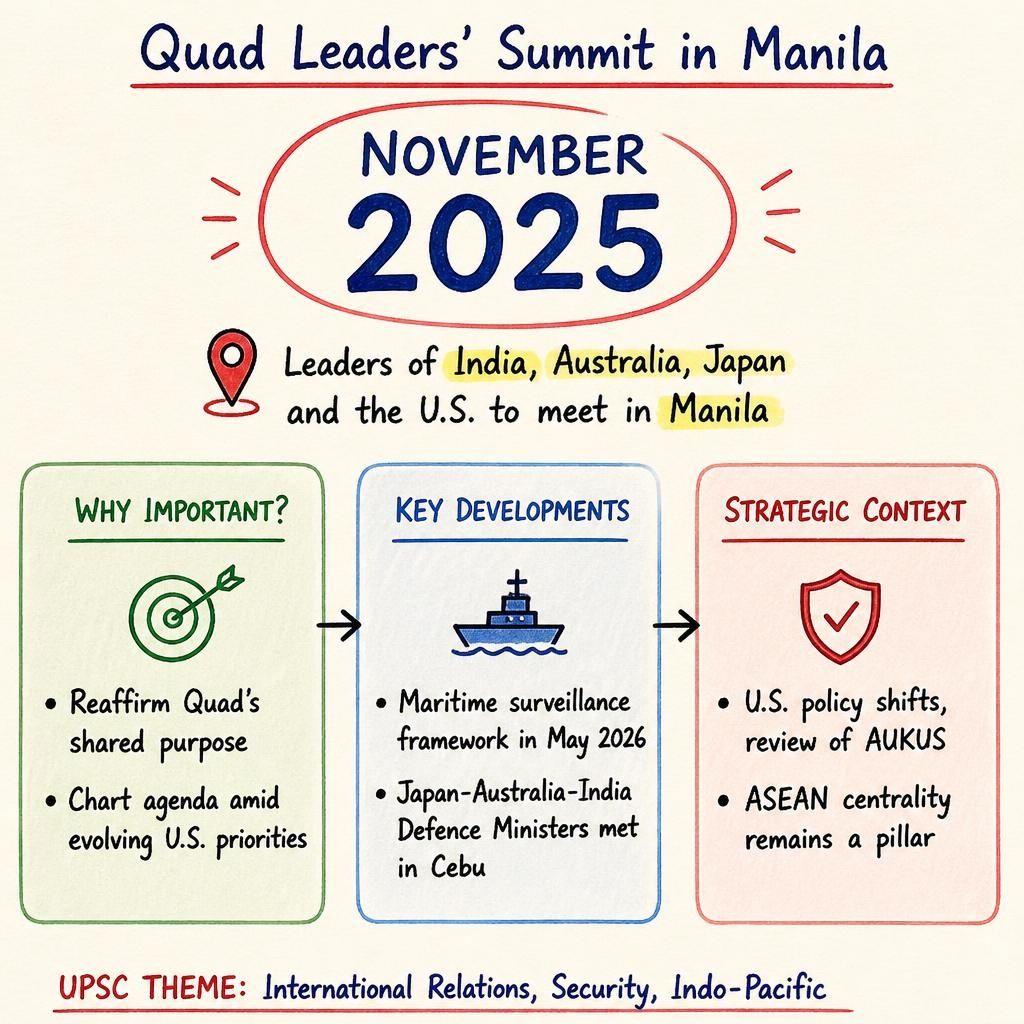
- The leaders of the Quad countries—India, Australia, Japan, and the U.S.—are expected to meet in Manila in November, on the sidelines of the ASEAN Summit.
- This will be the first Quad summit since Donald Trump began his second term as U.S. President and the first for Japanese Prime Minister Sanae Takaichi.
- The previous Quad Leaders’ Summit was held in Wilmington in 2024.
- The Quad experienced strategic turbulence in 2025 due to shifting U.S. geopolitical priorities and changing bilateral relations with members, particularly India.
- Despite challenges, the Quad continued operational synergies, notably elevating the Indo-Pacific Maritime Domain Awareness initiative to the Indo-Pacific Maritime Surveillance Collaboration framework in May 2026.
Quad Leaders Summit.jpg
Detailed Insights:
- The upcoming summit in Manila is crucial for reaffirming the Quad's shared purpose and charting its agenda, especially given its lack of a permanent bureaucracy.
- A key question is how President Trump will engage with the Quad and the broader Indo-Pacific, as his current priorities have been focused on the Russia-Ukraine war and West Asia.
- Concerns exist among Indo-Pacific partners regarding a potential shift in U.S. engagement and its insistence on burden-sharing within security architectures like NATO.
- The U.S. decision to review AUKUS has heightened uncertainty, prompting regional countries to diversify their security policies.
- Japan, through its One Cooperative Effort Among Nations (OCEAN) framework, is reshaping its post-war security posture by deepening strategic alignment with partner countries.
- Australia is strengthening defence partnerships with India, Japan, Southeast Asian, and Pacific Island countries to counter China's growing footprint.
- India continues its policy of multi-alignment and diversification of defence and strategic ties with like-minded countries in the Indian Ocean and wider Indo-Pacific.
- A recent meeting between the Defence Ministers of Japan, Australia, and India in Cebu signals a willingness to deepen partnership despite Washington's evolving role.
- The summit in Manila reinforces ASEAN centrality, a foundational strategic pillar of the Quad, and addresses Chinese actions in the region.
- The Quad leaders are expected to reiterate the importance of respecting sovereignty in the South and East China Seas and condemn attempts to disregard international law.
Key Concepts Involved:
- Quad: A strategic dialogue between Australia, India, Japan, and the United States, aimed at promoting a free, open, prosperous, and inclusive Indo-Pacific region.
- ASEAN Centrality: The principle that the Association of Southeast Asian Nations (ASEAN) should be at the heart of regional cooperation and security architecture.
- Indo-Pacific: A geopolitical concept emphasizing the interconnectedness of the Indian and Pacific Oceans, crucial for global trade and security.
- Multi-alignment: A foreign policy approach where a nation maintains strategic partnerships with multiple powers, rather than aligning exclusively with one bloc.

SuperKalam is your personal mentor for UPSC preparation, guiding you at every step of the exam journey.
Download the App


STUDY RESOURCES
CONTACT US
ⓒ Snapstack Technologies Private Limited