GS 2: GovernanceGS 3: EconomyPrelimsGS 3: Changes in Industrial Policy and Effects on Industrial GrowthGS 3: Indian Economy, Planning, Mobilization of Resources, Growth, Development and Employment
Investment-led growth, Pg17
Modi government shifts economic strategy from private investment-led growth to addressing weak mass demand, despite earlier reforms and incentives.
Practice MCQs
898 Students attempted
Key Highlights:
- The Narendra Modi government initially pursued an investment-led growth strategy, aligning with the Washington Consensus by emphasizing private sector growth and minimal government intervention.
- Key reforms introduced to enable private business included the Insolvency and Bankruptcy Code (IBC), Goods and Services Tax (GST), and corporate tax rate reductions.
- Despite these measures and incentives like the Production-Linked Incentive (PLI) scheme, private investment as a percentage of GDP declined since 2011-12.
- Weak consumption growth, which hit a 45-year low in 2017-18, was identified as a major impediment to private investment.
- The government's economic approach gradually shifted, acknowledging the need to address weak mass-level demand to incentivize fresh investments.
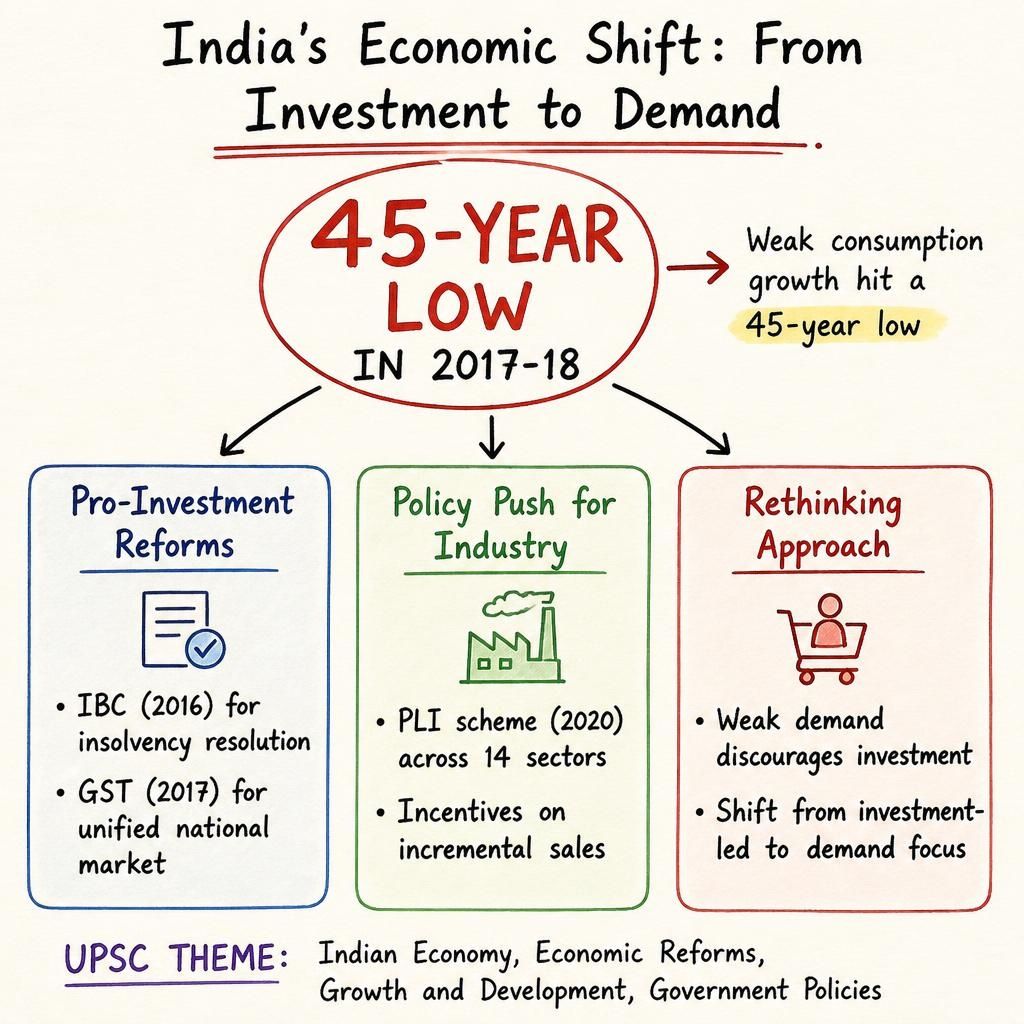
India's Economic Shift.jpg
Detailed Insights:
- The initial economic philosophy of "maximum governance, minimum government" aimed for a fast-growing private sector to drive job creation and prosperity.
- The IBC was enacted in 2016 to provide a unified, time-bound mechanism for resolving insolvency and bankruptcy, shifting control from debtors to creditors.
- The GST, implemented in 2017, aimed to create a unified national market by subsuming multiple indirect taxes, reducing cascading effects.
- The PLI scheme, launched in 2020, offers incentives on incremental sales to boost domestic manufacturing across 14 key sectors and attract investments.
- Finance Minister Nirmala Sitharaman had urged India Inc. to overcome diffidence and invest more, comparing them to Hanuman.
- The realization that weak consumer demand disincentivizes private investment led to a re-evaluation of the government's purely investment-led strategy.
- Investment as a percentage of GDP has been a concern, indicating that policy measures alone were insufficient to spur private capital formation without robust demand.
Key Concepts Involved:
- Washington Consensus: A set of free-market economic policies promoted by institutions like the IMF and World Bank, advocating deregulation, privatization, and fiscal discipline.
- Insolvency and Bankruptcy Code (IBC): A comprehensive law enacted in 2016 to consolidate and amend laws relating to reorganization and insolvency resolution of corporate persons, partnership firms, and individuals in a time-bound manner.
- Goods and Services Tax (GST): An indirect tax implemented in India from July 1, 2017, that replaced multiple central and state indirect taxes with a single, unified tax system on the supply of goods and services.
- Production-Linked Incentive (PLI) Scheme: A government initiative launched in 2020 to boost domestic manufacturing and exports by offering incentives on incremental sales to companies in specified sectors.

SuperKalam is your personal mentor for UPSC preparation, guiding you at every step of the exam journey.
Download the App


STUDY RESOURCES
CONTACT US
ⓒ Snapstack Technologies Private Limited