GS 1: Physical GeographyGS 3: Environment & EcologyPrelimsGS 3: Disaster and Disaster ManagementGS 1: Important Geophysical Phenomena like Earthquakes, Tsunami, Volcanic Activity and Cyclones
'Intensifying' El Niño to persist until March 2027; strongest ever since 1950, says NOAA, Pg11
NOAA predicts 'strongest ever' El Niño since 1950 to persist until March 2027, shattering sea surface temperature records and altering global weather patterns.
Practice MCQs
898 Students attempted
Key Highlights:
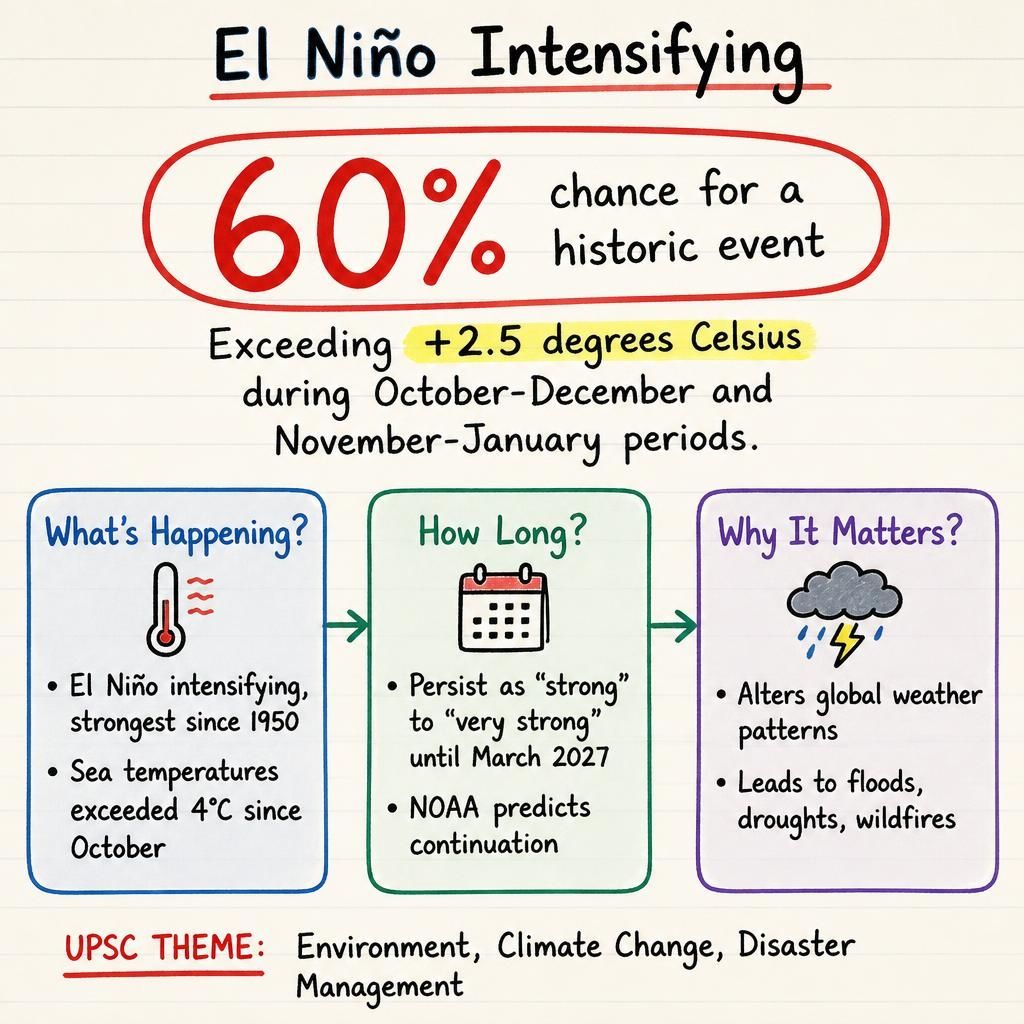
- The current El Niño event is predicted by the National Oceanic and Atmospheric Administration (NOAA) to persist as "strong" to "very strong" until March 2027.
- NOAA states this El Niño is intensifying and is set to become the "strongest ever since 1950", potentially shattering previous records for sea surface temperatures.
- There is a 60% chance for a historic event, exceeding +2.5 degrees Celsius, during the October-December and November-January periods.
- Sea surface temperatures in the equatorial Pacific have already exceeded 4 degrees Celsius since October, a first since data collection began in the 1950s.
El-Nino Intensifying.jpg
Detailed Insights:
- El Niño is a naturally occurring climate phenomenon characterized by warmer-than-average sea surface temperatures in the equatorial Pacific Ocean.
- It significantly alters global weather patterns, leading to increased temperatures, changes in rainfall, more wildfires, and extreme events like floods or droughts.
- El Niño is one of three phases of the El Niño Southern Oscillation (ENSO), which also includes ENSO neutral and La Niña (the cool phase).
- An El Niño event is officially declared when the average Relative Ocean Nino Index (RONI) value, measured over the Nino 3.4 region, surpasses 0.5 degrees Celsius for three consecutive months.
- The World Meteorological Organisation (WMO) had previously warned in October of emerging "off-the-charts" temperature values, which have now been confirmed.
Key Concepts Involved:
- El Niño: A climate pattern characterized by the unusual warming of surface waters in the equatorial Pacific Ocean.
- El Niño Southern Oscillation (ENSO): A recurring climate pattern involving changes in the temperature of waters in the central and eastern tropical Pacific Ocean and the overlying atmosphere.
- La Niña: The cool phase of ENSO, characterized by cooler-than-average sea surface temperatures in the equatorial Pacific.
- Relative Ocean Nino Index (RONI): A metric used to monitor and declare ENSO phases, based on sea surface temperature anomalies in specific Pacific regions.
- Nino 3.4 region: A specific area in the equatorial Pacific (5°N-5°S, 120°-170°W) crucial for monitoring ENSO conditions.

SuperKalam is your personal mentor for UPSC preparation, guiding you at every step of the exam journey.
Download the App


STUDY RESOURCES
CONTACT US
ⓒ Snapstack Technologies Private Limited