GS 3: EconomyPrelimsGS 3: Government BudgetingGS 3: Indian Economy, Planning, Mobilization of Resources, Growth, Development and EmploymentGS 2: Government policies and interventions for development in various sectors
Nobel lesson: value of stabilisation models, Pg7
Nobel laureates Robert Hall and Michael Woodford's work on microeconomic foundations for macroeconomic stabilisation offers crucial lessons for policymakers, especially in India.
Practice MCQs
891 Students attempted
Key Highlights:
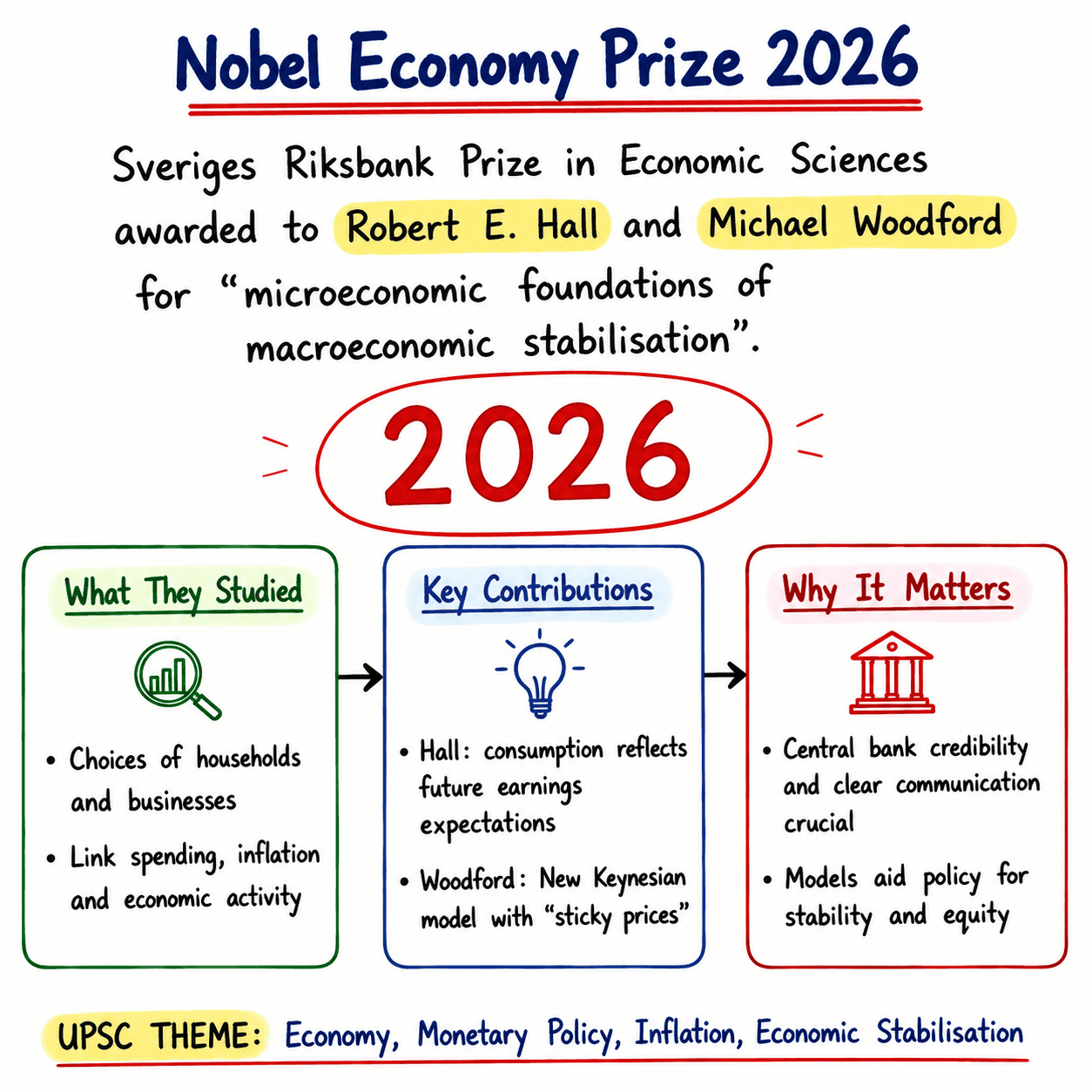
- The Sveriges Riksbank Prize in Economic Sciences in Memory of Alfred Nobel for 2026 was awarded to Robert E. Hall and Michael Woodford.
- They were recognized for their work on "microeconomic foundations of macroeconomic stabilisation".
- Their research emphasizes that effective economic policies require understanding how individual households and businesses make economic choices.
- Hall's work highlighted how consumption patterns reflect future earnings expectations, noting disparities in financial security.
- Woodford developed ideas within a New Keynesian model, linking consumer spending, inflation, and economic activity.
Nobel Economy Prize.jpg
Detailed Insights:
- Governments historically aim to mitigate economic fluctuations, known as business cycles, through various policy tools.
- The oil crises of the 1970s exposed limitations in existing economic models, as they failed to explain simultaneous high inflation and unemployment (stagflation).
- Hall's research suggests that policymakers, especially in countries like India, should consider variations among households with different financial security levels.
- Woodford's New Keynesian model incorporates the concept of "sticky prices," where firms do not immediately adjust prices to changes in demand or cost.
- This model demonstrates how expectations about future costs, demand, and competitor prices influence current inflation.
- Central bank credibility and clear communication are crucial as their announcements influence public expectations about future interest rates and inflation.
- Unpredictable signals or unfulfilled policy announcements from central banks can reduce the effectiveness of monetary policy.
- The models also warn that supply-side shocks, not just demand issues, can cause simultaneous inflation, lower output, and unemployment, requiring diverse policy responses.
- For India, stabilization models must integrate domestic realities, strong monetary policy, responsible fiscal management, reliable data, and targeted support for vulnerable populations.
Key Concepts Involved:
- Macroeconomic Stabilisation: Policies aimed at reducing fluctuations in economic activity, inflation, and unemployment.
- Business Cycle: The natural ebb and flow of economic expansion and contraction over time.
- New Keynesian Model: An economic model that incorporates sticky prices and rational expectations into a framework for understanding macroeconomic phenomena.
- Sticky Prices: The tendency of prices for goods and services to adjust slowly to changes in supply and demand.

SuperKalam is your personal mentor for UPSC preparation, guiding you at every step of the exam journey.
Download the App


STUDY RESOURCES
CONTACT US
ⓒ Snapstack Technologies Private Limited