GS 2: GovernanceGS 3: Science & TechnologyGS 3: Environment & EcologyPrelimsGS 3: Conservation, Pollution and Degradation
India’s water plants are failing to catch elusive ‘forever chemicals’, Pg II
Indian water treatment plants fail to remove persistent PFAS "forever chemicals," posing health risks due to regulatory gaps and inadequate monitoring.
Practice MCQs
891 Students attempted
Key Highlights:
- Polyfluoroalkyl substances (PFAS), or "forever chemicals," are widely detected in Indian water sources, posing a legitimate concern.
- Conventional water treatment systems are ineffective at removing PFAS, and their national extent of contamination in India remains poorly defined due to varied testing methods.
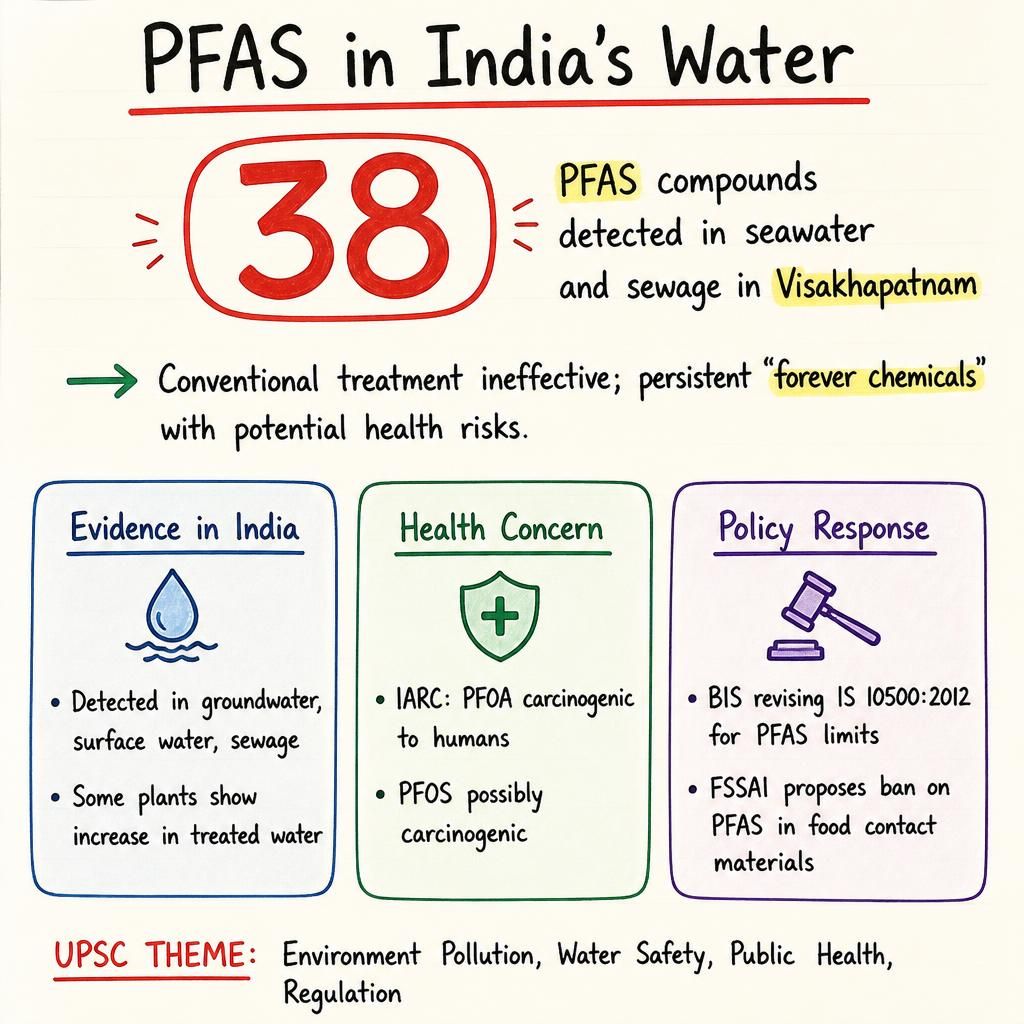
- Studies in Chennai and Visakhapatnam confirmed PFAS presence in groundwater, surface water, and sewage, with some treatment plants showing increased concentrations in treated water.
- The International Agency for Research on Cancer (IARC) classified perfluorooctanoic acid (PFOA) as carcinogenic and perfluorooctanesulfonic (PFOS) as possibly carcinogenic to humans.
- India currently lacks specific regulations banning PFAS manufacturing or dedicated drinking water limits under the IS 10500:2012 standard.
- The Bureau of Indian Standards (BIS) is revising the IS 10500:2012 standard, with a dedicated Working Group on Emerging Contaminants and Forever Chemicals examining PFAS limits.
- The Food Safety and Standards Authority of India (FSSAI) has proposed a ban on PFAS in food contact materials through a draft amendment to the Food Safety and Standards (Packaging) Regulations, 2018.
PFAS In Water.jpg
Detailed Insights:
- PFAS are synthetic compounds with strong carbon-fluorine bonds, making them resistant to degradation and persistent in the environment.
- A 2025 review highlighted significant PFAS contamination in Gujarat, Maharashtra, Tamil Nadu, and West Bengal, but noted inconsistencies in research methodologies.
- Research from IIT-Madras in 2024 found the highest PFAS levels in groundwater near garbage dumps in Chennai.
- A study in Visakhapatnam by GITAM (Deemed to be) University and international collaborators detected 38 PFAS compounds in seawater and sewage, with sewage contributing significantly to coastal concentrations.
- The increase of PFAS in treated water at some plants suggests the presence of unidentified precursors that transform into more stable PFAS during treatment.
- Current testing often relies on a fixed list of PFAS, potentially missing other diverse fluorinated compounds and their precursors.
- Adsorption-based treatment shows potential for PFAS removal, but cost-effective materials are still under development.
- The health risks of PFAS depend on the specific type, dose, and duration of exposure, with studies showing developmental and physiological impacts on aquatic life.
- The CSIR-Indian Institute of Toxicology Research (CSIR-IITR) is participating in a UNEP-funded National Implementation Plan to build baseline data on PFAS in India.
- India's "opt-out" position under Article 25(4) of the Stockholm Convention means new listings of persistent organic pollutants (POPs) do not automatically apply unless ratified.
- Experts advocate for harmonized monitoring, broader screening for precursors, and the establishment of precautionary interim limits for well-studied PFAS.
Key Concepts Involved:
- Polyfluoroalkyl Substances (PFAS): A group of synthetic chemicals known as "forever chemicals" due to their extreme persistence in the environment and resistance to degradation.
- Precursors: Chemical compounds that can transform into other, often more stable, PFAS during environmental processes or water treatment.
- Stockholm Convention: A global treaty aimed at protecting human health and the environment from Persistent Organic Pollutants (POPs).

SuperKalam is your personal mentor for UPSC preparation, guiding you at every step of the exam journey.
Download the App


STUDY RESOURCES
CONTACT US
ⓒ Snapstack Technologies Private Limited