GS 2: GovernanceGS 1: Physical GeographyGS 3: Disaster ManagementGS 3: Environment & EcologyPrelims
Flash flood in Nepal again: For India, a warning, Pg12
Nepal's flash flood renews concerns over Himalayan disasters in India, driven by climate change, necessitating robust early warning systems and monitoring.
Practice MCQs
891 Students attempted
Key Highlights:
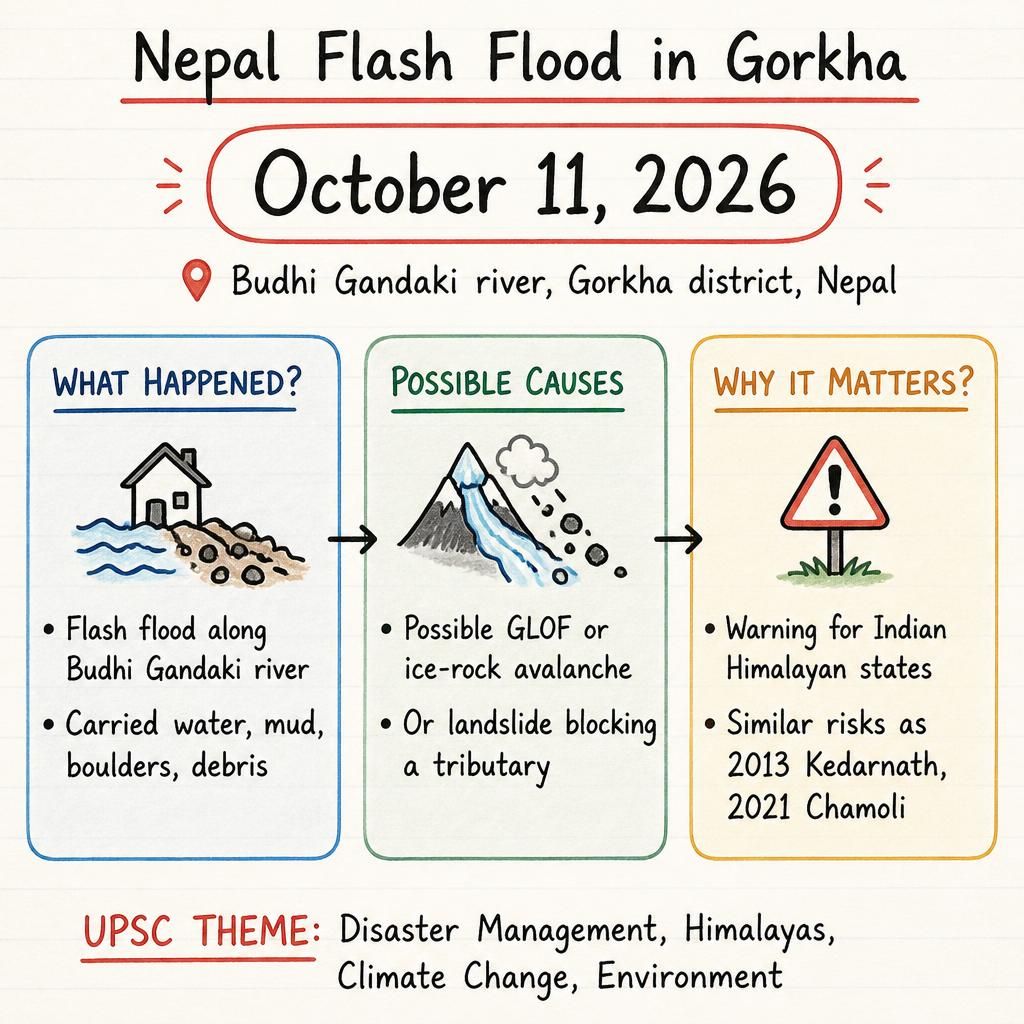
- A flash flood swept through settlements along Nepal's Budhi Gandaki river in Gorkha district on October 11, 2026, causing significant damage to infrastructure.
- The incident renewed concerns about sudden floods across the Himalayas, where retreating glaciers and unstable mountain slopes contribute to destructive flows.
- Initial assessments by glaciologists suggest the flood was consistent with a possible Glacial Lake Outburst Flood (GLOF) or an avalanche involving ice and rock, or a landslide blocking a tributary.
- The flood carried a dense slurry of water, mud, boulders, and debris, highlighting that the danger is not solely determined by water volume.
- The event serves as a warning for the Indian Himalayan states, which face similar hazards, including those seen in the 2013 Kedarnath disaster and the 2021 Chamoli disaster.
Flash Flood.jpg
Detailed Insights:
- The recent flash flood in Nepal's Gorkha district occurred along the Budhi Gandaki river, a tributary of the Trishuli River.
- High-altitude Himalayan terrain contains large quantities of loose material from erosion and past glacial activity, which can be mobilized by sudden water surges, creating destructive debris flows.
- Climate change is a significant factor, altering conditions in the Himalayas by causing ice to melt and glaciers to retreat, making slopes more susceptible to failure.
- The Intergovernmental Panel on Climate Change (IPCC) has documented accelerated glacier loss across the Hindu Kush Himalaya (HKH), with warming occurring at nearly twice the global average.
- The 2013 Kedarnath disaster was caused by heavy rainfall and a GLOF from the Chorabari Lake, while the 2021 Chamoli disaster involved a massive rock-and-ice avalanche from Ronti peak.
- India has initiated measures like installing its first indigenous GLOF early warning system at Vasundhara Tal in Uttarakhand to monitor high-risk glacial lakes.
- Effective disaster mitigation requires identifying vulnerable lakes and unstable slopes, continuous monitoring using satellite observations and ground-based sensors, and robust early-warning systems to provide timely information to downstream communities.
Scientific/Technical Concepts Involved:
- Flash Flood: A rapid flooding of low-lying areas, typically occurring within six hours of intense rainfall, a dam failure, or a Glacial Lake Outburst Flood (GLOF).
- Glacial Lake Outburst Flood (GLOF): A sudden release of water from a glacial lake due to the failure of its natural dam (often made of moraine or ice), frequently triggered by avalanches, landslides, or earthquakes.
- Avalanche: A rapid downslope movement of a mass of snow, ice, rock, or debris, often occurring in snow-covered mountainous regions when the accumulated snowpack becomes unstable.

SuperKalam is your personal mentor for UPSC preparation, guiding you at every step of the exam journey.
Download the App


STUDY RESOURCES
CONTACT US
ⓒ Snapstack Technologies Private Limited