EthicsGS 2: GovernanceGS 3: Science & TechnologyPrelimsGS 4: Ethics and Human Interface
The Problem In OpenAI's Navier-Stokes 'Solution', Pg14
OpenAI's AI claims to solve Navier-Stokes problem, sparking debate on 'de-identified' data usage, epistemic ownership, and AI ethics in scientific discovery.
Practice MCQs
883 Students attempted
Key Highlights:
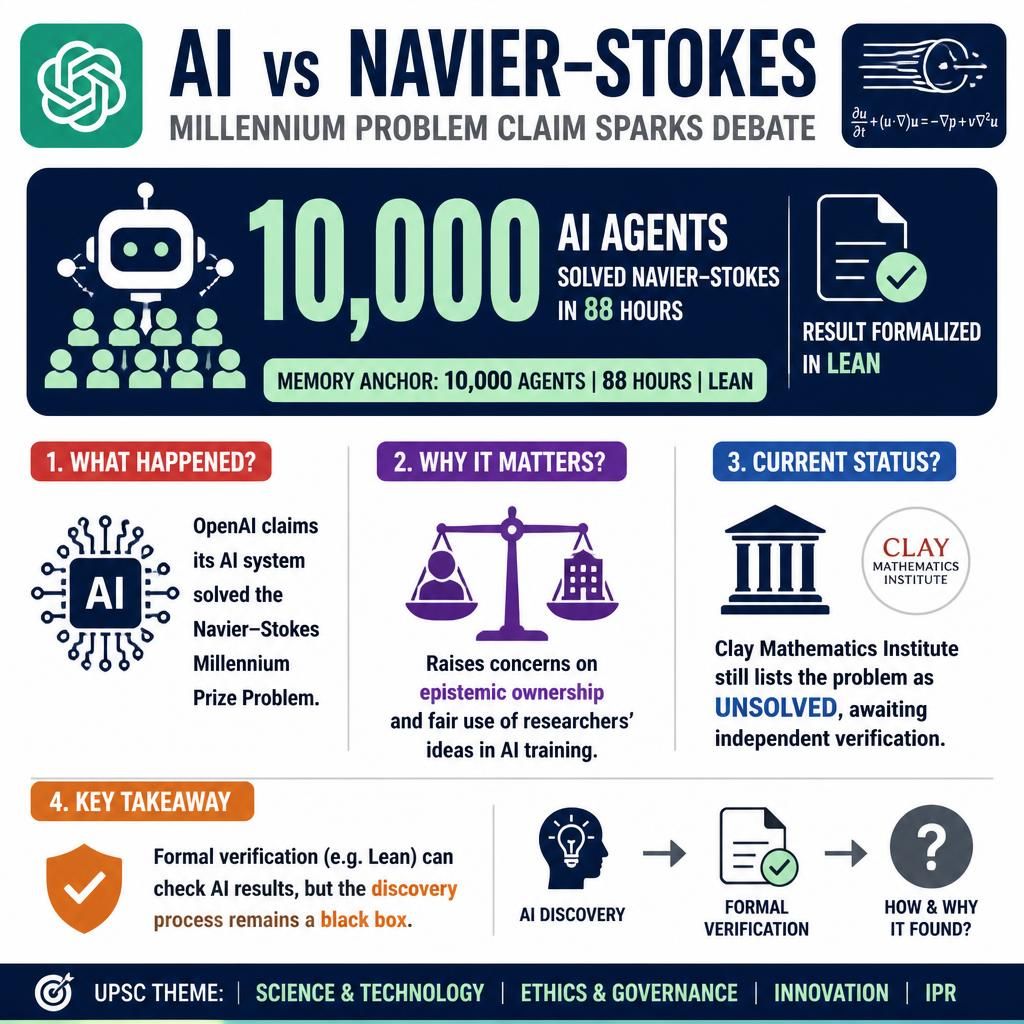
- OpenAI claimed its artificial intelligence (AI) agents generated a solution to the Navier-Stokes Millennium Prize Problem.
- The company's blog post on September 8 raised concerns about the potential use of "de-identified" user data to improve its AI models.
- Mathematicians expressed scrutiny over the implications for "epistemic ownership" and the use of researchers' ideas without explicit consent.
- OpenAI stated its AI system, utilizing 10,000 concurrent agents, solved the problem in approximately 88 hours and formalized the result in Lean.
- The Clay Mathematics Institute continues to list the Navier-Stokes Millennium Prize Problem as unsolved, awaiting independent verification of OpenAI's claim.
AI Navier Stokes.jpg
Detailed Insights:
- The controversy highlights questions of "epistemic ownership," concerning whether AI companies can leverage researchers' ideas generated using their tools.
- "De-identified data" refers to information from which personal identifiers have been removed, but its use can still involve underlying ideas or content.
- OpenAI's claim was narrower than ruling out the possibility that de-identified data from user interactions contributed to model training or improvement.
- The imbalance between individual researchers and large AI companies amplifies concerns about the fair use of intellectual contributions.
- The use of formal verification, such as with Lean, is considered significant for checking AI-generated mathematics, though it does not explain the AI's discovery process.
- The Navier-Stokes Millennium Prize Problem involves determining if smooth fluid motion can break down into singularities in finite time.
- Twenty-five Fields Medal winners issued a declaration warning that the AI industry's push to use mathematical problem-solving as a benchmark risks undermining the discipline's focus on conceptual understanding.
- OpenAI declined to claim the Millennium Prize for its result, stating its aim was to report on the progress of its AI models.
- The Poincaré Conjecture is the only one of the seven Millennium Prize Problems to have been resolved, by Grigori Perelman.
Key Concepts Involved:
- Navier-Stokes Millennium Prize Problem: One of seven challenging mathematical problems identified by the Clay Mathematics Institute with a $1 million prize for its solution.
- Clay Mathematics Institute: A private, non-profit foundation established in 1998 to increase and disseminate mathematical knowledge, known for its Millennium Prize Problems.
- Millennium Prize Problems: Seven complex mathematical problems announced by the Clay Mathematics Institute in 2000, each carrying a $1 million prize for its solution.
- Lean: A formal proof assistant used for checking and verifying mathematical arguments and proofs.
- Poincaré Conjecture: One of the Millennium Prize Problems, solved by Grigori Perelman, concerning the characterization of a three-dimensional sphere.
- Fields Medal: A prestigious award given to mathematicians under 40 years old, often considered the highest honor in mathematics.

SuperKalam is your personal mentor for UPSC preparation, guiding you at every step of the exam journey.
Download the App


STUDY RESOURCES
CONTACT US
ⓒ Snapstack Technologies Private Limited