GS 2: GovernanceGS 2: International RelationsGS 3: Environment & EcologyPrelimsGS 3: Infrastructure: Energy, Ports, Roads, Airports, Railways etc.
India, Germany & a Green Partnership for the Future, Pg11
India and Germany strengthen green partnership at 4th Environment Forum, focusing on climate resilience, biodiversity, and decarbonisation through joint initiatives.
Practice MCQs
883 Students attempted
Key Highlights:
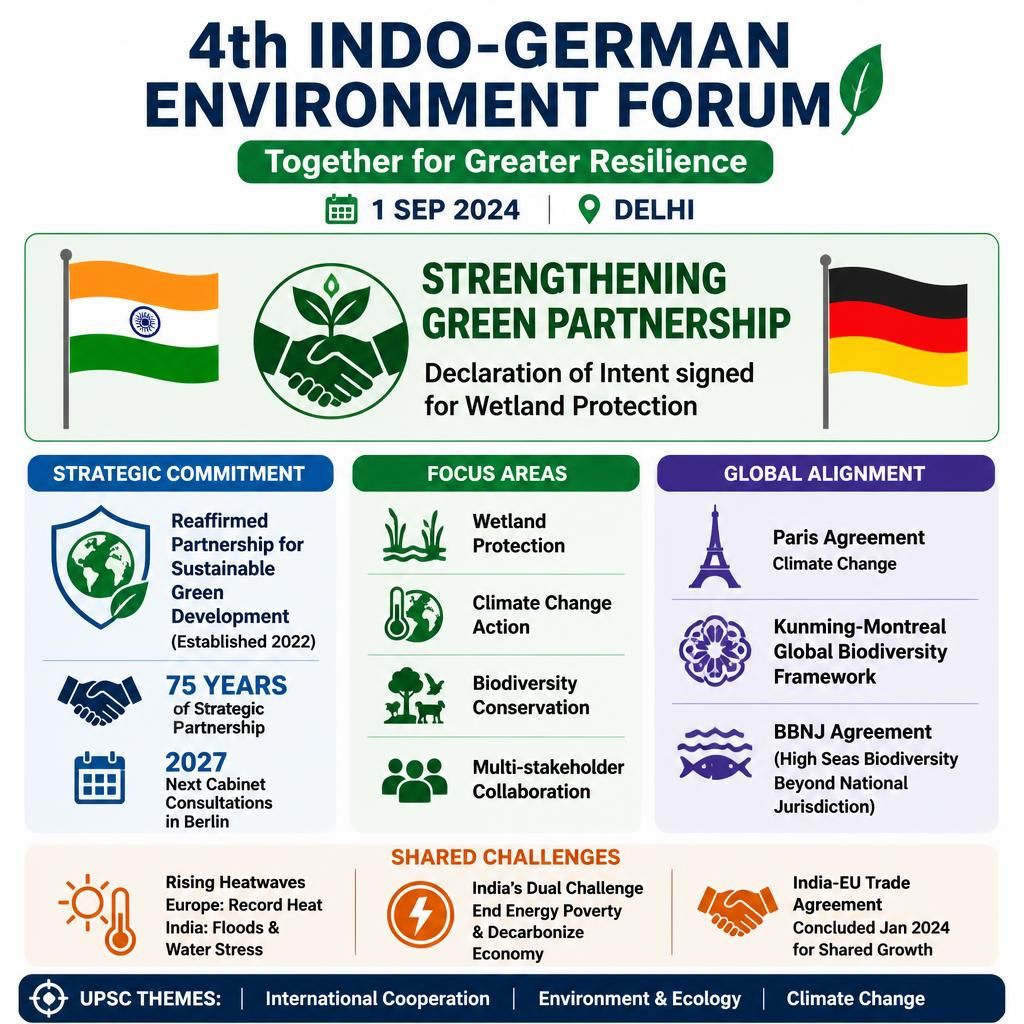
- The Fourth Indo-German Environment Forum was held in Delhi on September 1, focusing on climate change and biodiversity conservation.
- India and Germany reaffirmed their commitment to the Partnership for Sustainable Green Development, established in 2022.
- A Declaration of Intent was signed to strengthen cooperation on wetland protection.
- Both nations advocate for ambitious climate targets, as seen at a recent UN Climate Change Conference.
- The forum highlighted the Paris Agreement, the Kunming-Montreal Global Biodiversity Framework, and the BBNJ Agreement as key international environmental accords.
Indo-German Framework.jpg
Detailed Insights:
- The forum's theme was "Together for Greater Resilience," bringing together policymakers, business leaders, scientists, and civil society.
- The event underscored the challenges posed by global environmental crises and the impact of geopolitical tensions on multilateralism.
- India faces the dual challenge of combating energy poverty while simultaneously decarbonizing its economy.
- Germany, as the EU's strongest economy, is committed to the India-EU trade agreement, concluded in January, to foster economic growth.
- The bilateral relationship spans 75 years of strategic partnership, with cabinet minister-level consultations planned for 2027 in Berlin.
- Both countries acknowledge severe climate impacts, including record heatwaves in Europe and water shortages and floods in India.
- India's initiatives like solar parks demonstrate that climate action and industrial development can progress hand-in-hand.
- Germany offers expertise in grid integration, storage systems, and regulation to support India's renewable energy goals.
- Over 2,000 German companies operate in India, with many planning increased investments and manufacturing to meet local demand.
- A notable partnership exists between BHEL and Thyssenkrupp Nucera in environmental technologies.
- The private sector in both countries is focused on environmental technologies, circular economy, green steel, and low-carbon cement.
Key Concepts Involved:
- Paris Agreement: An international treaty on climate change adopted in 2015, aiming to limit global warming.
- Kunming-Montreal Global Biodiversity Framework: A landmark agreement adopted in 2022 to halt and reverse biodiversity loss globally.
- BBNJ Agreement: A new international treaty for the conservation and sustainable use of marine biological diversity of areas beyond national jurisdiction.
- Partnership for Sustainable Green Development: A bilateral initiative between India and Germany to foster cooperation in climate action and sustainable development.
- Circular Economy: An economic system aimed at eliminating waste and the continual use of resources, promoting reuse and recycling.
- Green Hydrogen: Hydrogen produced through electrolysis of water using renewable electricity, resulting in zero carbon emissions.

SuperKalam is your personal mentor for UPSC preparation, guiding you at every step of the exam journey.
Download the App


STUDY RESOURCES
CONTACT US
ⓒ Snapstack Technologies Private Limited