GS 3: EconomyGS 2: International RelationsPrelimsGS2: Bilateral, Regional and Global Groupings and AgreementsGS2: Effect of Policies and Politics of Developed and Developing Countries on India's Interests
Goods Exports Surge 20% As India Diversifies Trade, Pg1
India's merchandise exports surge 20% to $44.2 billion in July, driven by diversification and new routes despite West Asia turmoil.
Practice MCQs
876 Students attempted
Key Highlights:
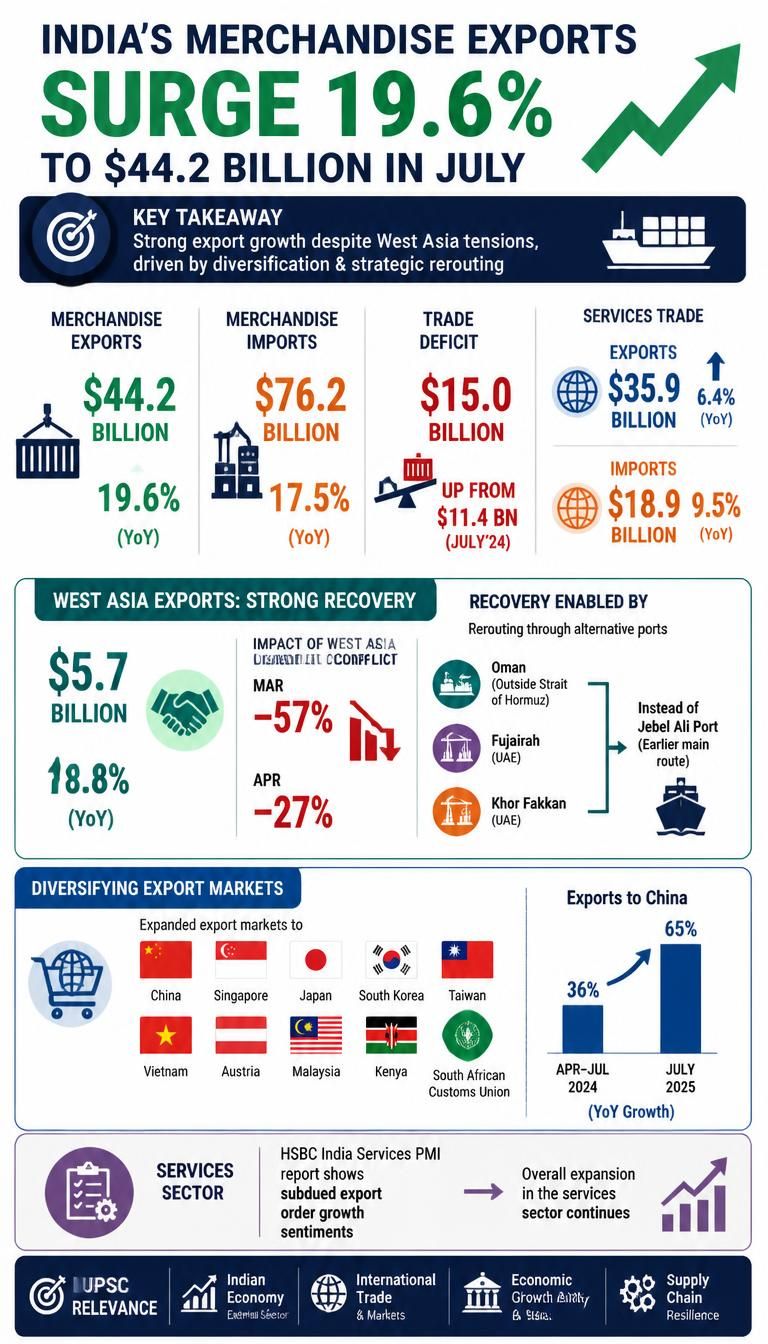
- India's merchandise exports surged by 19.6% to $44.2 billion in July, despite ongoing geopolitical tensions in West Asia.
- Exports to West Asia recovered significantly, growing by 8.8% in July compared to the same period last year, reaching $5.7 billion.
- This growth was primarily driven by the diversification of export destinations and the strategic rerouting of trade through alternative ports.
- India's trade deficit widened to $15 billion in July, up from $11.4 billion last year, as services imports grew faster than services exports.
Merchandise Export.jpg
Detailed Insights:
- Merchandise imports in July grew at a slower rate of 17.5% to $76.2 billion.
- India expanded its export markets to include countries like China, Singapore, Japan, South Korea, Taiwan, Vietnam, Austria, Malaysia, Kenya, and the South African Customs Union region.
- Exports to China saw a substantial increase of 65% in July and 36% during April-July.
- The recovery in West Asian exports was facilitated by utilizing ports in Oman (outside the Strait of Hormuz), Fujairah, and Khor Fakkan in the UAE, instead of the previously dominant Jebel Ali Port.
- Services exports grew by 6.4% to $35.9 billion, while services imports increased by 9.5% to $18.9 billion.
- The HSBC India Services PMI report indicated subdued export order growth sentiments for services, despite overall expansion in the sector.
- The initial impact of the West Asia conflict led to a contraction in exports to the region by nearly 57% in March and 27% in April.
Key Concepts Involved:
- Foreign Trade Policy: A government strategy outlining objectives and measures to promote exports, regulate imports, and enhance a nation's global trade competitiveness.
- Trade Diversification: The strategy of expanding a country's export markets and product range to reduce reliance on a few key destinations or goods.
- Strait of Hormuz: A critical maritime chokepoint connecting the Persian Gulf to the Arabian Sea, vital for global oil and gas shipments.
- South African Customs Union (SACU): The world's oldest customs union, comprising Botswana, Eswatini, Lesotho, Namibia, and South Africa, facilitating free trade among members and maintaining a common external tariff.

SuperKalam is your personal mentor for UPSC preparation, guiding you at every step of the exam journey.
Download the App


STUDY RESOURCES
CONTACT US
ⓒ Snapstack Technologies Private Limited