GS 2: PolityGS 2: GovernancePrelimsGS2: Parliament and State LegislaturesGS2: Government policies and interventions for development in various sectors
FCRA Bill: Can Joint Parliamentary Committees affect the course of legislation?, Pg18
FCRA Bill referred to JPC, sparking debate on parliamentary committees' power to influence legislation amidst declining scrutiny of bills.
Practice MCQs
876 Students attempted
Key Highlights:
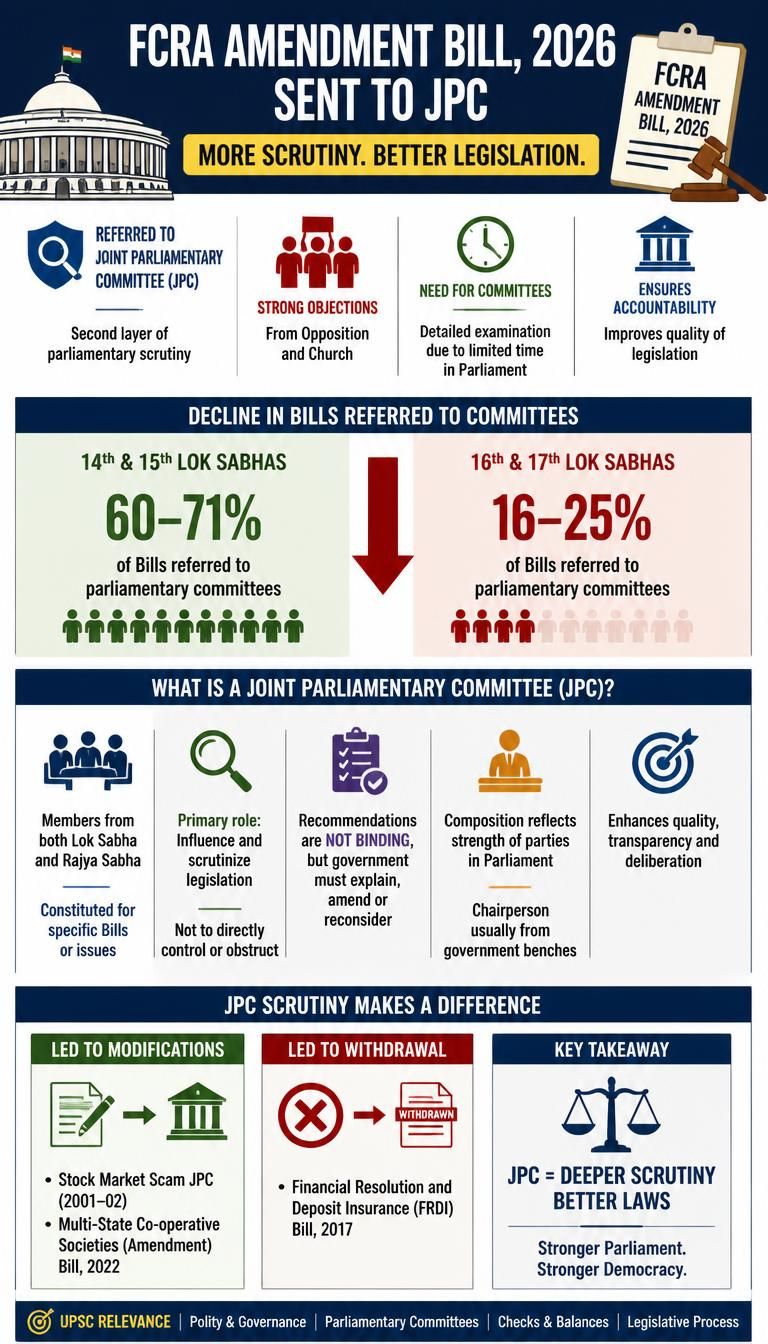
- The Foreign Contribution (Regulation) Amendment Bill, 2026, was referred to a Joint Parliamentary Committee (JPC) by the Lok Sabha.
- This referral provides a second layer of scrutiny for the Bill, despite strong objections from the Opposition and the Church.
- Parliamentary committees, including JPCs, are designed to allow for detailed examination of legislation due to limited parliamentary time.
- Data indicates a significant decline in the referral of Bills to parliamentary committees, from about 60-71% in the 14th and 15th Lok Sabhas to 16-25% in the 16th and 17th Lok Sabhas.
FCRA Bill.jpg
Detailed Insights:
- Joint Parliamentary Committees comprise members from both the Lok Sabha and Rajya Sabha, constituted for specific Bills or issues.
- The primary role of committees is to influence and scrutinize legislation, rather than to directly control or obstruct.
- While JPC recommendations are not binding, they compel the government to explain, amend, or reconsider parts of a Bill.
- The composition of a JPC generally reflects the strength of parties in Parliament, with the chairperson typically from the government benches.
- Historically, JPCs have led to modifications in legislation, as seen with the Stock Market Scam JPC (2001-02) and the Multi-State Co-operative Societies (Amendment) Bill, 2022.
- In some instances, JPC scrutiny has contributed to the withdrawal of Bills, such as the Financial Resolution and Deposit Insurance (FRDI) Bill, 2017.
- Opposition members can file dissent notes if they disagree with the majority report, though these rarely alter the central framework of a Bill.
- The referral of the FCRA Bill to a JPC is significant given the recent trend of fewer Bills being sent to committees.
Key Concepts Involved:
- Joint Parliamentary Committee (JPC): A temporary committee formed with members from both Houses of Parliament to examine a specific Bill or issue.
- Foreign Contribution (Regulation) Act (FCRA): An Indian law that regulates the acceptance and utilization of foreign contributions or hospitality by individuals, associations, or companies.
- Parliamentary Committees: Smaller groups of Members of Parliament tasked with detailed examination of legislation, policies, and government functioning.

SuperKalam is your personal mentor for UPSC preparation, guiding you at every step of the exam journey.
Download the App


STUDY RESOURCES
CONTACT US
ⓒ Snapstack Technologies Private Limited