GS 3: Science & TechnologyGS 2: International RelationsGS 2: GovernancePrelimsGS2: Government policies and interventions for development in various sectors
Europe’s AI Rules May Become India’s Opportunity, Pg10
EU's stringent AI Act creates a massive compliance market, offering India a strategic opportunity to provide services and leverage its trade agreement.
Practice MCQs
876 Students attempted
Key Highlights:
- India is considering standalone legislation to govern Artificial Intelligence (AI).
- The EU AI Act entered into force in August 2024 and became applicable on August 2, 2026.
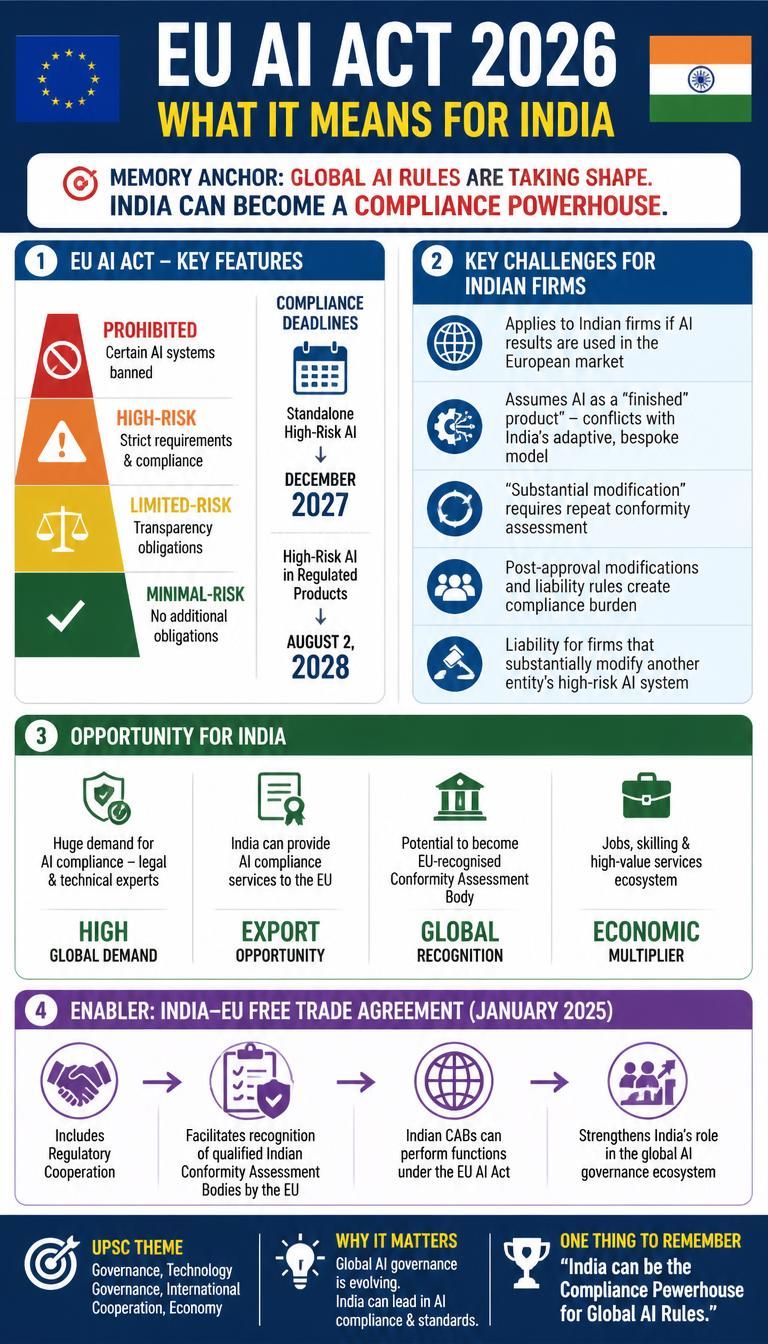
- The Act employs a risk-based approach, prohibiting certain AI systems, regulating high-risk ones, and imposing lighter checks for limited-risk use cases.
- Compliance deadlines for standalone high-risk AI systems are extended to December 2027, and for high-risk AI embedded in regulated products to August 2, 2028.
- The EU AI Act presents an opportunity for India to provide AI compliance services and potentially become a recognized Conformity Assessment Body.
EU AI Act.jpg
Detailed Insights:
- The EU AI Act applies to Indian firms whose AI systems produce results within the European market.
- The Act's assumption of AI as a "finished product" conflicts with the Indian technology industry's model of responsive adaptation and bespoke services.
- A "substantial modification" to an AI system, not contemplated during the initial assessment, necessitates a repeat of the conformity assessment process.
- Indian IT services firms and global capability centers, known for their responsive adaptation, may face challenges due to the Act's provisions on post-approval modifications.
- The Act assigns liability to firms that substantially modify another entity's high-risk AI system, potentially treating them as the original provider.
- The extensive compliance obligations under the EU AI Act are expected to create significant demand for legal and technical professionals, a need India is well-positioned to meet.
- The India-EU Free Trade Agreement, concluded in January, includes provisions for regulatory cooperation.
- This agreement could facilitate the recognition of qualified Indian Conformity Assessment Bodies by the EU, allowing them to perform functions under the Act.
Key Concepts Involved:
- EU AI Act: A landmark regulation by the European Union establishing a legal framework for Artificial Intelligence based on its risk level.
- Risk-based approach: A regulatory strategy that categorizes AI systems by their potential to cause harm, applying stricter rules to higher-risk applications.
- Conformity Assessment: A procedure to demonstrate that an AI system complies with the legal requirements and standards stipulated by the EU AI Act.
- Substantial Modification: A change to an AI system that was not foreseen during its initial assessment, impacting its compliance or altering its intended purpose, thereby requiring a new assessment.
- Conformity Assessment Body (CAB): An independent organization authorized to evaluate and certify that products, services, or systems meet specified regulatory standards.
- India-EU Free Trade Agreement (FTA): A bilateral trade pact between India and the European Union aimed at reducing trade barriers and enhancing economic cooperation.

SuperKalam is your personal mentor for UPSC preparation, guiding you at every step of the exam journey.
Download the App


STUDY RESOURCES
CONTACT US
ⓒ Snapstack Technologies Private Limited