GS 2: GovernanceGS 2: PolityPrelimsGS 2: Structure and Functioning of Executive and Judiciary
With 4 new benches, how SC plans to clear oldest pending cases, Pg16
CJI Surya Kant forms four dedicated benches to aggressively clear Supreme Court's 30-year-old civil and criminal case backlog.
Practice MCQs
869 Students attempted
Key Highlights:
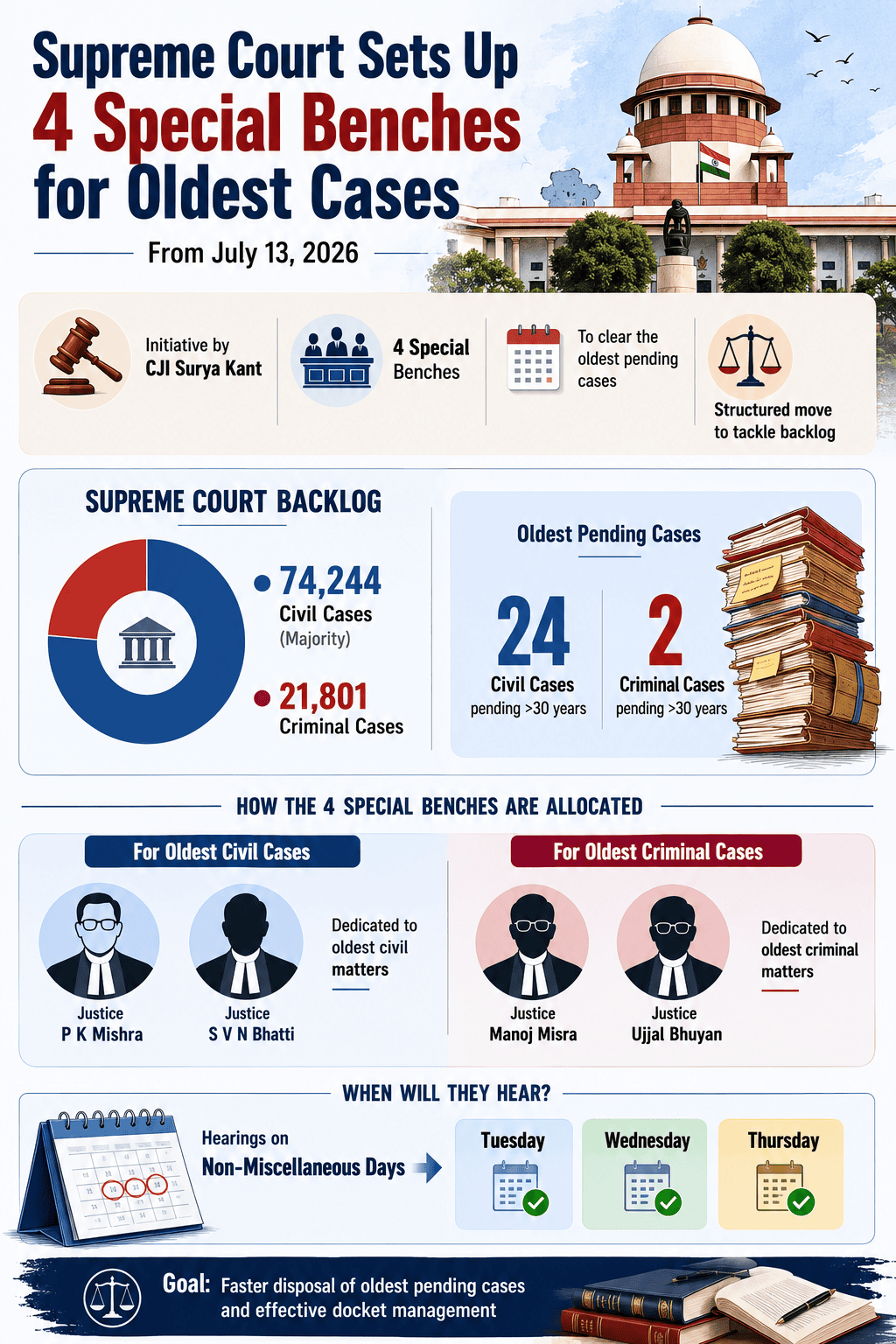
- Chief Justice of India Surya Kant has established four special benches to exclusively address the Supreme Court's oldest pending civil and criminal cases.
- This initiative became effective on July 13, 2026, as part of a structured effort to manage the court's docket.
- The Supreme Court currently faces a backlog of 96,045 cases, with civil matters constituting the majority at 74,244.
- Among these, 24 civil cases and two criminal cases have been pending for over 30 years.
- These dedicated benches will operate on "non-miscellaneous days," specifically Tuesdays, Wednesdays, and Thursdays, to ensure uninterrupted hearings.
SC.png
Detailed Insights:
- Two of the newly formed division benches, headed by Justices P K Mishra and S V N Bhatti, will concentrate solely on the oldest civil cases.
- The other two division benches, led by Justices Manoj Misra and Ujjal Bhuyan, are assigned to the oldest criminal matters.
- "Miscellaneous days" (Mondays and Fridays) are traditionally reserved for fresh filings and preliminary hearings, while "non-miscellaneous days" are for detailed arguments.
- Despite an increased rate of case disposal, the overall pendency has continued to rise due to new case intake, which reached an unprecedented 75,402 in 2025.
- Previous Chief Justices implemented various strategies, including U U Lalit's rigorous listing mechanism and D Y Chandrachud's SC-JUDICARE project for automated case classification and special benches.
- CJI Sanjiv Khanna focused on "admission matters" and identifying and weeding out infructuous cases to reduce the burden.
- CJI Surya Kant's primary objective with this reform is to reaffirm public confidence in the justice delivery system by ensuring timely resolution of long-pending cases.
Key Concepts Involved:
- Division Bench: A bench of two or more judges in a court, typically hearing cases that do not require a larger constitutional bench.
- Miscellaneous Days: In the Supreme Court, Mondays and Fridays are designated for fresh filings and preliminary hearings.
- National Judicial Data Grid (NJDG): An online platform under the eCourts Project that provides a comprehensive database of case information from district, subordinate, and high courts.
- SC-JUDICARE: A project launched to automate the classification of pending cases and group similar legal issues for combined hearings.
- Lok Adalat: A statutory alternative dispute resolution forum under the Legal Services Authorities Act, 1987, for amicable settlement of disputes.

SuperKalam is your personal mentor for UPSC preparation, guiding you at every step of the exam journey.
Download the App


STUDY RESOURCES
CONTACT US
ⓒ Snapstack Technologies Private Limited