GS 2: GovernanceGS 2: PolityGS 2: Social JusticePrelimsGS 2: Government policies and interventions for development in various sectors
All Ladakh districts to get autonomous hill councils, Pg10
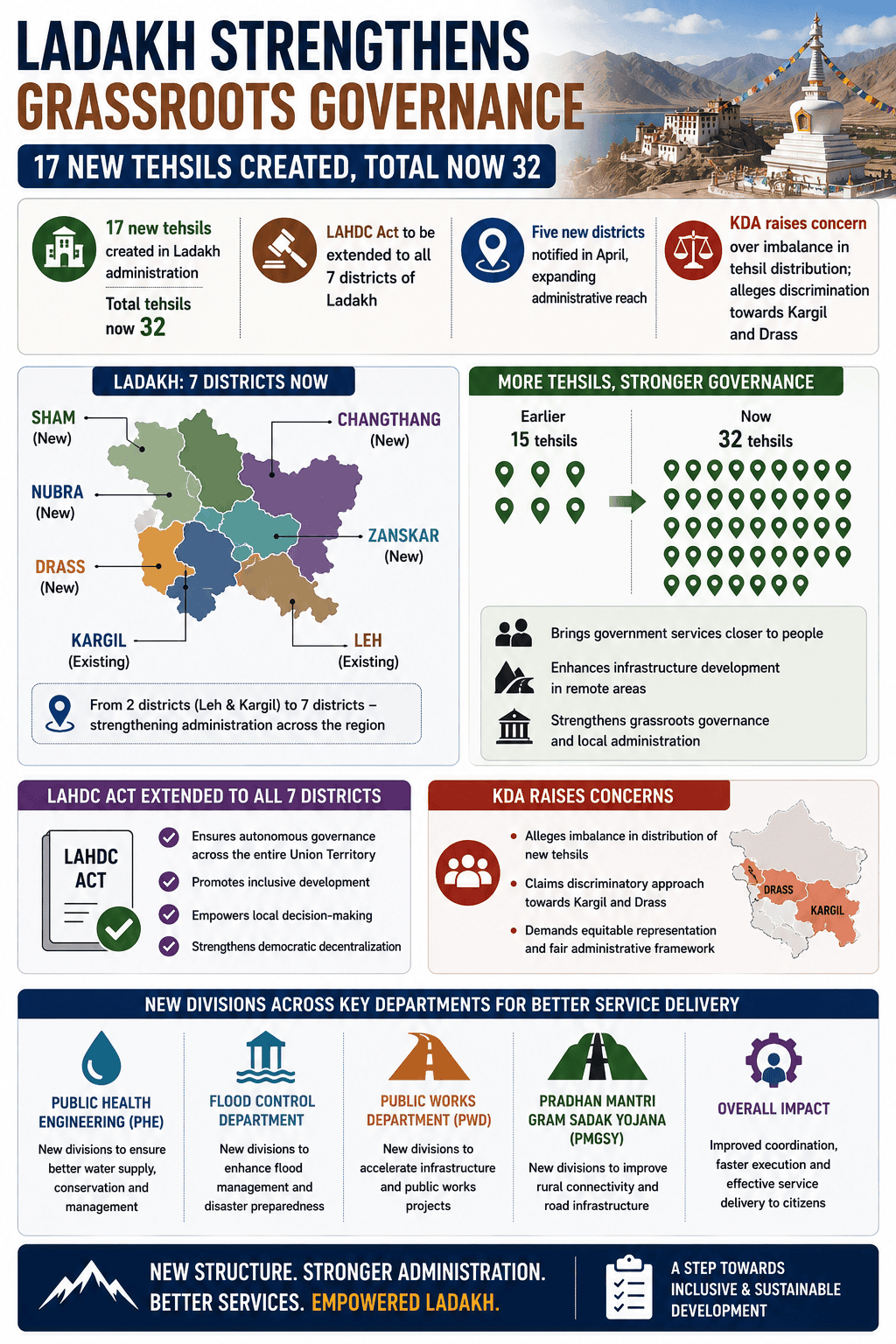
Ladakh administration creates 17 new tehsils, extends LAHDC Act to all districts, while KDA alleges glaring imbalance in resource allocation.
Practice MCQs
869 Students attempted
Key Highlights:
- The Ladakh administration announced the creation of 17 new tehsils, increasing the total to 32 across the Union Territory.
- The Ladakh Autonomous Hill Development Council (LAHDC) Act will be extended to all seven districts of the region.
- Five new districts—Sham, Nubra, Changthang, Zanskar, and Drass—were notified in April, joining Leh and Kargil.
- The Kargil Democratic Alliance (KDA) raised concerns about an imbalance in the distribution of new tehsils, alleging a discriminatory approach towards Kargil and Drass.
Grassroot Governance.png
Detailed Insights:
- The creation of new tehsils aims to strengthen grassroots governance, bring government services closer to people, and enhance infrastructure in remote areas.
- New divisions have also been established under the Public Health Engineering (PHE), Flood Control Department, Public Works Department (PWD), and Pradhan Mantri Gram Sadak Yojana (PMGSY) to improve service delivery.
- Discussions are ongoing regarding constitutional safeguards for Ladakh, with a focus on protecting its land, culture, and identity.
- The Union Home Ministry is considering a customized sui generis model for Ladakh under Article 371 of the Constitution.
- The KDA highlighted that the erstwhile Leh district received 12 new tehsils, while Kargil received only five, despite having a larger population and more villages.
- Concerns were also raised that Drass, a significant area, did not receive any additional tehsils.
Key Concepts Involved:
- Ladakh Autonomous Hill Development Council (LAHDC) Act: Legislation providing for local self-governance and development in the Ladakh region.
- Tehsil: An administrative division within a district, also known as a sub-district, responsible for local administration and revenue collection.
- Union Territory (UT): An administrative division in India directly governed by the central government.
- Article 371: A provision in the Indian Constitution that grants special provisions to certain states, allowing for unique administrative arrangements.
- Sui generis model: A unique or special model, often used to describe a legal or administrative framework tailored to specific circumstances.

SuperKalam is your personal mentor for UPSC preparation, guiding you at every step of the exam journey.
Download the App


STUDY RESOURCES
CONTACT US
ⓒ Snapstack Technologies Private Limited