GS 2: GovernanceGS 2: Social JusticeGS 2: International RelationsGS 3: Disaster ManagementGS 3: Environment & Ecology
Why is the Siang project contentious?, Pg10
Proposed Siang Upper Multipurpose Project faces intense protests from Adi community over submergence, environmental impact, and alleged deceit in consent acquisition.
Practice MCQs
891 Students attempted
Key Highlights:
- The proposed Siang Upper Multipurpose Project (SUMP) in Arunachal Pradesh is facing protests from the Adi community.
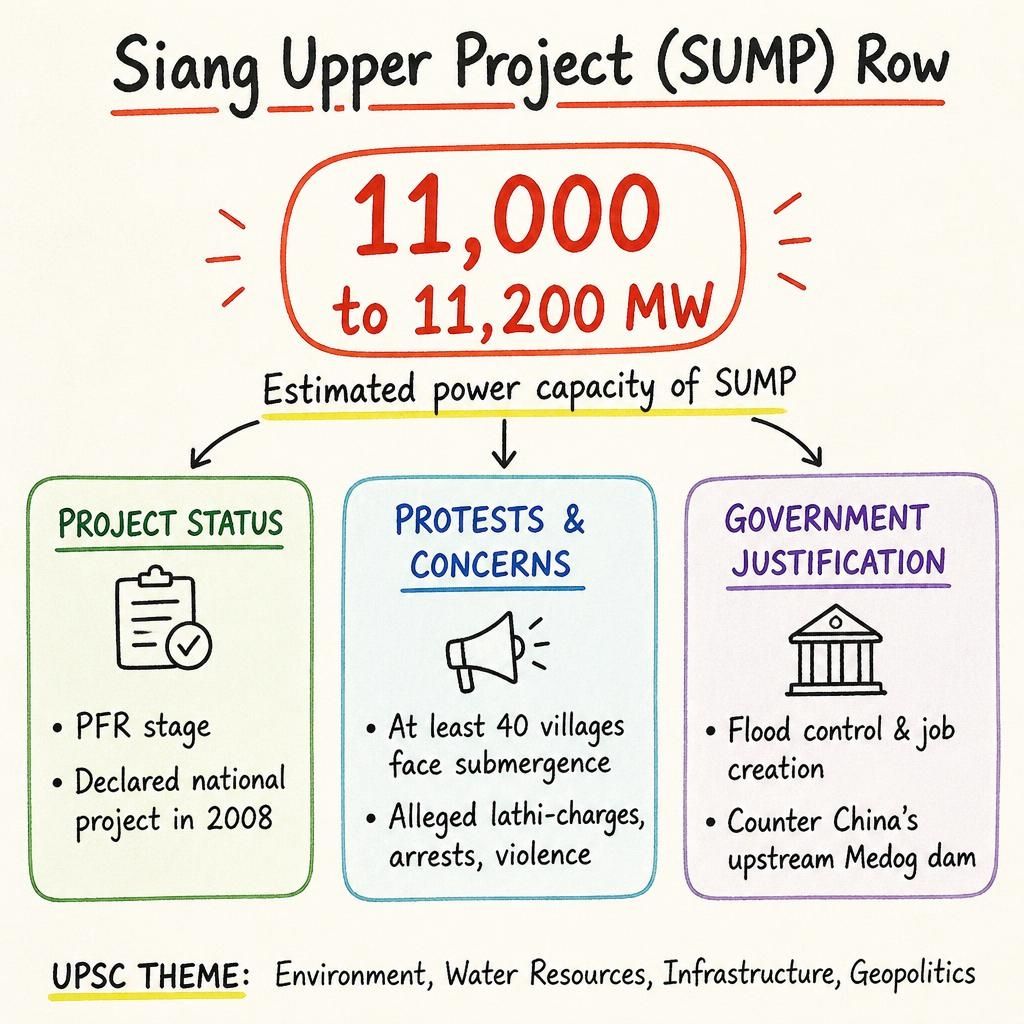
- The project, to be constructed by the National Hydroelectric Power Corporation (NHPC), aims for an estimated power capacity of 11,000 to 11,200 MW.
- Protesters cite concerns over the submergence of at least 40 villages, destruction of agricultural land, and cultural sites.
- The SUMP is currently in the Pre-Feasibility Report (PFR) stage, an early assessment of its viability.
- The government justifies the project for flood control, job creation, and to counter China's upstream Medog dam.
- Protests have escalated, leading to alleged lathi-charges, arrests, and violence against NHPC premises.
Siang Upper Project.jpg
Detailed Insights:
- The Siang River is the local name for the Brahmaputra in Arunachal Pradesh, a vital transboundary river.
- The SUMP was declared a national project in 2008, with a proposed dam height of 280-300 meters and 9.2 billion cubic meters of live storage.
- Project approval requires multiple clearances, including forest and environmental assessments from expert committees.
- Villagers allege that signatures for the PFR were obtained through deceit, not as consent for the dam's construction.
- The government emphasizes flood risk reduction in Arunachal Pradesh and Assam, and strengthening water and energy security, with power generation as a secondary benefit.
- China's planned 60,000 MW Medog dam upstream is a significant geopolitical factor influencing India's push for the SUMP.
- Arunachal Pradesh has historically been viewed as India's hydropower frontier, with many past agreements for projects not materializing.
- International examples like the Grand Ethiopian Renaissance Dam and the Indus Waters Treaty highlight the contentious nature of transboundary water resources.
- The Indus Waters Treaty was placed in "abeyance" by India in 2025, but a Court of Arbitration ruled it remains in force.
Key Concepts Involved:
- Pre-Feasibility Report (PFR): An initial study to assess the technical, economic, and environmental viability of a proposed project.
- Live Storage: The usable volume of water in a reservoir that can be drawn down and released for various purposes.
- National Project: A project designated by the central government for its strategic importance, often receiving priority in funding and clearances.
- Water Treaty: A formal agreement between two or more countries concerning the allocation, management, or use of shared water resources.

SuperKalam is your personal mentor for UPSC preparation, guiding you at every step of the exam journey.
Download the App


STUDY RESOURCES
CONTACT US
ⓒ Snapstack Technologies Private Limited