GS 3: Environment & EcologyGS 3: EconomyPrelimsGS 3: Infrastructure: Energy, Ports, Roads, Airports, Railways etc.GS 3: Conservation, Pollution and Degradation
Why India's Carbon Emissions Could Rise Amid Global Fall, Pg16
India's carbon emissions set to surge 4.4% in 2026, bucking global decline, fueled by extreme weather, coal power, and industrial expansion.
Practice MCQs
891 Students attempted
Key Highlights:
- Global fossil fuel emissions are projected to decline marginally by 0.4% in 2026.
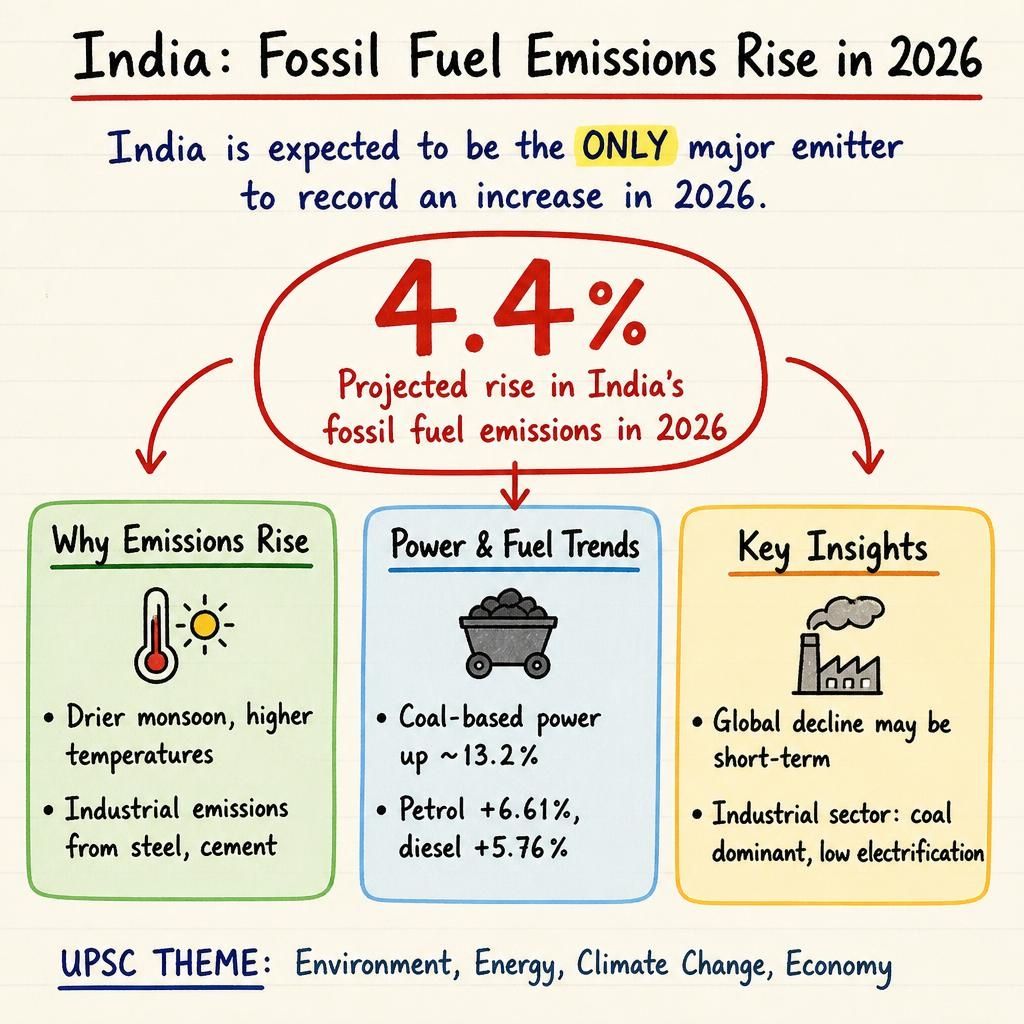
- India is expected to be the only major emitter to record an increase, with a projected rise of 4.4% in fossil fuel emissions.
- This increase is higher than India's average annual rise of 3.5% over the past decade.
- The rise in India's emissions is partly attributed to increased cooling demand due to a drier monsoon and higher temperatures.
- Industrial emissions from sectors like steel and cement also contributed significantly to India's CO2 increase.
Fossil Fuel Emission.jpg
Detailed Insights:
- The projected global decline in emissions is linked to the expansion of solar and wind power and the energy shock from the West Asia conflict.
- The Global Carbon Budget study suggests the global decline might be a short-term consequence rather than a sustained structural shift.
- India experienced an unusual surge in power demand due to persistently high temperatures and deficient rainfall, influenced by El Niño.
- Coal-based power generation in India increased by approximately 13.2% between April and November 2026 compared to the previous year.
- While overall petroleum product consumption declined, petrol consumption increased by 6.61% and diesel by 5.76% in January-October 2026.
- The Centre for Research on Energy and Clean Air (CREA) reported a 3.7% year-on-year increase in India's CO2 emissions in the first half of 2026.
- For two years until June 2026, India's electricity demand growth was met by clean energy, stabilizing power sector emissions.
- The primary challenge for India's emissions now lies in the industrial sector, where coal remains dominant and electrification is low.
Key Concepts Involved:
- Fossil Fuel Emissions: Greenhouse gases released from burning coal, oil, and natural gas for energy production.
- Carbon Dioxide (CO2): A major greenhouse gas primarily responsible for global warming, largely from human activities.
- El Niño: A climate pattern characterized by the unusual warming of surface waters in the eastern tropical Pacific Ocean, affecting global weather.

SuperKalam is your personal mentor for UPSC preparation, guiding you at every step of the exam journey.
Download the App


STUDY RESOURCES
CONTACT US
ⓒ Snapstack Technologies Private Limited