GS 3: Science & TechnologyGS 2: Social JusticePrelimsGS 3: BiotechnologyGS 3: Science and Technology in Everyday Life
Swabbing public transport to identify urban microbiomes, Pg II
IIT Madras study reveals Chennai Metro's unique 'transit biome' with widespread antimicrobial resistance genes, urging routine surveillance in Indian public transport.
Practice MCQs
891 Students attempted
Key Highlights:
- Researchers from IIT Madras conducted a study on the urban microbiome and Antimicrobial Resistance (AMR) patterns within the Chennai Metro Rail system.
- The study, carried out in late 2021 and early 2022, identified a distinct 'transit biome' in Chennai, shaped by the city's coastal climate, humidity, and urban density.
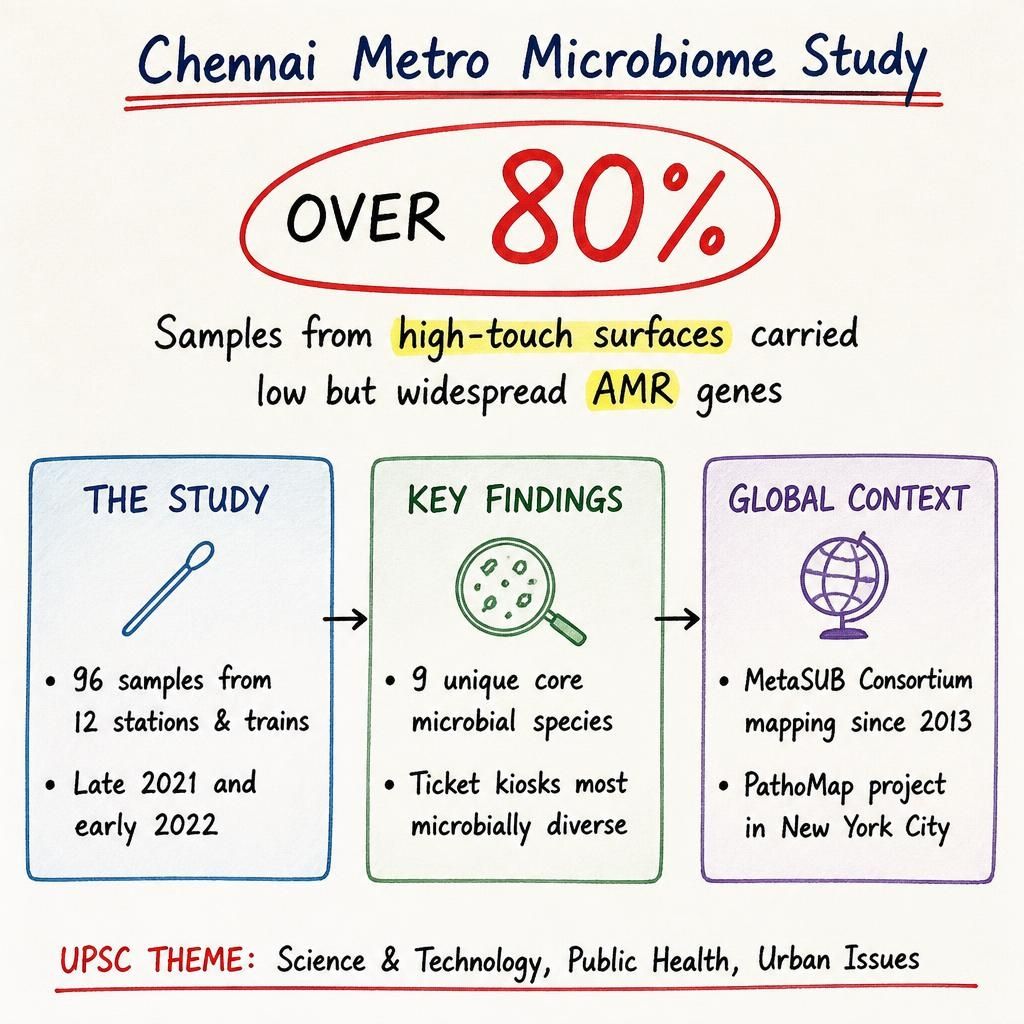
- Low but widespread AMR genes, particularly for sulfonamide and rifamycin resistance, were detected in over 80% of the samples collected from high-touch surfaces.
- Nine unique core microbial species, including salt-tolerant and human-skin-associated bacteria, were found to be specific to Chennai's metro environment.
- This research is the first of its kind in the Chennai Metro and underscores the importance of routine microbial and AMR surveillance in Indian public transport.
- Globally, initiatives like the PathoMap project in New York City and the MetaSUB International Consortium have been mapping urban microbiomes since 2013.
Microbiome Study.jpg
Detailed Insights:
- The study involved swabbing 96 samples from 12 stations and trains on Chennai Metro's Blue and Green Lines, targeting surfaces like handrails and ticket kiosks.
- Whole-genome metagenomic sequencing was employed to analyze 47 quality-controlled samples, providing a direct genetic analysis of the microbial communities.
- Ticket-vending kiosks were surprisingly found to be the most microbially diverse surfaces, even more so than train handrails.
- The widespread presence of AMR genes, even at low abundance, highlights a potential public health concern regarding the spread of drug resistance.
- The findings establish a baseline 'digital signature' of Chennai's urban microbiome, which is vital for future monitoring and understanding disease transmission risks.
- The MetaSUB International Consortium aims to create global geospatial metagenomic maps and track AMR markers in urban built environments.
- Previous international studies, such as in the Beijing subway, have identified the potential for transmission of highly resistant bacteria like carbapenem-resistant Enterobacteriaceae.
- Understanding urban microbiomes is crucial for developing effective public health strategies to mitigate pathogen and antibiotic resistance gene transmission in high-density transit settings.
Scientific/Technical Concepts Involved:
- Microbiome: The collection of all microorganisms (bacteria, fungi, viruses) living in a particular environment.
- Antimicrobial Resistance (AMR): The ability of microorganisms to resist the effects of an antimicrobial drug, making infections harder to treat.
- Metagenomics: The study of genetic material recovered directly from environmental samples, without culturing individual organisms.
- Transit Biome: The unique microbial community found within a public transportation system, influenced by local environmental and human factors.

SuperKalam is your personal mentor for UPSC preparation, guiding you at every step of the exam journey.
Download the App


STUDY RESOURCES
CONTACT US
ⓒ Snapstack Technologies Private Limited